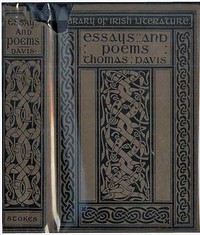
1. Thomas Davis. Selections from his Prose and Poetry. Edited by T. W. ROLLESTON, M.A. (Dublin).
2. Wild Sports of the West. W. H. MAXWELL. Edited by THE EARL OF DUNRAVEN.
3. Legends of Saints and Sinners from the Irish. Edited by DOUGLAS HYDE, LL.D. (Dublin).
4. Humours of Irish Life. Edited by CHARLES L. GRAVES, M.A. (Oxon).
5. Irish Orators and Oratory. Edited by T. M. KETTLE, National University of Ireland.
6. The Book of Irish Poetry. Edited by ALFRED PERCEVAL GRAVES, M.A. (Dublin).
Other Volumes in Preparation. Each Crown 8vo. Cloth, with Frontispiece net $1.00
INTRODUCTION.
In the present edition of Thomas Davis it is designed to offer a selection of his writings more fully representative than has hitherto appeared in one volume. The book opens with the best of his historical studies--his masterly vindication of the much-maligned Irish Parliament of James II.[1] Next follows a selection of his literary, historical and political articles from The Nation and other sources, and, finally, we present a selection from his poems, containing, it is hoped, everything of high and permanent value which he wrote in that medium. The "Address to the Historical Society" and the essay on "Udalism and Feudalism," which were reprinted in the edition of Davis's Prose Writings published by Walter Scott in 1890, are here omitted--the former because it seemed possible to fill with more valuable and mature work the space it would have taken, and the latter because the cause which it was written to support has in our day been practically won; Udalism will inevitably be the universal type of land-tenure in Ireland, and the real problem which we have before us is not how to win but how to make use of the institution, a matter with which Davis, in this essay, does not concern himself.
The life of Thomas Davis has been written by his friend and colleague, Sir Charles Gavan Duffy, and an excellent abridgment of it appears as a volume in the "New Irish Library." In the latter easily available form it may be hoped that there are few Irishmen who have not made themselves acquainted with it. It is not, therefore, necessary to deal with it here in much detail. Davis was born in Mallow on October 14th, 1814. His father, who came of a family originally Welsh, but long settled in Buckinghamshire, had been a surgeon in the Royal Artillery. His mother, Mary Atkins, came of a Cromwellian family settled in the County Cork. It does not seem an altogether hopeful kind of ancestry for an Irish Nationalist, and his family were, as a matter of fact, altogether of the other way of thinking. But the fact that his great-grandmother, on the maternal side, was a daughter of The O'Sullivan Beare may have had a counteracting influence, if not through the physical channel of heredity, at least through the poet's imagination. As a child, Davis was delicate in health, sensitive, dreamy, awkward, and passed for a dunce. It was not until he had entered Trinity College that the passion for study possessed him. This passion had manifestly been kindled, in the first instance, by the flame of patriotism, but how and when he first came to break loose from the traditional politics of his family we have no means of knowing, unless a gleam of light is thrown on the matter by a saying of his from a speech at Conciliation Hall:--"I was brought up in a mixed seminary,[2] where I learned to know, and knowing to love, my countrymen."
At the University he sought no academic distinctions, but read omnivorously. History, philosophy, economics, and ethics were the subjects into which he flung himself with ardour, and which, in after days, he was continually seeking to turn to the uses of his country. By the time he had left College and was called to the Bar (1837) he had disciplined himself by thought and study, and was a very different being from the dreamy and backward youth described for us by the candid friends of his schooldays. A dreamer, indeed, he always was, but he had learned from Bishop Butler, whom he reverenced profoundly and spoke of as "the Copernicus of ethics," that there is no practice more fatal to moral strength than dreaming divorced from action. Some concrete act, some definite thing to be done, was now always in his mind, but always, it may be added, as the realisation of some principle arrived at by serious and accurate thinking. He had acquired clear convictions, his powers of application were enormous, he had a boundless fertility of invention, and was manifestly marked out as a leader of men. It is interesting to go through the pages of Davis's Essays and to note how many of his practical suggestions for work to be done in Ireland have been taken up with success, especially in the direction of music and poetry, of the Gaelic language, and of the study of Irish archaeology and the protection of its remains. But a new Davis would mark with keener interest the many tasks which yet remain to be taken in hand.
His connection with the Bar was little more than nominal; from the beginning, the serious work of his life seemed destined to be journalism. After some experiments in various directions, he, with Gavan Duffy and John Blake Dillon, during a walk in the Phoenix Park in the spring of 1842, decided to establish a new weekly journal, to be entitled, on Davis's suggestion, The Nation. Its purpose, which it was afterwards to fulfil so nobly, was admirably expressed in its motto, taken from a saying of Stephen Woulfe: "To create and foster public opinion in Ireland, and to make it racy of the soil." Davis's was the suggestion of making national poems and ballads a prominent feature of the journal--the feature by which it became best known and did, perhaps, its most impressive, if not its most valuable, work. His "Lament for Owen Roe," which appeared in the sixth number, worked in Ireland like an electric shock, and woke a sleeping faculty to life and action. Henceforth Davis's public life was bound up with the Nation. Into this channel he threw all his powers. What kind of influence he exerted from that post of vantage the pages of this book will tell.
Davis was naturally a member of O'Connell's Repeal Association, but took no prominent part in its proceedings, except on one momentous occasion on which we must dwell for a while. The debate was on the subject of Peel's Bill for the establishment of a large scheme of non-sectarian education in Ireland. Of this measure Sir Charles Duffy writes:--
"A majority of the Catholic Bishops approved of the general design, objecting to certain details. All the barristers and country gentlemen in the Association, and the middle class generally, supported it. To Davis it was like the unhoped-for realization of a dream. To educate the young men of the middle class and of both races, and to educate them together, that prejudice and bigotry might be killed in the bud, was one of the projects nearest his heart. It would strengthen the soul of Ireland with knowledge, he said, and knit the creeds in liberal and trusting friendship."[3]
But O'Connell, though he had previously favoured the principle of mixed education, now saw a chance of flinging down a challenge to the "Young Irelanders" from a vantage-ground of immense tactical value. He threw his whole weight against the proposal, taunted and interrupted its supporters, and seemed determined at any cost to wreck the measure on which such high hopes had been set. The emotion which Davis felt, and which caused him to burst into tears in the midst of the debate, seemed to some of his friends at the time over-strained. But he was not the first strong man from whom public calamities have drawn tears; and assuredly if ever there were cause for tears, Davis had reason to shed them then. More, perhaps, than any man present, he realised the fateful nature of the decision which was being made. He knew that one of the governing facts about Irish public life is the existence in the country of two races who remain life-long strangers to each other. Catholic and Protestant present to each other a familiar front, but behind the surface of each is a dark background which in later life, when associations, and often prejudices, have been formed, the other can rarely penetrate and rarely wishes to do so. It was Davis's belief that if the young people of Ireland were to be permanently segregated from childhood to manhood in different schools, different universities, where early friendships, the most intimate and familiar of any, could never be made, and ideas never interchanged except through public controversy, the barrier between the two Irish races would be infinitely difficult to break down, and no scheme of Irish government could be conceived which would not seem like a triumph to one of them and bondage to the other. The views of the Young Irelanders did not prevail, and Ireland as a nation has paid the penalty for two generations, and will probably pay it for many a day to come. It may, of course, be argued that religious interests are paramount, and that these are incompatible with a scheme of mixed education. This is not the place to debate such a question, nor can anyone quarrel with a decision arrived at on such grounds. But let it be arrived at with a clear understanding of the certain consequences, and let it be admitted that when Davis saw the wreck of the scheme for united education he felt truly that a long and perhaps, for many generations, irretrievable step was being taken away from the road to nationhood.
But after this despondent reflection, let us cheer ourselves by setting the proud and moving words with which Duffy concludes his account of the transactions in the Life of Davis:--
"I have not tacked to any transaction in this narrative the moral which it suggests; the thoughtful reader prefers to draw his own conclusions. But for once I ask those to whom this book is dedicated to note the conduct of Catholic young men in a mortal contest. The hereditary leader of the people, sure to be backed by the whole force of the unreflecting masses, and supported on this occasion by the bulk of the national clergy--a man of genius, an historic man wielding an authority made august by a life's services, a solemn moral authority with which it is ridiculous to compare the purely political influence of anyone who has succeeded him as a tribune of the people--was against Thomas Davis, and able, no one doubted, to overwhelm him and his sympathisers in political ruin. A public career might be closed for all of us; our journal might be extinguished; we were already denounced as intriguers and infidels; it was quite certain that, by-and-by, we would be described as hirelings of the Castle. But Davis was right; and of all his associates, not one man flinched from his side--not one man. A crisis bringing character to a sharper test has never arisen in our history, nor can ever arise; and the conduct of these men, it seems to me, is some guarantee how their successors would act in any similar emergency."