Public-domain ebook
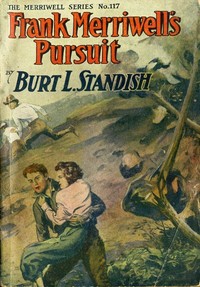
Frank Merriwell's Pursuit; Or, How to Win
Language: en5,867 downloads on Project Gutenberg
Subjects
In: Children's Book Series·Adventure·Novels
Public-domain ebook sourced from Project Gutenberg #22874.
Public-domain ebook
Language: en5,867 downloads on Project Gutenberg
Subjects
In: Children's Book Series·Adventure·Novels
Public-domain ebook sourced from Project Gutenberg #22874.
Frank Merriwell’s Pursuit is a fast‑moving juvenile adventure that thrusts its heroes into a night‑time trek across a bleak New England landscape. The story opens with a wounded man, bandaged and delirious, demanding whisky to steady his nerves before a desperate ride to Elizabethtown. His companions scramble to secure horses, negotiate payment, and battle the cold, dark forest as they ferry their injured friend toward a physician’s care. The narrative quickly establishes a pattern of danger, loyalty, and quick‑thinking bargains, setting the stage for a larger conflict that will involve gunfire, a mysterious bullet, and a vow of vengeance against the elusive Frank Merriwell.
The prose reflects the brisk, dialogue‑heavy style of early twentieth‑century boys’ magazines, with a straightforward, earnest voice that emphasizes physical courage and moral resolve. Its episodic pacing, vivid descriptions of rugged travel, and colorful, if occasionally exaggerated, speech make it appealing to readers who enjoy classic, action‑filled tales of youthful heroism. Fans of period adventure stories, especially those who appreciate a blend of frontier grit and school‑yard bravado, will find this work an engaging snapshot of its era.
The opening · free to read
The man outside, however, would not listen to this, but insisted that the journey to Elizabethtown must be made that night. He returned to his companions, and the mounted man was assisted to descend from the saddle. One of them held his arm while he walked into the house, and the other took care of the horse.
The lamp showed that the injured one had bloody bandages wrapped about his head. He was pale and haggard, and there was an expression of anxiety in his dark eyes. At times he pulled nervously at his small, dark mustache.
"Bring that whisky at once," said the wounded man's companion, as he assisted the other to a chair. "He needs a nip of it, and needs it bad."
The whisky was brought, and the injured man drank from the bottle. As he lifted it to his lips, he murmured:
"May the fiends take the dog who fired that bullet! May he burn forever in the fires below!"
The liquor seemed to revive him somewhat, and he straightened up a little, joining his companion in urging the man who had procured the whisky to secure horses and guide them, over the road to Elizabethtown.
"We have money enough," he said, fumbling weakly in his pockets and producing a roll of bills. "We will pay you every cent agreed upon. Why don't you hasten? Do you wish to see me die here in your wretched hut?"
The man addressed promised to lose no time, and soon hurried out into the night. He was not gone more than thirty minutes. Those waiting his return heard hoofbeats, and the light shining from the open door of the cabin fell on three horses as they stepped outside.
"It's fifty in advance and fifty when we reach Elizabethtown," he said, as he sprang off. "I will not start till the first fifty is paid."
"Pay him the whole of it," said the wounded man, "and shoot him full of lead if he fails to keep his part of the bargain."
Stimulated by the whisky, this man had revived wonderfully, and soon the four rode out of Keene on the road that followed the river southward.
Through the long hours of that black night the guide led them on their journey. The road was indeed a wretched one, winding through deep forests, over rocky hills and traversing gloomy valleys. As the night advanced it grew colder until their teeth chattered and their blood seemed stagnating in their veins. Many times they paused to give the wounded one a drink from the bottle. Often this man was heard cursing in Spanish and declaring that the distance was nearer a hundred miles than twenty-five.
Morning was at hand when, exhausted and wretched, they entered Elizabethtown. Soon they were clamoring at the door of a physician, into whose home the wounded man was assisted as soon as the door was opened.
"Examine my head at once, doctor," he faintly urged, as he sat back in a big armchair. "Find out where that infernal bullet is. Tell me if it's somewhere inside my skull, and if I have a chance of recovery."
In a short time the bandages were removed and the doctor began his examination.
"Well! well!" he exclaimed, as he saw where the bullet had entered. "How long ago did this happen? Yesterday afternoon? Forty miles from here? And you came all this distance? Well, you have sand! At first glance one would suppose the ball had gone straight through your head. It struck the frontal bone and was deflected, following over the coronal suture, and here it is lodged in your scalp at the back of your head. I will have it out in a moment."
He worked swiftly, clipping away the hair with a pair of scissors, and then with a lance he made an incision and straightened up a moment later, having a flattened piece of lead in his hand.
"My friend," he said, "you have grit, and I don't think you'll be laid up very long with that wound. You're not at all seriously injured. It must have been fired from some one below you. Was he shooting at a deer?"
"Yes, senor," was the answer.
"Very strange," said the physician. "This is a thirty-two-calibre bullet, and it's not like the kind used to shoot deer. Most remarkable."
He hastened to cleanse and dress the wound, again bandaging the man's head.
"You are certain, senor, that this injury is not serious?" questioned the wounded man, when everything had been done.
"I see no reason why it should be," was the answer. "It is not liable to give serious trouble to a man of your stamina, endurance, and nerve."
The doctor's bill was paid, and then they sought a hotel, where they found accommodations, and the wounded one was put into bed. Ere getting into bed he shook hands with his two companions and said:
"It's not easy, senors, to kill one in whose veins runs the blood of old Guerrero. They thought me dead, but the dog that fired the shot shall pay the penalty of his treachery, and I swear I will yet crush Frank Merriwell as the panther crushes the doe. That's the oath of Porfias del Norte!"
Watson Scott, familiarly known as Old Gripper, was a man of great hardihood and endurance, and, therefore, for all of his recent experience with Frank Merriwell's enemies, for all that he had been imprisoned by his captors in a natural well and had stood for hours in water up to his hips, he rapidly recovered after arriving once more at the cottage of his friend and business associate, Warren Hatch, on Lake Placid.
But Old Gripper had been aroused, and he was determined to make it hot for his recent captors, who, led by Porfias del Norte, had gone to desperate lengths to obtain valuable papers which were the basis of a business combination that threatened the interests of Del Norte and his associates.
"Unless they move on the jump I'll have the bunch of them nipped before long," Old Gripper declared.
To his vexation he found it was impossible to properly swear out a warrant for the arrest of Del Norte's companions without making the journey to Saranac Lake.
"I'll do that the first thing in the morning," he said.
In the morning, however, he found himself stiff and lame, and he was induced to delay until noon.
During the forenoon he decided to return without further delay to New York. Having settled on this, he sent a message to Saranac Lake, stating his charges against Porfias del Norte's band of desperadoes, and asking that the warrant be drawn up and brought to him at the station as he was passing through. He also gave instructions that officers should be on hand to immediately take up the work of running the gang down.
Before noon Belmont Bland, Old Gripper's private secretary, was apparently taken ill, and when the time came for Scott to depart Bland seemed unable to travel. He asserted that it was one of his usual nervous attacks, and declared he would be all right by the next day. Therefore it was arranged that he should remain at Lake Placid.
Frank Merriwell had given in to the urging of Warren Hatch, who almost begged him to stay over another day and fish again in the morning.
"It's not often I strike a fisherman after my own heart," said Hatch. "When I do I don't like to let him slip through my fingers. Stay over until to-morrow at least, Merriwell. There is no reason why you should tear away in such a hurry."
"You can stay, Merriwell," declared Scott. "We have settled the railroad deal right here. Bragg and I will get things to moving in the city. Leave that to us."
"I'm very willing to leave it to you," laughed Frank. "I'll stay one more day, Mr. Hatch."
"If we can have another good morning to fish--ah, we won't do a thing!" chuckled Hatch, ending with a cough.
"You ought to stay up here for the next month," declared Old Gripper. "That cough of yours----"
"Oh, it's nothing! I've had it for a year, and it's not serious in any way--only annoying."
The book keeps going
Reading is free forever. Sign up and watch scenes appear while you read.



Scenes Storieta drew for other classics.
New illustrated classics
Once or twice a month: the latest books to get full character casts, scene art, and free comic editions. No account needed.