Storieta
English
Save & sign up
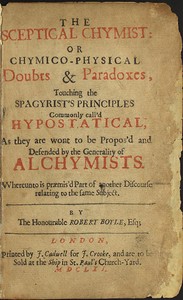
Cover of The Sceptical Chymist or Chymico-Physical Doubts & Paradoxes, Touching the Spagyrist's Principles Commonly call'd Hypostatical; As they are wont to be Propos'd and Defended by the Generality of Alchymists. Whereunto is præmis'd Part of another Discourse relating to the same Subject.

Public-domain ebook

The Sceptical Chymist or Chymico-Physical Doubts & Paradoxes, Touching the Spagyrist's Principles Commonly call'd Hypostatical; As they are wont to be Propos'd and Defended by the Generality of Alchymists. Whereunto is præmis'd Part of another Discourse relating to the same Subject.

by Robert Boyle

Language: en9,050 downloads on Project Gutenberg

Subjects

In: Chemistry·Classics of Literature·History - Early Modern (c. 1450-1750)

Public-domain ebook sourced from Project Gutenberg #22914.

About this book

Robert Boyle’s The Sceptical Chymist is a seventeenth‑century scientific tract that reads more like a series of debates than a conventional laboratory manual. The work opens with a detailed transcriber’s note that explains the preservation of the original 1661 printing’s irregular spelling, punctuation, and occasional printer’s errors, followed by a full title page and a contents list that divides the treatise into a preface, introductory physiological considerations, and six numbered parts plus a conclusion. In the preface Boyle explains why the manuscript has reached the public in a “maim’d and imperfect” state, recounts his earlier attempts to balance skepticism toward both Aristotelian and alchemical doctrines, and promises a collection of experiments and arguments intended to clarify the nature of the elements for any reader familiar with the usual chymical terminology.

The voice is unmistakably that of a learned gentleman of the Restoration period, employing elaborate rhetorical flourishes, classical allusions, and a mixture of Latin, Greek, and early modern English spelling. Boyle’s style is both polemical and methodical, as he positions himself as a “Carneades” who challenges the prevailing alchemical orthodoxy while offering his own experimental observations. Readers who enjoy the history of chemistry, the philosophy of science, or the intellectual clashes between early modern natural philosophers will find this work rewarding. Its dense, argumentative prose and occasional archaic spelling make it best suited to scholars, graduate students, or enthusiasts comfortable navigating eighteenth‑century scientific literature.

The opening · free to read

This e-book was prepared from a facsimile of the 1661 first edition and contains spelling, capitalization, and punctuation inconsistencies typical of the era. These have been preserved as they appear in the original.

Printer errors have also been preserved. Those mentioned in the Errata at the end of the book are noted with [Errata: corrected text]. Other obvious printer errors are noted with [Transcriber's Note: corrected text] where the meaning might be unclear without the correction. See also the printer's note preceding the Errata, which contains material omitted from the text (the place where it should be inserted is marked in the text with a Transcriber's Note).

There are a number of sidenotes in this book, most of which function as footnotes (e.g., citations to other works) and some of which function as true sidenotes. For the sake of clarity, sidenotes functioning as footnotes have been converted to numbered footnotes, with number markers at appropriate places in the text.

A character with a macron is represented by an equal sign. E.g., [=a] indicates "a" with macron.

A table of contents has been provided for the reader's convenience.

The book keeps going

Keep reading, and see it illustrated

Reading is free forever. Sign up and watch scenes appear while you read.

Illustrated scene from Alice's Adventures in WonderlandIllustrated scene from The Adventures of Sherlock HolmesIllustrated scene from Frankenstein

Scenes Storieta drew for other classics.

New illustrated classics

A new classic, drawn, in your inbox.

Once or twice a month: the latest books to get full character casts, scene art, and free comic editions. No account needed.