Public-domain ebook
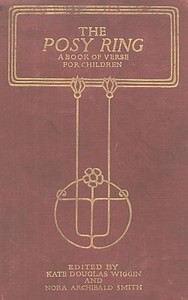
The Posy Ring: A Book of Verse for Children
Language: en5,410 downloads on Project Gutenberg
Subjects
In: Punch·Children & Young Adult Reading·Poetry
Public-domain ebook sourced from Project Gutenberg #22922.
Public-domain ebook
Language: en5,410 downloads on Project Gutenberg
Subjects
In: Punch·Children & Young Adult Reading·Poetry
Public-domain ebook sourced from Project Gutenberg #22922.
The Posy Ring is a sprawling anthology that gathers together a hundred‑plus verses for young readers, drawn from the work of such nineteenth‑ and early‑twentieth‑century poets as Robert Louis Stevenson, Christina G. Rossetti, Emily Dickinson, and Rudyard Kipling. The volume opens with a whimsical “Lilliput Notice” by William Brighty Rands, a mock‑official proclamation that frames the collection as a treasure chest of poems left at the gate of a fanciful “Pinafore Palace.” From there the book proceeds through a series of seasonal sections, “A Year’s Windfalls,” “The Child’s World,” “The Flower Folk,” and “Play‑Time”, each introduced by a short poem and followed by a litany of titles ranging from “Windy Nights” to “Wynken, Blynken, and Nod.” The contents page reads like a literary promenade, offering a taste of the varied voices and subjects that await within.
The verses are rendered in the lyrical, often rhymed style typical of Victorian and Edwardian children’s poetry, with a gentle didactic tone that celebrates nature, imagination, and the rhythms of daily life. The language is straightforward yet richly descriptive, making the collection appealing to readers who enjoy classic nursery‑rhyme charm as well as to educators seeking historical examples of poetry for children. Those who appreciate the musicality of poets such as Wordsworth, Tennyson, and Kipling, or who wish to explore a wide swath of early‑modern American and British verse, will find this compendium a rewarding and evocative reading experience.
The opening · free to read
When at home alone I sit And am very tired of it, I have just to shut my eyes To go sailing through the skies-- To go sailing far away To the pleasant Land of Play; To the fairy land afar Where the Little People are; Where the clover-tops are trees, And the rain-pools are the seas, And the leaves like little ships Sail about on tiny trips; And above the daisy tree Through the grasses, High o'erhead the Bumble Bee Hums and passes.
In that forest to and fro I can wander, I can go; See the spider and the fly, And the ants go marching by Carrying parcels with their feet Down the green and grassy street. I can in the sorrel sit Where the ladybird alit. I can climb the jointed grass; And on high See the greater swallows pass In the sky, And the round sun rolling by Heeding no such thing as I.
Through the forest I can pass Till, as in a looking-glass, Humming fly and daisy tree And my tiny self I see, Painted very clear and neat On the rain-pool at my feet. Should a leaflet come to land Drifting near to where I stand, Straight I'll board that tiny boat Round the rain-pool sea to float.
Little thoughtful creatures sit On the grassy coasts of it; Little things with lovely eyes See me sailing with surprise. Some are clad in armour green-- (These have sure to battle been!) Some are pied with ev'ry hue, Black and crimson, gold and blue; Some have wings and swift are gone:-- But they all look kindly on.
When my eyes I once again Open and see all things plain; High bare walls, great bare floor; Great big knobs on drawer and door; Great big people perched on chairs, Stitching tucks and mending tears, Each a hill that I could climb, And talking nonsense all the time-- O dear me, That I could be A sailor on the rain-pool sea, A climber in the clover-tree, And just come back, a sleepy-head, Late at night to go to bed.
Robert Louis Stevenson.
Baby, see the flowers! Baby sees Fairer things than these, Fairer though they be than dreams of ours. Baby, hear the birds! Baby knows Better songs than those, Sweeter though they sound than sweetest words.
Baby, see the moon! Baby's eyes Laugh to watch it rise, Answering light with love and night with noon.
Baby, hear the sea! Baby's face Takes a graver grace, Touched with wonder what the sound may be.
Baby, see the star! Baby's hand Opens, warm and bland, Calm in claim of all things fair that are.
Baby, hear the bells! Baby's head Bows as ripe for bed, Now the flowers curl round and close their cells.
Baby, flower of light, Sleep and see Brighter dreams than we, Till good day shall smile away good night.
Little Gustava sits in the sun, Safe in the porch, and the little drops run From the icicles under the eaves so fast, For the bright spring sun shines warm at last, And glad is little Gustava.
She wears a quaint little scarlet cap, And a little green bowl she holds in her lap, Filled with bread and milk to the brim, And a wreath of marigolds round the rim. "Ha! ha!" laughs little Gustava.
Up comes her little gray coaxing cat With her little pink nose, and she mews, "What's that?" Gustava feeds her,--she begs for more; And a little brown hen walks in at the door "Good day!" cries little Gustava.
She scatters crumbs for the little brown hen. There comes a rush and a flutter, and then Down fly her little white doves so sweet, With their snowy wings and crimson feet: "Welcome!" cries little Gustava.
So dainty and eager they pick up the crumbs. But who is this through the doorway comes? Little Scotch terrier, little dog Rags, Looks in her face, and his funny tail wags: "Ha, ha!" laughs little Gustava.
"You want some breakfast too?" and down She sets her bowl on brick floor brown; And little dog Rags drinks up her milk, While she strokes his shaggy locks like silk: "Dear Rags!" says little Gustava.
Waiting without stood sparrow and crow, Cooling their feet in the melting snow: "Won't you come in, good folk?" she cried. But they were too bashful, and stood outside Though "Pray come in!" cried Gustava.
So the last she threw them, and knelt on the mat With doves and biddy and dog and cat. And her mother came to the open house-door "Dear little daughter, I bring you some more. My merry little Gustava!"
Kitty and terrier, biddy and doves, All things harmless Gustava loves. The shy, kind creatures 'tis joy to feed, And oh her breakfast is sweet indeed To happy little Gustava!
Celia Thaxter.
The rosy mouth and rosy toe Of little baby brother, Until about a month ago Had never met each other; But nowadays the neighbours sweet, In every sort of weather, Half way with rosy fingers meet, To kiss and play together.
John B. Tabb.
Long, long before the Babe could speak, When he would kiss his mother's cheek And to her bosom press, The brightest angels standing near Would turn away to hide a tear-- For they are motherless.
And when,--its force expended, The harmless storm was ended, And as the sunrise splendid Came blushing o'er the sea-- I thought, as day was breaking, My little girls were waking, And smiling and making A prayer at home for me.
William Makepeace Thackeray.
"To-night will be a stormy night-- You to the town must go: And take a lantern, child, to light Your mother through the snow."
"That, father, will I gladly do: 'Tis scarcely afternoon-- The minster-clock has just struck two; And yonder is the moon."
At this the father raised his hook, And snapped a faggot-band; He plied his work;--and Lucy took The lantern in her hand.
Not blither is the mountain roe: With many a wanton stroke Her feet disperse the powdery snow, That rises up like smoke.
The storm came on before its time She wandered up and down; And many a hill did Lucy climb, But never reached the town.
The wretched parents all that night Went shouting far and wide; But there was neither sound nor sight To serve them for a guide.
At daybreak on a hill they stood That overlooked the moor; And thence they saw the bridge of wood, A furlong from their door.
They wept--and, turning homeward, cried, "In heaven we all shall meet!" When in the snow the mother spied The print of Lucy's feet.
Then downwards from the steep hill's edge They tracked the footmarks small; And through the broken hawthorn hedge, And by the low stone wall:
And then an open field they crossed; The marks were still the same; They tracked them on, nor ever lost; And to the bridge they came.
They follow from the snowy bank Those footmarks, one by one, Into the middle of the plank; And further there were none!
--Yet some maintain that to this day She is a living child; That you may see sweet Lucy Gray Upon the lonesome wild.
O'er rough and smooth she trips along, And never looks behind; And sings a solitary song That whistles in the wind.
The book keeps going
Reading is free forever. Sign up and watch scenes appear while you read.



Scenes Storieta drew for other classics.
New illustrated classics
Once or twice a month: the latest books to get full character casts, scene art, and free comic editions. No account needed.