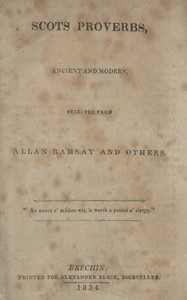
The Proverbs of Scotland
Public-domain ebook
The Proverbs of Scotland
Language: en7,399 downloads on Project Gutenberg
Subjects
In: Mythology, Legends & Folklore
Public-domain ebook sourced from Project Gutenberg #26150.
Public-domain ebook
Language: en7,399 downloads on Project Gutenberg
Subjects
In: Mythology, Legends & Folklore
Public-domain ebook sourced from Project Gutenberg #26150.
The work is a compendium of Scottish sayings assembled by Alexander Hislop, presented as a series of proverb‑like statements followed by brief glosses or anecdotes. The opening pages already reveal the book’s structure: a terse maxim, often rendered in Scots dialect, appears, then an explanatory note that cites a source, a literary quotation, or a folk explanation. The material ranges from practical advice (“Cut your coat according to your cloth”) to moral observations (“Do what ye ought and let come what will”) and includes references to Burns, Scott, Jamieson and other authorities, giving each proverb a cultural context. The collection is organized alphabetically, allowing the reader to wander through the breadth of Scottish folk wisdom as it was recorded in the nineteenth‑century.
Hislop’s voice is that of a diligent antiquarian, employing the vernacular spelling of the period while interspersing scholarly asides. The style is concise, often humorous, and steeped in the idiom of the Highlands and Lowlands, reflecting a time when oral tradition was being codified. Readers who enjoy linguistic curiosities, cultural history, or the flavor of regional aphorisms will find this volume rewarding, especially those with an interest in the interplay between everyday speech and literary citation in early‑modern Scotland.
Ye suld munt up a muckle square of canvass, like Dick Tinto, and paint folk's ainsells, that they like muckle better to see than ony craig in the haill water; and I wadna muckle objeck even to some of the Wallers coming up and sitting to ye. They waste their time war, I wis—and, I warrant, ye might mak a guinea a-head of them. Dick made twa, but he was an auld used hand, and folk maun creep before they gang."— St Ronan's Well. Cripples are aye better planners than workers. Cripples are aye great doers—break your leg and try. People who are always very ready to give advice are generally slow in giving assistance. "Crookit carlin," quo' the cripple to his wife. "Oh wad some power the giftie gie us To see oursels as others see us! It wad frae mony a blunder free us, And foolish notion." —Burns. Cry a' at ance, that's the way to be served. Curses mak the tod fat. …
Keep reading free · start reading with no account
New illustrated classics
Once or twice a month: the latest books to get full character casts, scene art, and free comic editions. No account needed.