Public-domain ebook
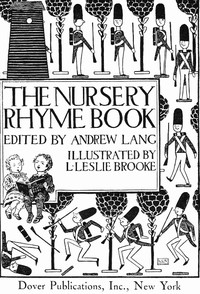
The Nursery Rhyme Book
Language: en5,328 downloads on Project Gutenberg
Subjects
In: Children & Young Adult Reading·Poetry·Mythology, Legends & Folklore
Public-domain ebook sourced from Project Gutenberg #26197.
Public-domain ebook
Language: en5,328 downloads on Project Gutenberg
Subjects
In: Children & Young Adult Reading·Poetry·Mythology, Legends & Folklore
Public-domain ebook sourced from Project Gutenberg #26197.
The Nursery Rhyme Book is a sprawling anthology that gathers together the familiar verses of childhood alongside a bewildering assortment of historical asides, riddles, charms and game‑songs. Its opening pages set the tone with a nostalgic narrator recalling the cracked, picture‑laden volumes that once filled a wooden box in a childhood library, and the way those rhymes taught him to read “without tears.” From “Who Killed Cock Robin?” to the obscure verses about Charley, King Arthur and the Prince of Wales, the collection is organized into clearly labelled sections, Historical, Literal and Scholastic, Tales, Proverbs, Songs, Riddles and Paradoxes, and so on, each introduced by a brief heading and often accompanied by period illustrations. The reader is invited to wander through a mosaic of folklore, nursery lore and occasional commentary on the people and events that have been woven into the verses over three centuries.
The voice is that of a reflective, slightly rambling adult who remembers the rhymes as both playthings and primers for language, while the style swings between straightforward recitation and digressive, almost essay‑like commentary. The language is unmistakably early‑modern English, peppered with Scots dialect and occasional French, reflecting the book’s origins in the 17th‑ and 18th‑century oral tradition. Those who will enjoy it are readers who love the sound of familiar verses but also appreciate the cultural and historical layers that surround them, scholars of folklore, parents looking to share the songs of their own youth, and anyone curious about how nursery rhymes have been catalogued, illustrated and linked to the larger tapestry of British and European history.
The opening · free to read
About the people mentioned in this book:--We do not exactly know who Old King Cole was, but King Arthur must have reigned some time about 500 to 600 A.D. As a child grows up, he will, if he is fond of poetry, read thousands of lines about this Prince, and the Table Round where his Knights dined, and how four weeping Queens carried him from his last fight to Avalon, a country where the apple-trees are always in bloom. But the reader will never forget the bag-pudding, which "the Queen next morning fried." Her name was Guinevere, and the historian says that she "was a true lover, and therefore made she a good end." But she had a great deal of unhappiness in her life.
I cannot tell what King of France went up the hill with twenty thousand men, and did nothing when he got there. But I do know who Charley was that "loved good ale and wine," and also "loved good brandy," and was fond of a pretty girl, "as sweet as sugar-candy." This was the banished Prince of Wales, who tried to win back his father's kingdom more than a hundred years ago, and gained battles, and took cities, and would have recovered the throne if his officers had followed him. But he was as unfortunate as he was brave, and when he had no longer a chance, perhaps he did love good ale and wine rather too dearly. As for the pretty girls, they all ran after him, and he could not run away like Georgey Porgey. There is plenty of poetry about Charley, as well as about King Arthur.
About King Charles the First, "upon a black horse," a child will soon hear at least as much as he can want, and perhaps his heart "will be ready to burst," as the rhyme says, with sorrow for the unhappy King. After he had his head cut off, "the Parliament soldiers went to the King," that is, to his son Charles, and crowned him in his turn, but he was thought a little too gay. Then we come to the King "who had a daughter fair, and gave the Prince of Orange her."
"O what's the rhyme to porringer? Ken ye the rhyme to porringer? King James the Seventh had ae dochter, And he gave her to an Oranger.
Ken ye how he requited him? Ken ye how he requited him? The lad has into England come, And ta'en the crown in spite o' him.
The dog, he shall na keep it lang, To flinch we'll make him fain again; We'll hing him hie upon a tree, And James shall have his ain again."
The truth is, that the Prince of Orange and the King's daughter fair (really a very pretty lady, with a very ugly husband) were not at all kind to the King, but turned him out of England. He was the grandfather of Charley who loved good ale and wine, and who very nearly turned out King Georgey Porgey, a German who "kissed the girls and made them cry," as the poet likewise says. Georgey was not a handsome King, and nobody cared much for him; and if any poetry was made about him, it was very bad stuff, and all the world has forgotten it. He had a son called Fred, who was killed by a cricket-ball--an honourable death. A poem was made when Fred died:--
"Here lies Fred, Who was alive and is dead. If it had been his father, I would much rather; If it had been his brother, Still better than another; If it had been his sister, No one would have missed her; If it had been the whole generation, So much the better for the nation. But as it's only Fred, Who was alive and is dead, Why there's no more to be said."
This poet seems to have preferred Charley, who wore a white rose in his bonnet, and was much handsomer than Fred.
Another rhyme tells about Jim and George, and how Jim got George by the nose. This Jim was Charley's father, and the George whom he "got by the nose" was Georgey Porgey, the fat German. Jim was born on June 10; so another song says--
"Of all the days that's in the year, The Tenth of June to me's most dear, When our White Roses will appear To welcome Jamie the Rover."
But, somehow, George really got Jim by the nose, in spite of what the poet says; for it does not do to believe all the history in song-books.
After these songs there is not much really useful information in the Nursery Rhymes. Simple Simon was not Simon Fraser of Lovat, who was sometimes on Jim's side, and sometimes on George's, till he got his head cut off by King George. That Simon was not simple.
The Babes in the Wood you may read about here and in longer poems; for instance, in a book called "The Ingoldsby Legends." It was their wicked uncle who lost them in the wood, because he wanted their money. Uncles were exceedingly bad long ago, and often smothered their nephews in the Tower, or put out their eyes with red-hot irons. But now uncles are the kindest people in the world, as every child knows.
About Brian O'Lin there is more than this book says:--
"Brian O'Lin had no breeches to wear; He bought him a sheepskin to make him a pair, The woolly side out, and the other side in: 'It's pleasant and cool,' says Brian O'Lin."
He is also called Tom o' the Lin, and seems to have been connected with Young Tamlane, who was carried away by the Fairy Queen, and brought back to earth by his true love. Little Jack Horner lived at a place called Mells, in Somerset, in the time of Henry VIII. The plum he got was an estate which had belonged to the priests. I find nobody else here about whom history teaches us till we come to Dr. Faustus. He was not "a very good man"; that is a mistake, or the poem was written by a friend of the Doctor's. In reality he was a wizard, and raised up Helen of Troy from the other world, the most beautiful woman who ever was seen. Dr. Faustus made an agreement with Bogie, who, after the Doctor had been gay for a long time, came and carried him off in a flash of fire. You can read about it all in several books, when you are a good deal older. Dr. Faustus was a German, and the best play about him is by a German poet.
As to Tom the Piper's Son, he was probably the son of a Highlander, for they were mostly on Charley's side, who was "Over the hills and far away." Another song says--
"There was a wind, it came to me Over the south and over the sea, And it has blown my corn and hay Over the hills and far away. But though it left me bare indeed, And blew my bonnet off my head, There's something hid in Highland brae, It has not blown my sword away. Then o'er the hills and over the dales, Over all England, and thro' Wales, The broadsword yet shall bear the sway, Over the hills and far away!"
Tom piped this tune, and pleased both the girls and boys.
About the two birds that sat on a stone, on the "All-Alone Stone," you can read in a book called "The Water-Babies."
Concerning the Frog that lived in a well, and how he married a King's daughter and was changed into a beautiful Prince, there is a fairy tale which an industrious child ought to read. The frog in the rhyme is not nearly so lucky.
After these rhymes there come a number of riddles, of which the answers are given. Then there are charms, which people used to think would help in butter-making or would cure diseases. It is not generally thought now that they are of much use, but there can be no harm in trying. Nobody will be burned now for saying these charms, like the poor old witches long ago. The Queen Anne mentioned on page 172 was the sister of the other Princess who married the Prince of Orange, and she was Charley's aunt. She had seventeen children, and only one lived to be as old as ten years. He was a nice boy, and had a regiment of boy-soldiers.
"Hickory Dickory Dock" is a rhyme for counting out a lot of children. The child on whom the last word falls has to run after the others in the game of "Tig" or "Chevy." There is another of the same kind:--
"Onery Twoery Tickery Tin Alamacrack Tenamalin Pin Pan Musky Dan Tweedleum Twiddleum Twenty-one Black fish White trout Eery, Ory You are out."
Most of the rhymes in this part of the book are sung in games and dances by children, and are very pretty to see and hear. They are very old, too, and in an old book of travels in England by a Danish gentleman, he gives one which he heard sung by children when Charles II. was king. They still sing it in the North of Scotland.
In this collection there are nonsense songs to sing to babies to make them fall asleep.
Bessy Bell and Mary Gray, on page 207, were two young ladies in Scotland long ago. The plague came to Perth, where they lived, so they built a bower in a wood, far off the town. But their lovers came to see them in the bower, and brought the infection of the plague, and they both died. There is a little churchyard and a ruined church in Scotland, where the people who died of the plague, more than two hundred years ago, were buried, and we used to believe that if the ground was stirred, the plague would fly out again, like a yellow cloud, and kill everybody.
There is a French rhyme like "Blue-Eye Beauty"--
"_Les yeux bleus_ Vont aux cieux. Les yeux gris Vont a Paradis. Les yeux noirs Vont a Purgatoire."
None of the other rhymes seem to be anything but nonsense, and nonsense is a very good thing in its way, especially with pictures. Any child who likes can get Mrs. Markham's "History of England," and read about the Jims, and Georges, and Charleys, but I scarcely think that such children are very common. However, the facts about these famous people are told here shortly, and if there is any more to be said about Jack and Jill, I am sure I don't know what it is, or where the hill they sat on is to be found in the geography books.
The book keeps going
Reading is free forever. Sign up and watch scenes appear while you read.



Scenes Storieta drew for other classics.
New illustrated classics
Once or twice a month: the latest books to get full character casts, scene art, and free comic editions. No account needed.