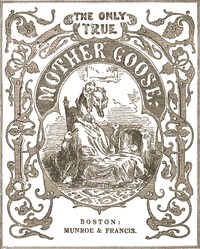
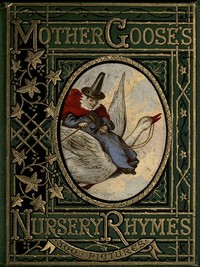
Mr. Editor:--Your correspondent, N.B.S., has so decisively given a quietus to the question as to the birthplace of Cotton Mather, that there is no danger of its ever being revived again. But there is another question of equal importance to many, to the literary world in particular, which should in like manner be put to rest. Who was Mother Goose? and when were her melodies first given to the world? These are questions which have been often asked, but have never been satisfactorily answered. The recent publication of a book called "Mother Goose for Old Folks" has again revived these questions, which serves to show that the subject has not yet lost its interest.
Many persons imagine that Mother Goose is a myth,--that no such person ever existed. This is a mistake. Mother Goose was not only a veritable personage, but was born and resided many years in Boston, where many of her descendants may now be found. The last that bore the ancient paternal cognomen died about the year 1807, and was buried in the Old Granary Burying Ground, where probably lie the remains of the whole blood, if we may judge from the numerous grave-stones which mark their resting place. The family originated in England, but at what time they came to this country is unknown,--but probably about the year 1656. This was the "_Wealthy family of Goose_" which is immortalized by Mr. Bowditch in his book of Suffolk Names, who at the same time has immortalized himself. They were landholders in Boston, so early as 1660. Nearly half the space between West and Winter streets, on Washington street, and extending westerly towards Tremont street, 275 feet belonged to this family, as did also a large tract of land on Essex, Rowe and Bedford streets, upon which now stand two churches and a large number of dwelling houses. So much for Mother Goose. Now for her melodies.
It is well known to antiquarians that more than two hundred years ago there was a small book in circulation in London bearing the name of "Rhymes for the nursery; or Lulla-Byes for Children," which contained many of the identical pieces which have been handed down to us and now form part of the "Mother Goose's Melodies" of the present day. It contained also other pieces much more silly, if possible, and some that the American types of the present day would refuse to give off an impression. The "cuts" or illustrations thereof were of the coarsest description.
The first book of the kind known to be printed in this country bears the title of "_Songs for the Nursery; or, Mother Goose's Melodies_ for Children." Something probably intended to represent a goose with a very long neck and mouth wide open, covered a large part of the title page, at the bottom of which, Printed by T. Fleet, at his printing house, Pudding lane, 1719. Price, two coppers. Several pages were missing, so that the whole number could not be ascertained.
This T. Fleet, according to Isaiah Thomas, was a man of considerable talent and of great wit and humor. He was born in England, and was brought up in a printing office in the city of Bristol, where he afterwards worked as a journeyman. Although he was considered a man of sense, he was never thought to be overburdened with religious sentiments; he certainly was not in his latter days. Yet he was more than suspected of being actively engaged in the riotous proceedings connected with the trial of Dr. Sacheverell, in Queen Ann's time. In London, Bristol, and many other places, the mobs and riots were of a very serious nature. In London several meeting houses were sacked and pulled down, and the materials and contents made into bonfires, and much valuable property destroyed. Several of the rioters were arrested, tried and convicted. The trials of some of them are now before me. How deeply Fleet was implicated in these disturbances was never known, but being of the same mind with Jack Falstaff, that "the better part of valor is discretion," thought it prudent to put the Ocean between himself and danger. He made his way to this country and arrived in Boston, 1712. Being a man of some enterprise he soon established a printing office in Pudding lane (now Devonshire street), where he printed small books, pamphlets, ballads, and such matter as offered. Being industrious and prudent, he gradually accumulated property. It was not long before he became acquainted with the "wealthy family of Goose," a branch of which he had before known in Bristol, and was shortly married to the eldest daughter.
By the record of marriages in the City Registrar's office, it appears that in "1715, June 8, was married by Rev. Cotton Mather, Thomas Fleet to Elizabeth Goose." The happy couple took up their residence in the same house with the printing office in Pudding lane. In due time their family was increased by the birth of a son and heir. Mother Goose, like all good grandmothers, was in ecstasies at the event; her joy was unbounded; she spent her whole time in the nursery, and in wandering about the house, pouring forth, in not the most melodious strains, the songs and ditties which she had learned in her younger days, greatly to the annoyance of the whole neighborhood--to Fleet in particular, who was a man fond of quiet. It was in vain he exhausted his shafts of wit and ridicule, and every expedient he could devise: it was of no use--the old lady was not thus to be put down; so, like others similarly situated, he was obliged to submit. His shrewdness, however, did not forsake him; from this seeming evil he contrived to educe some good; he conceived the idea of collecting the songs and ditties as they came from his mother, and such as he could gather from other sources, and publishing them for the benefit of the world--not forgetting himself. This he did--and thus "_Mother Goose's Melodies_" were brought forth. The adoption of this title was in derision of his good mother-in-law, and was perfectly characteristic of the man, as he was never known to spare his nearest friends in his raillery, or when he could excite laughter at their expense.
Cotton Mather and Mother Goose thus stand in juxtaposition; and as the former was instrumental in cementing the union, which resulted in placing the latter so conspicuously before the world, it is but just that it should be so,--although the one was a learned man, a most voluminous writer, and published a great many books, some wise and some foolish, it may well be doubted whether any one, or all of them, together, have passed through so many editions,--been read by so many hundreds of thousands, not to say millions,--put so many persons to sleep, or in general done so much good to the world as the simple melodies of the other.
REQUIESCAT.
GOOSE'S MELODIES.
Little boy blue, come blow your horn, The sheep's in the meadow, the cow's in the corn, What! is this the way you mind your sheep, Under the haycock fast asleep?
There was a mad man, And he had a mad wife, And they lived all in a mad lane! They had three children all at a birth, And they too were mad every one. The father was mad, The mother was mad, The children all mad beside; And upon a mad horse they all of them got, And madly away did ride.
Baa, baa, black sheep, have you any wool? Yes, marry have I, three bags full, One for my master, and one for my dame, And one for the little boy that lives in the lane.
The man in the wilderness, Asked me, How many strawberries Grew in the sea? I answered him as I thought good, As many red herrings As grew in the wood.
Little Robin Redbreast Sat upon a tree, Up went the Pussy-Cat, And down went he; Down came Pussy-Cat, Away Robin ran, Says little Robin Redbreast-- Catch me if you can. Little Robin Redbreast jumped upon a spade, Pussy-Cat jumped after him, and then he was afraid. Little Robin chirped and sung, and what did pussy say? Pussy-Cat said Mew, mew mew,--and Robin flew away.
Sing a song of sixpence, a bag full of rye, Four and twenty blackbirds baked in a pie: When the pie was opened, the birds began to sing; And wasn't this a dainty dish to set before the king? The king was in the parlour, counting out his money; The queen was in the kitchen, eating bread and honey; The maid was in the garden, hanging out the clothes, There came a little blackbird and nipt off her nose.
Lady-bird, Lady-bird, Fly away home, Your house is on fire, Your children will burn.
One, Two -- buckle my shoe; Three, Four -- open the door; Five, Six -- pick up sticks; Seven, Eight -- lay them straight; Nine, Ten -- a good fat hen; Eleven, Twelve -- I hope you're well. Thirteen, Fourteen -- draw the curtain; Fifteen, Sixteen -- the maid's in the kitchen; Seventeen, Eighteen -- she's in waiting. Nineteen, Twenty -- my stomach's empty.
Snail, Snail, Come out of your hole, Or else I'll beat you black as a coal. Snail, Snail, Put out your head, Or else I'll beat you till you're dead.
The man in the moon came down too soon To inquire the way to Norridge; The man in the south, he burnt his mouth With eating cold plum porridge.
When I was a little boy, I lived by myself, And all the bread and cheese I got I put upon a shelf; The rats and the mice, they made such a strife, I was forced to go to London to buy me a wife. The streets were so broad, and the lanes were so narrow. I was forced to bring my wife home in a wheelbarrow; The wheelbarrow broke, and my wife had a fall, And down came the wheelbarrow, wife and all.
Bye, Baby bunting, Father's gone a hunting, Mother's gone a milking, Sister's gone a silking, And Brother's gone to buy a skin, To wrap the Baby bunting in.
'Twas once upon a time, when Jenny Wren was young, So daintily she danced and so prettily she sung, Robin Redbreast lost his heart, for he was a gallant bird; So he doffed his hat to Jenny Wren, requesting to be heard.
O, dearest Jenny Wren, if you will but be mine, You shall feed on cherry-pie and drink new currant wine, I'll dress you like a goldfinch or any peacock gay; So, dearest Jen, if you'll be mine, let us appoint the day.
Jenny blushed behind her fan and thus declared her mind: Since, dearest Bob, I love you well, I take your offer kind; Cherry-pie is very nice and so is currant wine, But I must wear my plain brown gown and never go too fine.
Cushy Cow bonny, let down your milk, And I will give you a gown of silk, A gown of silk and a silver tee, If you'll let down your milk to me.
There were two blind men went to see Two cripples run a race, The bull did fight the humblebee And scratched him in the face.
Fa, Fe, Fi, Fo, Fum! I smell the blood of an Englishman. Be he live or be he dead, I'll grind his bones to make me bread.
Richard and Robin were two pretty men; They laid abed till the clock struck ten; Robin starts up and looks at the sky, Oh ho! brother Richard, the sun's very high, Do you go before with the bottle and bag, And I'll follow after on little Jack Nag.
We'll go to the wood, says Richard to Robin, We'll go to the wood, says Robin to Bobin, We'll go to the wood, says John all alone, We'll go to the wood, says every one.
What to do there? says Richard to Robin, What to do there? says Robin to Bobin, What to do there? says John all alone, What to do there? says every one.