VICTORIA! by grace of God our Queen, To thee thy children truest homage pay. Thy children! ay, for Mother thou hast been, And by a mother's love thou holdest sway. Thy greatest empire is thy Nation's heart, And thou hast chosen this the better part. Behold, an off'ring meet thy people bring; Hark! to the mighty world-sound gathering From shore to shore, and echoing o'er the sea, Attend! ye Nations while our paeans ring-- Victoria's children sing her Jubilee.
The grandest sight the world hath ever seen Thy kingdom offers. Clothed in fair array, The Majesty of Love and Peace serene, While hosts unnumbered loyalty display, Striving to show, by every loving art, The day for them can have no counterpart. Lo! sixty years of joy and sorrowing For Queen and People, either borrowing From other sympathy, in woe or glee, Hath knit their hearts to thine, wherefore they sing-- Victoria's children sing her Jubilee.
With royal dignity and gracious mien Thine high position thou hast graced alway; No cloud of discord e'er hath come between Thy nation and thyself; the fierce white ray That beats upon thy throne bids hence depart The faintest slander calumny can dart. Thy fame is dear alike to churl and king, And highest honour lies in honouring The Sovereign to whom we bend the knee; "God save the Queen," one strain unvarying-- Victoria's children sing her Jubilee.
What prophet, or what seer, with vision keen, Reading the message of a far-off day, The wonders of thy reign could have foreseen, Or known the story that shall last for aye? A page that History shall set apart; Peace and Prosperity in port and mart, Honour abroad, and on resistless wing A steady progress ever-conquering. Thy glorious reign, our glorious theme shall be, And gratitude in every heart upspring-- Victoria's children sing her Jubilee.
Behold, ye tyrants, and a lesson glean How subjects may be governed. Lo! the way A Woman teaches who doth ne'er demean Her office high. Hark! how her people pray For blessings on the head that doth impart So wise a rule. For them no wrongs do smart, No cruelties oppress, no insults sting, Nor does a despot hand exaction wring; Though governed, Britain's subjects still are free. Gaze then--ye unwise rulers wondering-- Victoria's children sing her Jubilee.
ENVOY.
Queen Mother, love of thee doth ever spring Within thy children's hearts, a priceless thing, Nor pomp nor state that falleth unto thee Can ever rival this grand carolling-- Victoria's children sing her Jubilee.
My Dear Little Friends,
You will no doubt be surprised to find this book commencing with a perfectly serious poem, and one which probably some of you will find a little difficulty in understanding. When you have grown older, however, and happen to look at this little book again, you will be glad to be reminded of the historic event which the poem commemorates. Now, about ourselves, when I asked in my last book, The Missing Prince, for letters from my little readers, I had no idea that I had so many young friends, and I can hardly tell you how delighted I have been at receiving such a number of kind letters from all parts of the world.
I do hope that I have answered everyone, but really there have been so many, and if by mistake any should have been overlooked, I hope my little correspondents will write again and give me an opportunity of repairing the omission.
Such charming little letters, and all, I am happy to find, really written by the children themselves, which makes them doubly valuable to me.
And how funny and amusing some of them were to be sure! And what capital stories some of you have told me about your pets.
Some pathetic incidents too; as, for instance, that of 'Shellyback,' the tortoise, whose little owner wrote a few months after her first letter to say that poor 'Shellyback' was dead.
I have been very happy to notice how fond you all seem of your pets, for I have always found that children who make friends with animals invariably have kind and good hearts. And the poor dumb creatures themselves are always so ready to respond to any little act of kindness, and are so grateful and affectionate, that I am sure it adds greatly to one's happiness in life to interest oneself in them.
One of my correspondents, aged eight, has embarrassed me very much indeed by suggesting that I should "wait for her till she grows up," as she should "so like to marry a gentleman who told stories." I hope she didn't mean that I did anything so disgraceful; and besides, as it would take nearly twenty-five years for her to catch up to me, she might change her mind in that time, and then what would become of me.
Some of my letters from abroad have been very interesting. One dear little girl at Darjeeling, in India, wrote a very nice descriptive letter, and concluded by asking me to write "something about the stars," and speaking of new stories brings me to another subject that I wish to talk to you about.
You know that I spoke in my last book about writing a school story, and one about animals. Well, when I found that so many of you wanted to hear "more about the Wallypug," I was obliged to put these two books aside in order to gratify your wishes. I hope that you will be as interested in hearing about his Majesty this time as you were last.
You will be sure to notice that the pictures are by another artist, but Mr. Harry Furniss has been away from England for some months, and so it has been impossible for him to illustrate this volume. Some other time, perhaps, Dorothy and he will give us more of their work; but in the meantime Mr. Alan Wright has been very interested in drawing pictures for this book, and I hope you will be pleased with his efforts.
Now, about writing to me next time. When I asked you to address me under care of my publishers, I did not realize that in the course of business I might find it necessary to change them sometimes, and so to avoid any possibility of confusion, will you please in future address all letters to
MR. G. E. FARROW, c/o Messrs. A. P. WATT & SON, Hastings House, Norfolk Street, Strand.
What am I to do with all the beautiful Christmas and New Year's cards which I have received? Will you be vexed if, after having enjoyed receiving them as I have done so much, I give them to the poor little children at the hospitals to make scrap books with? I happen to know how much they value and appreciate gifts of this kind, and by allowing me to bestow them in this way, your pretty presents will be giving a double happiness.
Well, I must conclude this rather long letter now, or I shall be accused of being tedious; but really it gives me almost as much pleasure to write to you, as it does to receive your letters. Good-bye. Don't forget that many of you have promised to write to me again, and that I am always more than glad to welcome any new friends.
Believe me, dear Children, Yours affectionately, G. E. FARROW
His Majesty and Suite Arrive
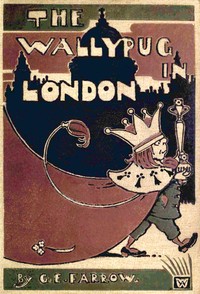
A most extraordinary thing has happened; the Wallypug has been to London! But there, I am forgetting that possibly you have never read The Wallypug of Why, in which case you will, of course, know nothing about his Majesty, and so I had better explain to you who, and what, he is.
To begin with, then, he is a kind of king of a place called Why, which adjoins the mysterious kingdom of Zum. I am afraid, though, that if you searched your atlases for a very long while you might not find either of these places, for the geographers are so undecided as to their exact position that they have not shown them on the maps at all. Some little friends of mine, named Girlie and Boy, have been there, however, and I can tell you, if you like, the way they went. This is the way to Why:
Just go to bed and shut your eyes And count one hundred, one by one; Perhaps you'll find to your surprise That you're at Why when this is done.
I say perhaps, because this only happens when you have been particularly good all day, and sometimes boys and girls are not quite as good as they--but there, I won't say what I was going to, for I am quite sure that it would not apply to you. This is the way to Zum:
Not when the moon is at its full, But just a tiny boat-shaped thing, You may see Pierrot sitting there And hear the little fellow sing. If so, just call him, and he'll come And carry you away to Zum.
There, now, I've told you the way to go to both places, so that, if you wish to, you can go there whenever you please.
I am telling you all this because one day in the spring Girlie and Boy, who live in another part of London, came to see me, and we had been talking about these things for about the hundredth time, I should think: for these children are never tired of telling me of all the strange things which happened to them when they journey to these wonderful places. In fact they were just arguing as to which was the most interesting place to go to, Why or Zum, when my housekeeper, Mrs. Putchy, came to the door with the unwelcome news that the carriage had come for my little friends, and that it was time to say good-bye. After they had gone I sat staring into the fire wondering where Why could be, and if there was really such a person as the Wallypug, when my little dog Dick, who had been lying on the rug before the fire, suddenly jumped up, and barking excitedly, ran to the other end of the study, where a picture, which I had bought the day before at an auction sale, stood leaning against the wall. Now this picture had been sold very cheap, because no one could tell at all what it was about, it was so old and dusty, and the colours were so dark and indistinct. I had bought it hoping that it might prove valuable, and there it stood till it could be sent to be cleaned and restored. Imagine my surprise then, when, on following Dick across the study, I discovered that the colours in the picture had all become bright, and were working one into the other in the most remarkable way, red running into green, and blue into yellow, while a little patch of black in the centre of the picture was whirling round and round in quite a distracting manner. What could it all mean? I stared and wondered, till, out of the confusion, there gradually grew shapes which bore some resemblance to human beings, and, presently, I could recognize quite distinctly, first a young man in knee breeches, smiling in a particularly self-satisfied way, and escorting a large fish, who was walking upright, with slippers on his tail, and who wore a waistcoat and necktie. Then an amiable-looking old gentleman, carrying a wand, who was followed by a curious little person, wearing a crown and carrying an orb and sceptre. A particularly stiff and wooden-looking soldier stood at the back of this strange group. Judge of my amazement when, quite as a matter of course, the whole party deliberately stepped out of the picture into the room, and, before I could realize what had happened, the old gentleman with the wand came forward with a flourish and an elaborate bow, and announced:
"A-hem! his Majesty the Wallypug of Why and suite."
I was so astonished that for the moment I could not think what to say, but at last I managed to stammer, as I made a low bow to the Wallypug: