
Great Pirate Stories
Public-domain ebook
Great Pirate Stories
Language: en6,124 downloads on Project Gutenberg
Subjects
Public-domain ebook sourced from Project Gutenberg #27090.
Public-domain ebook
Language: en6,124 downloads on Project Gutenberg
Subjects
Public-domain ebook sourced from Project Gutenberg #27090.
This volume is a collection of historic pirate narratives, introduced by a reflective foreword that frames piracy as the “high romance of the seas” and traces its decline from the age of sail to the steam era. The opening pages set the tone with a scholarly yet lively essay that juxtaposes the brutal reality of buccaneers against their enduring allure, before moving into a series of excerpts ranging from Michael Scott’s vivid “Piccaroon” episode to Daniel Defoe’s dramatized “King of the Pirates.” The first story plunges the reader into a Caribbean port where a multilingual crew negotiates a desperate passage to Jamaica, their dialogue rendered in period dialect and peppered with nautical detail, immediately immersing the audience in the gritty texture of eighteenth‑century seafaring.
The prose reflects the late‑eighteenth‑ to early‑nineteenth‑century style of adventure writing, with a measured, descriptive voice that balances scholarly commentary and colorful storytelling. Readers who enjoy richly textured historical accounts, maritime jargon, and the rough humor of sailors will find this anthology rewarding, especially those fascinated by the interplay of myth and fact in the age of privateering.
The opening · free to read
Piracy embodies the romance of the sea at its highest expression. It is a sad but inevitable commentary on our civilization, that, so far as the sea is concerned, it has developed from its infancy down to a century or so ago, under one phase or another of piracy. If men were savages on land they were doubly so at sea, and all the years of maritime adventure--years that added to the map of the world till there was little left to discover--could not wholly eradicate the piratical germ. It went out gradually with the settlement and ordering of the far-flung British colonies. Great Britain, foremost of sea powers, must be credited with doing more both directly and indirectly for the abolition of crime and disorder on the high seas than any other force. But the conquest was not complete till the advent of steam which chased the sea-rover into the farthest corners of his domain. It is said that he survives even today in certain spots in the Chinese waters,--but he is certainly an innocuous relic. A pirate of any sort would be as great a curiosity today if he could be caught and exhibited as a fabulous monster.
The fact remains and will always persist that in the lore of the sea he is far and away the most picturesque figure,--and the more genuine and gross his career, the higher degree of interest does he inspire.
There may be a certain human perversity in this, for the pirate was unquestionably a bad man--at his best, or worst--considering his surroundings and conditions,--undoubtedly the worst man that ever lived. There is little to soften the dark yet glowing picture of his exploits. But again, it must be remembered, that not only does the note of distance subdue, and even lend a certain enchantment to the scene, but the effect of contrast between our peaceful times and his own contributes much to deepen our interest in him. Perhaps it is this latter, added to that deathless spark in the human breast that glows at the tale of adventure, which makes him the kind of hero of romance that he is today.
He is undeniably a redoubtable historical figure. It is a curious fact that the commerce of the seas was cradled in the lap of buccaneering. The constant danger of the deeps in this form only made hardier mariners out of the merchant-adventurers, actually stimulating and strengthening maritime enterprise.
Buccaneering--which is only a politer term for piracy--thus became the high romance of the seas during the great centuries of maritime adventure. It went hand in hand with discovery,--they were in fact almost inseparable. Most of the mighty mariners from the days of Leif the Discoverer, through those of the redoubtable Sir Francis Drake down to our own Paul Jones, answer to the roll-call.
It was a bold hardy world--this of ours--up to the advent of our giant-servant, Steam,--every foot of which was won by fierce conquest of one sort or another. Out of this past the pirate emerges as a romantic, even at times heroic, figure. This final niche, despite his crimes, cannot altogether be denied him. A hero he is and will remain so long as tales of the sea are told. So, have at him, in these pages!
JOSEPH LEWIS FRENCH.
The Wonderful Fight of the Exchange of Bristol with the Pirates of Algiers 61 From Purchas, His Pilgrims. By SAMUEL PURCHAS.
The Daughter of the Great Mogul 89 From The King of the Pirates. By DANIEL DEFOE.
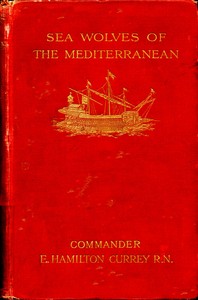
Barbarossa--King of the Corsairs 97 From Sea Wolves of the Mediterranean. By E. HAMILTON CURREY, R.N.
Morgan at Puerto Bello 115 From The Buccaneers of America. By JOHN ESQUEMELING.
The Ways of the Buccaneers 126 From Buccaneer Customs on the Spanish Main. By JOHN MASEFIELD after JOHN ESQUEMELING.
A True Account of Three Notorious Pirates 132 From The Buccaneers of America. By HOWARD PYLE, ED.
Narrative of the Capture of the Ship Derby, 1735 196 By CAPTAIN ANSELM.
Francis Lolonois, the Slave Who Became a Pirate King 209 From The Buccaneers of America. By JOHN ESQUEMELING.
The Fight between the Dorrill and the Moca 232 From The Indian Antiquary, Vol. 49.
Jaddi the Malay Pirate 240 From The Indian Antiquary, Vol. 49.
The Terrible Ladrones 247 From The Ladrone Pirates. By RICHARD GLASSPOOLE.
The Female Captive 276 From an Old Pamphlet, published in 1825. By LUCRETIA PARKER.
The Passing of Mogul Mackenzie, the Last of the North Atlantic Pirates 298 From Blackwood's Magazine. By ARTHUR HUNT CHUTE.
The Last of the Sea-Rovers: The Riff Coast Pirates 312 From the Nautical Magazine. By W. B. LORD.
"Fader was a Corramantee, Moder was a Mingo, Black picaniny buccra wantee, So dem sell a me, Peter, by jingo. Jiggery, jiggery, jiggery."
"Well sung, Massa Bungo!" exclaimed Mr. Splinter; "where do you hail from, my hearty?"
"Hillo! Bungo, indeed! free and easy dat, anyhow. Who you yousef, eh?"
"Why, Peter," continued the lieutenant, "don't you know me?"
"Cannot say dat I do," rejoined the negro, very gravely, without lifting his head, as he sat mending his jacket in one of the embrasures near the water-gate of the arsenal--"Hab not de honour of your acquaintance, sir."
He then resumed his scream, for song it could not be called:--
"Mammy Sally's daughter Lose him shoe in an old canoe Dat lay half full of water, And den she knew not what to do. Jiggery, jig----"
"Confound your jiggery, jiggery, sir! But I know you well enough, my man; and you can scarcely have forgotten Lieutenant Splinter of the Torch, one would think?"
However, it was clear that the poor fellow really had not known us; for the name so startled him, that, in his hurry to unlace his legs from under him, as he sat tailor-fashion, he fairly capsized out of his perch, and toppled down on his nose--a feature, fortunately, so flattened by the hand of nature, that I question if it could have been rendered more obtuse had he fallen out of the maintop on a timber-head, or a marine officer's.
"Eh!--no--yes, him sure enough; and who is de picaniny hofficer--Oh! I see, Massa Tom Cringle? Garamighty, gentlemen, where have you drop from? Where is de old Torch? Many a time hab I, Peter Mangrove, pilot to Him Britannic Majesty squadron, taken de old brig in and through amongst de keys at Port Royal!"
"Ay, and how often did you scour her copper against the coral reefs, Peter?"
His Majesty's pilot gave a knowing look, and laid his hand on his breast--"No more of dat if you love me, massa."
"Well, well, it don't signify now, my boy; she will never give you that trouble again--foundered--all hands lost, Peter, but the two you see before you."
"Werry sorry, Massa Plinter, werry sorry--What! de black cook's-mate and all?--But misfortune can't be help. Stop till I put up my needle, and I will take a turn wid you." Here he drew himself up with a great deal of absurd gravity. "Proper dat British hofficer in distress should assist one anoder--we shall consult togeder.--How can I serve you?"
"Why, Peter, if you could help us to a passage to Port Royal, it would be serving us most essentially. When we used to be lying there a week seldom passed without one of the squadron arriving from this; but here have we been for more than a month without a single pennant belonging to the station having looked in: our money is running short, and if we are to hold on in Carthagena for another six weeks, we shall not have a shot left in the locker--not a copper to tinkle on a tombstone."
The negro looked steadfastly at us, then carefully around. There was no one near.
"You see, Massa Plinter, I am desirable to serve you, for one little reason of my own; but, beside dat, it is good for me at present to make some friend wid de hofficer of de squadron, being as how dat I am absent widout leave."
"Oh, I perceive--a large R against your name in the master-attendant's books, eh?"
"You have hit it, sir, werry close; besides, I long mosh to return to my poor wife, Nancy Cator, dat I leave, wagabone dat I is, just about to be confine."
The book keeps going
Reading is free forever. Sign up and watch scenes appear while you read.



Scenes Storieta drew for other classics.
New illustrated classics
Once or twice a month: the latest books to get full character casts, scene art, and free comic editions. No account needed.