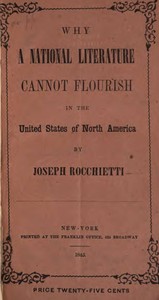
Many americans, and a few foreigners, think that America is yet too young a country for possessing a National Literature. If they intend to say, that the number of classical writers of America, cannot yet compete with the number of classical writers of any old country, of course, it cannot be otherwise. But, that the living present americans cannot have an equal number of writers, as the living old nations, for no other reason, but because this nation is a new one, is what I deny.
Were America a nation of indians beginning now their civilization, independently of any other already civilized nation, to reproach them because they have not a competent literature as well as the old civilized nations, it would be the same as to reproach the times of Abram, because they were not civilized as the present most civilized nations. Such is not the case with the United States of America. The american soil is new; but, the american people is not younger than the european people. This country is composed of colonies from the old continent, who came here with the very laws, religions, learning, languages, prejudices, arts, and literature of the old continent. The classical writers of their mother countries belong to the american also: and to say that the present living american people cannot have a classical literature as well as the present living writers of their mother country, because it is too young a people, it would be the same as to say, that the language of the United States is not an english language.
Besides, if it is a soil fit to expel old prejudices, it is this new soil, now in possession of an old people as we stand in this country. Some writers, traveling through this country, supposed the americans a people of facts only, from whom fine arts, poetry, or literature cannot be expected; as if fine arts, poetry, and literature were not things of fact, as laws, government, or mechanical works. Man is an imitating being: honor an american Tasso, or an american Michæl Angelo, and instead of having too many, who aspire the presidency of the United States, you will have your Tassos, and your Michæl Angelos. That America has her artists, poets, and literati as well as England, France, Germany, or Italy, I have no doubt: but, if the genius does not flourish here as it does among the old nations, my purpose is now to demonstrate it.
I say it again; were the people encouraged to look back to standards of classical literature, so rich in all the languages of the old continent, this glorious, ambitious country, soon would have her Johnsons, her Rousseaus, her Dantes, her Machiavellis. But, the little which the americans read now, are but light works from the english press, here reprinted; contentions of parties, called politics; and american periodicals, praising each other: and these periodicals, having now the consideration of oracles in literature, keep under a contemptible silence many american geniuses, who were too independent to bend under the ruling will of any party. However, there are daily papers, as well as periodicals of my highest esteem: I mean only to say, here; monopoly can be found in every trade; and fashion, not only ruins the feet of chinese, and the shape of american ladies; fashion ruins also a National Literature.
There is, at present, in the United States of America, a fashionable, unwholsome, immoral practice of writing, which, although the ancients had not always been free of reproach, now a days, is rather too much frequented. I mean a kind of personal ridiculing, and retaliating each other’s national foible, unmercifully. If an english comes here, and finds faults with us, as no nation can be yet without faults, it is our duty to thank the writer, and correct ourselves. If the imputation is false, truth speaks for itself. But, to go into England with a spirit of revenge by retaliating with ostentation, pleasure, and self conceit, the faults which we find among that nation, faults which we have not, we must then have forgotten the very moral principle required to literature. He, or she who does not know charity, the former would do better to plant potatoes; and the latter to attend her family kitchen, or darn her husband’s stockings. A writer should look with pain at the faults of all nations; and could he have a little patriotic feeling without prejudice, he would not tell to his children they are the prettiest, because he finds others who are uglier. He should rather feel displeased not to find, on earth, another nation from whom he cannot learn how to become better.
That book which does not elevate the human mind to noble, generous sentiments, is a dangerous book! He who ridicules others, should, in his turn, be the only subject worthy of being ridiculed: but, the innocent man who steps into a drawing room, laming as Byron with a wish to imitate Byron, if, unfortunately, he falls on the carpet, or cannot prevent his tumbler of lemonade from falling on a lady’s black satin dress, not only we should indulge his weak side; but, if we wish to be polite, we should turn our eyes from his uncomfortable position. Though to ridicule another it is the same as to say: I am a perfect being, I often found, that he who is fond of the fun, and laughs at his neighbor, because this has no nose, he turns angry, when another laughs at him, because he has only one eye: I mean to say, here; could we see the soul of the individual, so fond of ridiculing his fellow beings, such an exhibition would present a hideous grim face of envy without heart, without any worthy feeling.
In writing against the present, fashionable style of ridiculing, I wish to be well understood. I do not intend here, to dissuade writers from exposing the ridicule of man in the abstract. On the contrary; I think, for our improvements, nothing is more beneficial than the caricatures, or the faults of real life, exposed in a ridiculous light, by which the reader would correct his faults, if he has any like. But the writer should give the caricatures with such modifications, or charged colors, with which to avoid all personalities. And here, the writer, who must pen from nature, may sometimes delineate a living character, whom he had forgotten, or did never see: but, such a writer cannot be blamed for all the faults of man; and as it is not a malicious composition, he, who has like ridicules, has but to correct himself.
National faults also cannot be personalities. Besides, I may, for instance, write, or speak of persons I met in a stage, in a private house, theatre, or church, provided their names are not mentioned. If the historical fact happened, only, with the person introduced in the tale, nobody knows of whom the writer is speaking, or writing; if it happened before other persons, the truth of the fact prevents, rather, those fond of making false stories from the smallest event; the truth cannot offend either of the parties. Besides, men would conduct themselves better, were they afraid of being exposed: and if we have committed an offence towards an innocent person, we should listen, and do better for the time to come. I mean only to say here, were all writers, who can wield a pen, permitted to book all the characters they meet with, writers should be avoided as cholera: and though in this, and many other countries libeling did turn fashionable, I understood that such writers are not the most welcome, among those who do not like to see their private characters heralded; and that America can not be offended in finding american families heralded, because lords, and ladies of England are heralded also, it is the same as to wish here, the same faults, permitted in that country, for no other reason, because the lords of England cannot prevent an english editor from prying into their private houses. If I preach morals, and at the same time I act immorally, not only I wrong myself in exposing my hypocrisy; but, I turn literature into an infamous art. I repeat it again, good or bad characters may be blended in a novel, comedy, or tragedy, where the characters, though taken from nature, cannot offend any private individual; but, the names, or exact characters, should not be exposed by writers, unless the individuals are notorious, or had already become a part of history.
Like immoral writers have, now a days, become so fashionable for which, loosing all respect which man ought to have for man, we see dandies ridiculing not only private characters; they write of nations, as if their cat-like brain could judge that of an elephant. That part, or that half of a man, whose life was spent in setting his cravat without a fault, as soon as he visits a strange country, where the cravat is tied à la sans façon, such a half man calls all those people a set of fools. He who did never live in the luxury of a palace, finds that his two story house, built without knowledge of architecture, is by far more comfortable than the palace built by Michæl Angelo. The protestant finds nothing reasonable in a catholic country; and the catholic nothing reasonable in a protestant one. He whose life was spent in contending parties, cannot understand how the citizens of another country go so quietly to their own private business, without meddling with the ruling power. The subject of England calls the americans free fools; and the turk calls barbarous those nations condeming a man to a forced labor for bigamy, or polygamy. These, while they do not permit divorce, connive at a man living with another woman, as far as he does not marry in church the second, as he did the former still living. Because that country educates, and brings them up, all the children from poor parents, this other traveler, who had never read the laws of Sparta, blames all poor, who marry in his country, because his legislators did no more provide for them, than they had for the flies which pester his luxurious table.
I might blend here, and multiply the prejudices as well as the good reasons of travelers to infinity, almost: but, unless the dandy ceases from being a dandy; the religious from being a superstitious man; I mean, as far as the writer does not look at things with a charitable, and unprejudiced eye, the too many writers of our day, not only injure our literature; they degrade it. And why, instead of cavils, frivolous misrepresentations of persons and nations, writers do not place themselves as citizens of the world, correcting national faults, as a father would his beloved children? The greatest man, and the most nigh to perfection, could not, would not, should not boast of his fine qualities. If an Aristides is rare, very rare among us, how can a nation boast supremacy over another? From my own experience I always found the best the modest; and he who has no merit boasting merit. It is a pity in seeing writers finding fault with nations, because these eat with a knife and fork, or because they do not eat three eggs in a tumbler. Knifes and forks are convenient, when the meat is hot; and I, who am fond of eggs, like to crack four eggs in a tumbler, provided the present sensible american does not care of the puerile english observation. Besides, if I am pleased in looking at the fine architecture of an italian palace, I am pleased also in seeing that the small, modest, and nearly uniform houses of the United States of North America, have the blessed appearance of a nation, whose richest citizens do not outshine the poor.