Public-domain ebook
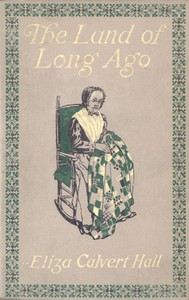
The Land of Long Ago
Language: en476 downloads on Project Gutenberg
Subjects
In: Novels·American Literature
Public-domain ebook sourced from Project Gutenberg #32203.
Public-domain ebook
Language: en476 downloads on Project Gutenberg
Subjects
In: Novels·American Literature
Public-domain ebook sourced from Project Gutenberg #32203.
The opening · free to read
"Make haste, child," called Aunt Jane; "there's mighty little time between dinner and sundown, and if we're goin' to town we'd better be startin'."
Aunt Jane came out of the house, drawing on a pair of silk gloves. She was arrayed in her best gown of black alpaca, a silk-fringed cape covered her shoulders, her poke bonnet was draped with a veil of figured lace, and under the lace her face shone with happy anticipation, for a lifetime of trips to town had not dulled her enjoyment of such an event.
The horse and buggy stood at the gate. The former had a pedigree as long as that of the penniless lass, and Aunt Jane could tell many wonderful tales of Nelly's spirit and speed in the days of her youth. Some remnant of this fire was supposed to smolder yet in the old thoroughbred, but as I looked at the drooping head and half-shut eyes, I saw there was good reason for Aunt Jane's haste, if we were expected to get back from town before nightfall.
"What are we going to town for?" I asked, as I stepped into the buggy and took up the reins.
Aunt Jane hesitated. "Well," she said, "I'm goin' to lay in a supply o' soda and cream o' tartar, and I may buy some gyarden seed and one thing or another. I ain't exactly out o' soda and cream o' tartar, and I could git the seed from some o' the neighbors. I reckon if the truth was told, I'm goin' to town jest to be a-goin'."
A certain English humorist, who is not so well known to this generation as Mark Twain, once wrote a page of gentle satire about those misguided people who leave their native land to travel in foreign countries. He finds but three reasons for their folly: "infirmity of body, imbecility of mind, and inevitable necessity"; and the whole circle of such travelers he classifies under the following heads: the Idle, the Inquisitive, the Lying, the Proud, the Vain, and the Splenetic. Had he gone a little farther into his subject, he might have written approvingly of the Innocent Traveler, who, on a May day, sets forth to go from his home in the country to the near-by town, all for the mere pleasure of traveling.
Why, indeed, should the desire for travel send one across oceans or over continents? Wherever we go we find only the old earth and the old sky, and, under varying forms of dress and complexion, the same old humanity of which we are a part. Does not the sun rise or set as splendidly over some blue Kentucky hill as over the Jungfrau? Is the daisy on Mars Hill any fairer than the daisy that opens its petals on any meadow of the New World? And if historic associations are the aim of your wanderings, turn the pages of some old school history, or send your memory on a backward pilgrimage to the olden days, and a country road may carry you into a past as glorious as that which lies along the Appian Way.
For a long time we rode in silence. On crowded streets and in towns one must talk; but out of doors in the country there is a Voice continually speaking in a language as old as the song of the morning stars, and if the soul hears that, human words are not needed.
Aunt Jane was the first to speak. "Ain't it sweet and peaceful this time o' the year!" she said. "I look at these pretty fields and woods all fenced in, with good roads runnin' alongside, and it don't seem like it could be jest a little more'n two generations between now and the time when this was the Dark and Bloody Ground, and the white men was fightin' with Indians and bears and wildcats to git possession of it. Why, right over there on that ridge o' hills is the place where Sam Amos's grandfather run the ga'ntlet when he was captured by the Indians. Sam used to have the old tow-linen shirt with the bloodstains and the cut on the shoulder where one o' the Indians struck him with a tomahawk. I ricollect Parson Page used to say that life was jest a runnin' of the ga'ntlet. There's enemies on each side of us, and every one of 'em is strikin' at us. And we can't run away, and we know that there's one stroke comin' some time or other that's certain to bring us down. And all we've got to do is to stand up and keep goin' right on, and be ready for the last blow, whenever it happens to fall. And here's Devil's Holler," she continued; "look down that bluff, and you'll see it."
I looked and saw a deep cup-shaped valley, dark with the shadows of overhanging rocks and trees, and luxuriant with ferns and underbrush that grew rankly out of soil made rich by the drifted leaves of a hundred autumns.
"Some folks say that the old stage road used to run past here, and a band o' robbers used to hide by the side o' the road and waylay the stage and rob the passengers, and maybe murder 'em and bury their bodies at the bottom o' the holler. And"--she lowered her voice--"some folks say the place is ha'nted. Sam Amos declared the devil come out o' that holler and chased him for half a mile one dark night when he was late comin' home from town. But I reckon the only devil that chased Sam was the devil in the bottom of his whiskey-jug, and Uncle Billy Bascom says there never was any stage line along this road within his ricollection. So there you are; don't know what to believe and what not to believe."
Just here the road made a steep, upward curve, and we looked down on the clear, green ripples of a river that wound between high rocky cliffs on one hand, and on the other vast fields of corn growing lustily in the deep, rich soil.
"Why should such a pretty little river be called the Barren River?" I asked. "There isn't anything barren about the river or the country around it."
Aunt Jane's eyes sparkled. She was capable of answering the question, for it touched a page of ancient history that was to her a twice-told tale. "You see all these trees, child?" she said impressively, waving her hand in the direction of the luxuriant masses of foliage. "Jest look at that tulip-tree yonder, eighty feet high, I reckon, and the flowers standin' up all over it like the gold candlesticks the Bible tells about. You wouldn't think all these trees could grow up since the first settlers come through here. But I've heard father tell about it many a time. He said the Indians used to set fire to the woods and the fields, and when the first settlers come through here, they called this the Barrens on account o' there bein' no trees, and they passed by all this good land and went further up on Gasper River, where there was springs comin' out o' the hills and plenty of trees. You see, there's two things a settler has to have: wood and water; and that's why the country up around Gasper was settled before this was, and this got the name of the Barrens, when there ain't a richer lot o' ground anywhere.
"And speakin' of names, honey, did I ever tell you how Kittle Creek got its name?
"Well, now, folks has been laughin' about that story for the last seventy-five years, and I reckon they'll keep on laughin' as long as there's a old man or a old woman like me livin' to tell it;" and Aunt Jane began laughing in advance of the story.
"The right name o' Kittle Creek is Clear Fork," she said, "but it's been Kittle Creek ever since old man Sam Stapleton give it that name. And this was the way of it. Old man Sam lived on the fur side o' the creek, and he was in the habit o' comin' to town every once in a while to lay in his groceries and such things, and every time he'd come to town he'd git his jug filled, of course, and drink all along the way home; but by the time he'd git to Clear Fork he wouldn't know where he was, or who he was, or which way he was goin'. He was a mighty good-hearted man, but that jug was his besettin' sin.
"Well, one evenin' he was comin' home the usual way, him and the jug, and he got to the creek and concluded he'd git off his horse and lay down and take a little nap. Some o' the women folks in that neighborhood had been doin' their washin' that day, and there was a big iron kittle on the bank set up on some stones where they'd b'iled their clothes. Old man Sam laid down by the kittle and went to sleep. Pretty soon he got awake and set up and rubbed his eyes, and took notice of the kittle, and says he,
"'Have I crossed this creek or not?' says he. 'It appears to me like I've seen this kittle before, but whether it was on this side o' the creek or the other, to save my life I can't tell.'
"Then he studied a while and says he,
"'Well, I'll give myself the benefit of the doubt.' So he crossed the creek, got off his horse and set down in the shade, and took a drink out o' the jug and fell asleep again. After a while he woke up and looked around, and says he: 'Here I am again, and here's the creek, and yonder's that old kittle jest as natural as life. But what I want to know is, am I agoin' to town, or am I comin' back home?' And he looked at the sun, and says he, 'Judgin' by the way that sun looks, it might be nine o'clock in the mornin', and it might be three o'clock in the evenin'; and not bein' a Solomon I ain't able to decide which it is, but I'll take my chances and go across the creek.'
"So across the creek he went, took another drink, and laid down and fell asleep right by the kittle. Pretty soon he woke up the third time, and says he: 'Well, if here ain't that old kittle again! Howdy, Mr. Kittle! Can you tell me which way I'm goin', and whether it's mornin' or evenin'?'
"Well, the kittle didn't answer; and the old man set there and thought a while, and then he crossed the creek and took another drink and another nap, and crossed again, and there was the same old kittle, and he looked at it and give it a kick, and says he: 'I never saw as many blame kittles in all my life as I've seen to-day. I reckon this must be Kittle Creek.'"
Aunt Jane paused to join in my laughter.
"I always thought it was a shame to laugh at a poor drunkard," she resumed, "but old man Sam told the Kittle Creek story on himself. I don't reckon he thought he was changin' the name of Clear Fork Creek, but from that time on nobody ever called it anything but Kittle Creek."
She stopped and peered over the side of the buggy. Her keen eyes had detected a change in the road. There had been no rain for a week, but the horse's hoofs and the wheels of our buggy had suddenly ceased to raise any dust.
"Looks like there'd been a shower here lately," she remarked; "but I don't see any sign o' rain except right here in the middle o' the road."
"Perhaps this is the oiled road, Aunt Jane," said I.
"That's jest what it is!" exclaimed Aunt Jane delightedly. "Uncle Billy Bascom was tellin' me about the new-fangled way they had of layin' the dust, but it didn't seem to me like oil'd mix with dust any more'n it will with water. That shows how little old folks knows. Well, ain't this nice! Ridin' along in dry weather and never raisin' a bit o' dust! Uncle Billy didn't approve o' the oiled roads. He says, says he, 'Jane, it looks to me like them town folks won't never git through circumventin' Providence.' Says he, 'They've got their gas and their 'lectricity, so's it don't make a bit o' difference whether the sun or the moon or the stars shines or not. And they've got their 'lectric fans, which makes 'em independent of the wind blowin', and now they're fixin' the roads so's they won't have to pray for rain.' Says he, 'It looks like they're tryin' to git rid of all sense o' dependence on the Almighty; but as for me,' says he, 'I've got my pegs sot, and I ain't goin' to have my brains all tore up follerin' after new ways.'
The book keeps going
Reading is free forever. Sign up and watch scenes appear while you read.



Scenes Storieta drew for other classics.
New illustrated classics
Once or twice a month: the latest books to get full character casts, scene art, and free comic editions. No account needed.