Public-domain ebook
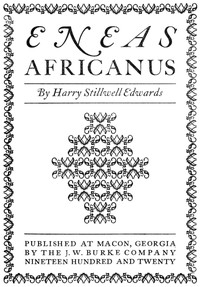
Eneas Africanus
Language: en297 downloads on Project Gutenberg
Subjects
In: Humour·Novels·American Literature
Public-domain ebook sourced from Project Gutenberg #33594.
Public-domain ebook
Language: en297 downloads on Project Gutenberg
Subjects
In: Humour·Novels·American Literature
Public-domain ebook sourced from Project Gutenberg #33594.
The opening · free to read
"Ye bryde whose lippes kysse myne And taste ye water an no wyne Shall happy live an hersel see A happy grandchile on each knee."
These lines were surrounded with a wreath and surmounted by a knight's head, visor down, and the motto: "Semper Fidelis."
This cup was hurriedly packed with other silver in a hair trunk and intrusted to Eneas with verbal instructions as to travel. He drove an old-fashioned, flea-bitten blooded mare to a one-horse wagon full of forage and carried all the Confederate money the family left, to pay his expenses. He was last seen, as I ascertained soon after the war from a wounded member of my command, about eight miles southeast of Atlanta, asleep in the wagon, the mare turning to the right instead of keeping the straight road to Macon. Eneas was a faithful negro, born and raised in the Tommey family and our belief is he was murdered by army stragglers and robbed of the trunk. He had never been over the road he was traveling, as we always traveled to North Georgia by rail, shipping the horses likewise. His geographical knowledge consisted of a few names--places to which I had at different times taken him, and in the neighborhood of my home, such as Macon, Sparta, Louisville, and the counties of Washington and Jefferson. If given a chance to talk he would probably confine himself to "Lady Chain," the mare he was driving; "Lightning," the noted four-mile stallion temporarily in my possession; the Tommey family and our settlement, "Tommeysville." On these topics he could talk eighteen hours a day.
I have no hope of ever seeing Eneas again, for if living he would have gotten back if he had to travel all over the South to do it, but there is a bare chance that the cup may be found, and I am writing to gratify my daughter, whose wedding day is approaching. All brides in the family, since 1670, have used this cup on their wedding days. If the cup was stolen, doubtless the thieves sold it, and if so, the holder may read these lines if they are given publicity. I am willing to waive any question of ownership and purchase the cup at the holder's valuation, if within my power; or, if unwilling to sell, he may loan the cup for a few days.
I shall be greatly obliged if you will publish this letter with a request that all Southern papers, daily and weekly, copy the same. Thanking you in advance and with all good wishes for your happiness and prosperity, I am, most respectfully,
Dear Major Tommey: I read with deep interest and sympathy your letter in the Atlanta Constitution inquiring of a negro named Eneas. This man, I am sure, came to my house about twenty miles south of Atlanta in 1864. I remember the occasion perfectly, because he mentioned your name and one of my boys was serving in your command. I gave him shelter for the night and food for himself and horse. He insisted on sleeping in his wagon. He told me that the mare was famous on the race track and very valuable and he was afraid to leave her. This struck me as singular, at the time, because she seemed old and broken down. I did not see any trunk, but his wagon was full of hay and fodder and he may have had one hidden under it. Eneas asked me to put him on the road to Thomasville--or so I understood him--and I gave him explicit directions as far as Newnan, advising him to get more at that point. He was gone when I arose next morning. I do hope you will find the old man, as well as the cup. I took quite a fancy to him. He gave me a very vivid description of yourself--whom I had long wished to meet--and of your home, the twelve-room house, lawn with its three fountains, beautiful lake and your hundred negroes in their painted cottages, etc.
Excuse this rambling letter. Your name has stirred an old woman's memories.
Sincerely your friend, Martha Horton.
P. S.--My son William, who served in your command, married a Connecticut girl. Think of it, Major! But she proved to be a noble-hearted woman and has influenced him to give up tobacco and stimulants in every form. He travels this territory for a New York house. His wife is well connected, and one of her ancestors came over in the Mayflower. She is with me now and sends you her regards. Billy has convinced her that next to General Joseph Johnston, you were the bravest man in the Georgia armies.
M. H.
Sir: Read your letter in the Columbus Enquirer. I kept a livery stable here in '64 and saw the man you are huntin about that time. He drove a broken down old speckled grey mare he called Lady Chain, now that you mention it, and claimed she was in foal to "Lightning," the great four-mile horse. I took this for a joke along with some of the fairy stories he gave me about the Tommeys, but he was so polite and humble that I let him stay over night in the stable. Offered to pay me next morning, an seemed like he had about a bushel of Confedrit money; but I was long on Confed myself and didn't let him put any more on me. Don't remember seein any trunk. He was on his way to Thomasville, so he said, and I giv him as much directions as he could carry. Very truly, William Peters.
Dear Sir: My wife remembered your old nigger as soon as she read your letter in the paper, and so did I when she called it to my mind. He was a big talker all right, and sat on our back steps half the night talking about the Tommeys, their race horse, twenty-room house, yard with six fountains, and a whole tribe of niggers. We fed him and he slept in his wagon. Next day he wanted to pay me in Confederate money; was using a corn sack for a pocketbook, and it was most full. He moved on to Thomasville, about six miles from here, but I don't think it was the place he was looking for. I reckon it must have been "Tommeysville" he was looking for. Major, I took a good look at Lady Chain and you ain't lost much if you never get her back, but if you don't find the nigger, you've lost the champion liar of Georgia. I hope you get him back, but it's hardly possible a man talking like he did could last seven years on the public road.
Respectfully, Abner Cummings.
Your man Eneas came to my home in Thomasville in the winter of '65 or the fall of '64, in great distress. He said he had traveled a thousand miles to get to Thomasville, but it wasn't the right Thomasville. He had no idea of States, geography or direction. Claimed he lived in Jefferson County, next to Washington County, and as this describes two counties across the line in Florida, several people at different times had sent him over there. I gave him a letter to a friend over in Jefferson County near Tallahassee. He had an old grey mare he said was a famous race horse, but she didn't look it. Claimed she was in foal to the celebrated "Lightning," whose four-mile race in the mud at New Orleans I witnessed. I thought the old nigger was loose in the upper story. He had no trunk when here.
Very truly, Andrew Loomis.
My Dear Sir: Eneas, your old negro, whose name I had forgotten until I read your letter in a local paper, was on my plantation near here in '65. He came here very blue and utterly discouraged from Thomasville, Ga. Said he was looking for a little Thomasville owned by Major George E. Tommey. He brought a letter from a friend of mine. There are no Tommeys in this county, and no Thomasville, and not knowing what to do with him, I passed him along to Colonel Chairs, a friend in Washington County, which is on the gulf coast. Chairs wrote me that he had had a great deal of fun out of Eneas. The gulf astonished him. He declared solemnly that he knew he was in the wrong Washington, because there were no oranges, or scrub palmettoes, or big green spiders (crabs) in his, and the water had no salt in it. Eneas talked a good deal of Macon and Louisville, and there being a county and town so named, besides another Thomasville, to the north in Alabama, Chairs started him up that way. I am truly sorry the old man came to grief. He was a harmless old fellow, though a picturesque liar, as are many old negroes when they talk of their white folks.
It is possible that Eneas had a trunk, but I have no recollection of seeing one in his possession.
Yours very truly, Randolph Thomas.
Sir: A ole nigger name of enus come by hyar in the firs yer atter the war with er old mare an er colt he claim was by the lightnin. He was lokin for a tomusville, an I tried to show him the way back to tomusville, in Georgia, but he got mad and wanted to fight me, an ef he hadnt ben er ole man I would have busted him open. Mr. tommy, you wont never see yo nigger no more less he mends his way of acktin when you are tryin to help him.
Respectfull, sir, yours, Pompey Wiley (Colored).
He lef hyar for Macon County.
Dear Sir: Your negro, Eneas, came to my place in this county in 1865, I think, from a little village named Thomasville to the northeast. He was very poor and his pathetic story appealed to my sympathies. I let him have some rations and a piece of land and he planted a cotton crop. He married a young mulatto woman on my place that year, and when he left here about Christmas, 1866, carried with him a young baby besides the old mare and her colt. The colt, by the way, was a beauty.
Eneas was a puzzle to me, though I have lived among negroes all my life. His stories of you and your place were marvels. But for the fact that he held the mare and colt in your name, refusing dozens of offers for the latter when in dire need, I should have put him down a reckless romancer. He began preaching here among the negroes and proved to be a most eloquent spiritual advocate. He claimed to be the pastor of a big congregation at home. I heard him on one occasion when he baptized forty converts and was thrilled by his imagery and power.
Eneas knew nothing of geography beyond the names of a few towns and counties. Hearing of a Macon and Louisville over in Mississippi, he gathered his household goods into his wagon in December, '66. I do hope you will yet find him. Suppose you make inquiries through the African Methodist Church? He ought to be a bishop by this time.
Very respectfully, James Tally, Attorney at Law.
My Dear Sir: I was greatly interested in your letter copied into our county paper from the Atlanta Constitution, concerning Eneas Tommey. He was here in 1868 or 1869 with a wife and several children. They came in a one-horse wagon drawn by an old grey mare he called Lady Chain, and followed by a splendid young colt he declared was from celebrated racing stock. An almost worn out pass from his mistress, Mrs. Tommey, though it bore no date or address, saved the old man from arrest. His story, that he was lost and on his way home, though remarkable, was possible, and he was not molested. The narrative of his wanderings interested me greatly. He came up the river--the Mississippi--from Jefferson County, trying to find a ford. He had heard of a Washington parish and a Thomasville in Louisiana, and was trying to reach them. He rented a piece of land near here and raised a crop, leaving in 1869 for Jefferson County, Alabama. I gave him a letter to a minister in that county.
The book keeps going
Reading is free forever. Sign up and watch scenes appear while you read.



Scenes Storieta drew for other classics.
New illustrated classics
Once or twice a month: the latest books to get full character casts, scene art, and free comic editions. No account needed.