Public-domain ebook
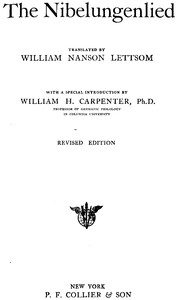
The Nibelungenlied Revised Edition
Language: en1,369 downloads on Project Gutenberg
Subjects
In: Poetry·Mythology, Legends & Folklore·Classics of Literature
Public-domain ebook sourced from Project Gutenberg #38468.
Public-domain ebook
Language: en1,369 downloads on Project Gutenberg
Subjects
In: Poetry·Mythology, Legends & Folklore·Classics of Literature
Public-domain ebook sourced from Project Gutenberg #38468.
The Revised Edition of the Nibelungenlied presents the great German national epic in English translation, situating it alongside its older Norse counterparts. The opening essay frames the poem as a work of universal appeal, noting its “universal intelligibility” and the way its characters, knights, ladies, and the legendary figures Siegfried, Kriemhild, Hagen, and others, reflect the courtly life of twelfth‑ and thirteenth‑century Germany. It contrasts the German version with the older “Elder Edda” material, explaining how the story migrated northward and later returned, and it emphasizes the poem’s dramatic unity, where “deed follows deed” toward an inevitable catastrophe. This contextual grounding prepares the reader for a narrative that, while rooted in medieval German customs, resonates with broader human motives of love, honor, and vengeance.
The verse is rendered in a measured, lyrical style that retains the medieval Germanic tone while remaining accessible to modern readers. Its language balances the formal diction of a courtly epic with the immediacy of personal emotion, allowing the drama of battles and betrayals to unfold with vivid clarity. Scholars of medieval literature, students of comparative mythology, and anyone fascinated by the roots of heroic storytelling will find the work rewarding. Those who appreciate the interplay of history and legend, especially the contrast between German and Norse traditions, will be drawn to its rich tapestry of characters and its compelling, tightly woven plot.
The opening · free to read
The "Nibelungenlied," as the great national epic of Germany, is not only one of the most important literary monuments that the German mind has produced in all periods of its history, but, in reality beyond this, it is also in its matter and its manner one of the world's great classics. It is this inherently because of the universal intelligibility of its story, for the broad human sympathy which must be felt with its characters and their motives of action, and for the sustained poetic treatment of the whole in the long poem. In all these respects the "Nibelungenlied," although German in its spirit and its environment, rises inevitably above the confines of nationality, and becomes, like other works that are in a true sense great, by virtue of its universality an integral part of that cosmopolitan body that we call the literature of the world.
Like the "Iliad," or any other popular epic whatever, the "Nibelungenlied" is, however, first and foremost a picture of the national life and the national soul. Its characters in this way are, consequently, both fundamentally and of necessity a part of their own special environment into which each, according to his individuality, fits; and the manners and customs, the religion and ethics, are first of all essentially German in order to embody them and to motive their actions to the public for which the poem was originally intended. What we are given in the "Nibelungenlied" is primarily then, at least in its exterior, a picture of German life in the twelfth and thirteenth centuries. The customs are those of the courts and castles of the place and time, the men and women are the knights and ladies who inhabit them; and if the real mainsprings of motive and action sometimes go back beyond the poet's own day and generation for reasons that shall presently be told, the thoughts and feelings of the characters under his hand betray on the surface no trace of it.
To an English reader there is astonishingly little in the "Nibelungenlied" in motive that is unintelligible or hopelessly remote. It is not that its manners of thought are our manners of thought, or its ethics our ethics. Its deeds, since the real story is an ancient inheritance, are tragic with battle, murder, and sudden death; but, in spite of all this, there is in us an innate appreciation of it and of its spirit that it is utterly impossible to feel in much literature that is not our own. This of course arises from the fact that it is, in a sense, our own, as, in part, at the beginning in very truth it was. The difference in its whole environment from us is still, in reality, not great, and we realize, consciously or unconsciously, that it is in many ways our own ancient past that is chronicled in the German poem.
For all these reasons it comes readily about that, in the light of the poet's master touch, the characters of the "Nibelungenlied" that he has left in such actuality in his verses are to us neither vague nor shadowy, but are real persons who live and act before us. This is in fact truer of the "Nibelungenlied" than of almost any other great poem of the kind, whatever its time and place of origin. Siegfried and Kriemhild, Hagen and Rudeger are not the mere creations and impersonations of a poet's imagination; they are to us real men and women who lived their lives and died their deaths as the poet has described them. That he has told his tale with wonderful literary skill as a whole and at times with marvellous appreciation of the value of the moment, is also to be stated. Because no doubt in part from the way in which the poem has come down to us, there is at times superfluous material that had better been left away, but in this fact, too, the poem differs but little from other popular epics.
As a whole, the "Nibelungenlied" is characterized by a literary unity of treatment by no means inconsiderable, and greater, in point of fact, than its origin would ordinarily promise. Its unity, however, is dramatic, rather than epic in the ordinary sense. This character it never loses throughout the whole long action. Deed follows deed, stroke upon stroke, until the final catastrophe is inevitably reached and the story is ended.
That this story in its origin is not narrowly German, but is Germanic property, should be borne in mind by its reader, since many of its episodes acquire thereby a broader significance, and the whole poem assumes a wider interest.
The earliest versions of the story of the Volsungs and Nibelungs, the Germanic "tale of Troy," that have come down to us are not from German territory, but from the Scandinavian North, although here, too, the scene of the principal action is on the Rhine and in the land of the Huns, which is vaguely conceived to be a part of the German country. Sigmund, the father of Sigurd, is a King in the land of the Franks; Sigurd is slain to the south of the Rhine, and in the Rhine is forever hidden the fateful hoard of the Nibelungs. The story in reality wandered out twice into the North from its original home in Germany: once apparently in the Viking age when the Northmen for the first time came into close contact with the other Germanic people on the continent and in the British Islands, a period long antecedent to the "Nibelungenlied;" and again five hundred years later, after the German poem had arisen, since it can be readily shown that this has been used as a source of a part of the material.
The very first of these Northern versions is that contained in the "Elder Edda," a collection of mythological and legendary poems in the Old Norse language, of unknown authorship, whose time and place of origin are alike matters of varying supposition. The subject was the theme of poets for centuries in the North. The oldest of the poems in the "Edda" that has to do with the story of the "Nibelungenlied," from internal evidence, was made as early as the year 900; the latest is from a time not far from 1200. These poems and fragments of poems, some of them even in prose rescript and most of them interspersed here and there with bits of prose, do not make in any sense a connected story. Their unknown collector arranged them as well as might be in connected sequence, but even then their action is not consecutive; they overlap each other, parts of the story are told and retold and not seldom with an inconsistency of detail. There is, accordingly, in the "Elder Edda" no thought of an epic either in matter or manner. There is the material for an epic in the rough, but without an idea in the mind of any poet of the time of actual epical treatment.
The story as contained in the Old Norse poems is by no means identical with the "Nibelungenlied." First and foremost, it is infinitely older in its whole conception, and much more nearly approaches original conditions as they existed in the mode of thought and in the manner of living of the early Germanic people. It is a story, here, of the days when the world was young; when the gods still walked the earth and mixed themselves in with human affairs in which they had an active interest; when motives were clearer and action was more direct; when human passions burned even fiercer than in the "Nibelungenlied," and love and hate together knew no boundaries until they had worked themselves out in the utter destruction of their object. Of the first of these conditions, the "Nibelungenlied" in its character of an epic of the Middle Ages has not kept a trace. In the Eddic poems it is the ring cursed by the gods to all its possessors that motives the entire action; that leads with the certainty of fate to the death of Sigurd, the Siegfried of the "Edda," to all the woes that follow, and to the ultimate utter destruction of the entire race of the Nibelungs.
As most critics have pointed out, the fundamental difference in the treatment of the story consists in the fact that the principal epic interest in the Eddic poems is the relation of Sigurd to Brynhild, the Valkyrie, who is here a heroic figure, who rises immeasurably not only above the other women of the tale, but above most of the other characters in importance of personality. In the "Nibelungenlied" it is Kriemhild, Gudrun in the "Edda," and Hagen who are the principal figures in the action. In the Northern version, Gudrun does not avenge herself upon her brothers as does Kriemhild in the "Nibelungenlied," but Atli, her husband after Sigurd, slays them, and Gudrun then takes vengeance upon him. In the "Edda," too, other saga cycles are brought into connection with this, viz., the Northern legend of Helgi, at the beginning, and the Gothic legend of Ermanrich, at the end.
The Eddic poems are not the only versions in Old Norse literature. An epitome of the story based upon the poems is contained in the "Snorra Edda," a work written by the Icelander Snorri Sturluson, who lived from 1178 to 1241, to serve as a handbook for poets and which contains in this way the myths and legends of the North.
Next to the Eddic songs the most important of the Northern versions, however, is the long "Völsunga Saga" from the second half of the thirteenth century, which, again, is based upon the Eddic poems and upon others in addition that have now been lost. Like most of the Old Norse sagas, it is prose with the occasional inclusion of verse cited to justify or to embellish its statements. It gives with extraordinary wealth of detail the whole old story in connected form and desires to be called, as it has been called, a prose epic. William Morris, in his superb translation, has deservedly characterized it as "the most complete and dramatic form of the Great Epic of the North." The story is further contained, in some of its details only, in the strange tale of "Nornagest," which has again made use of the Eddic songs and quotes one of them entire.
The Old Norse story is so important for its bearing on the intelligibility of the "Nibelungenlied" that it is absolutely necessary to take it actively into consideration in any discussion of the German poem. The epitome contained in the "Snorra Edda," since it gives the whole story from beginning to end in a form as short as may be, is here given in its entirety:
"Three gods, Odin, Hœnir, and Loki, once went out to explore the whole world. They came to a certain river, and went along the river to a waterfall, and at the waterfall there was an otter that had taken a salmon out of the fall and ate it, half asleep. Then Loki took up a stone and cast it at the otter and struck him in the head. Loki thereupon boasted of his catch that he had got at a blow both the otter and the salmon. They took the salmon and the otter and carried them along with them until they came to a farmstead, where they went in. The head of the household that dwelt there was named Hreidmar; he was a mighty man and much skilled in magic. He invited the gods to lodge there for the night, and they told him that they had with them provisions in plenty and showed him their booty. But when Hreidmar saw the otter he called his sons Fafnir and Regin and said that Otter, their brother, had been killed, and told them who had done it. Thereupon, the father and his sons fell upon the gods and took them and bound them, saying that the otter was the son of Hreidmar. The gods offered as a ransom as much money as Hreidmar himself should determine, and that was agreed upon as a reconciliation and was bound with oaths.
The book keeps going
Reading is free forever. Sign up and watch scenes appear while you read.



Scenes Storieta drew for other classics.
New illustrated classics
Once or twice a month: the latest books to get full character casts, scene art, and free comic editions. No account needed.