Public-domain ebook
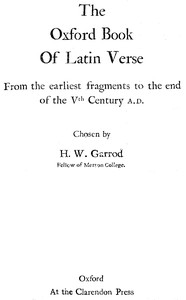
The Oxford Book of Latin Verse From the earliest fragments to the end of the Vth Century A.D.
Language: en1,259 downloads on Project Gutenberg
Subjects
In: Poetry
Public-domain ebook sourced from Project Gutenberg #38503.
Public-domain ebook
Language: en1,259 downloads on Project Gutenberg
Subjects
In: Poetry
Public-domain ebook sourced from Project Gutenberg #38503.
This volume is an anthology of Latin verse that deliberately avoids the grand genres of epic and drama, focusing instead on the shorter, lyric and fragmentary pieces that survive from the earliest ritual chants through the end of the fifth century A.D. The editor explains his selective approach in a preface dated September 1912, noting that he has excluded most didactic poetry, satire, and Christian verse, while allowing occasional “disloyal” excerpts, such as a lyric from Seneca’s tragedies or a passage from Rutilius’s Itinerarium, to preserve the integrity of a complete collection. The anthology opens with the primitive Saliar hymns, proceeds through the Saturnian meter of early priestly incantations, and concludes with an invocation to the goddess Clio, thereby framing the work between two historically grounded termini rather than imposing an artificial chronology.
The selection reflects a scholarly voice that balances rigorous textual criticism with a pragmatic concern for the reader’s experience, favoring metrically sound verses and eschewing overtly Christian material. Its style is academic yet readable, offering insight into the evolution of Latin poetry from ritual chant to the refined lyricism of the Augustan age. Students of classical literature, poets interested in the roots of Western verse, and anyone drawn to the interplay of Roman, Greek, and Italic influences will find this anthology both informative and inspiring.
The opening · free to read
Ergo alte uestiga oculis et rite repertum carpe manu, namque ipse uolens facilisque sequetur si te fata uocant.
Even outside Didactic Poetry I have allowed myself an occasional disloyalty to my own rule against excerpts. I have, for example, detached one or two lyrics from the Tragedies of Seneca. And, again, from the long and sometimes tedious Itinerarium of Rutilius I have detached the splendid apostrophe to Rome which stands in the forefront of that poem. These are pieces without which no anthology of Latin poetry would be anything but grotesquely incomplete. And after all we should be the masters and not the slaves of our own rules.
Satire finds no place in this book. Horace is represented only by his lyrics. Juvenal and Persius are not represented at all. The Satires and Epistles of Horace are books of deep and wide influence. They have taught lessons in school which have been remembered in the world. They have made an appeal to natures which teaching more profound and spiritual leaves untouched. By their large temper and by their complete freedom from cant they have achieved a place in the regard of men from which they are not likely to be dislodged by any changes of literary fashion or any fury of the enemies of humane studies. I am content to leave them in this secure position, and not to intrude them into a Collection where Horace himself would have known them to be out of place. Indeed, he has himself said upon this subject all that needs to be said.[1] Persius similarly, in the Prologue to his Satires, excludes himself from the company of the great poets. Nor can I believe that Juvenal has any place among them. In the rhetoric of rancour he is a distinguished practitioner. But he wants two qualities essential to great poetry--truth and humanity. I say this because there are critics who speak of Juvenal as though he were Isaiah.
My Selection begins with fragments of the Saliar hymns, and ends with the invocation of Phocas to 'Clio, reverend wardress of Antiquity.' If I am challenged to justify these termini, I will say of the first of them that I could not begin earlier, and that it is commonly better to take the beginnings offered to us than to make beginnings for ourselves. The lower terminus is not so simple a matter. I set myself here two rules. First, I resolved to include no verse which, tried by what we call 'classical' standards, was metrically faulty. Secondly, I judged it wiser to exclude any poetry definitely Christian in character--a rule which, as will be seen, does not necessarily exclude all the work of Christian poets. Within these limits, I was content to go on so long as I could find verse instinct with any genuine poetic feeling. The author whose exclusion I most regret is Prudentius. If any one asks me, Where is Merobaudes? where Sedulius? where Dracontius? I answer that they are where they have always been--out of account. Interesting, no doubt, in other ways, for the student of poetry they do not count. Prudentius counts. He has his place. But it is not in this Collection. It is among other memories, traditions, and aspirations, by the threshold of a world where Vergil takes solemn and fated leave of those whom he has guided and inspired:
Non aspettar mio dir più nè mio cenno.
I have spent a good deal of labour on the revision of texts: and I hope that of some poems, particularly the less known poems, this book may be found to offer a purer recension than is available elsewhere. I owe it to myself, however, to say that I have sometimes preferred the convenience of the reader to the dictates of a rigorous criticism. I have thought it, for example, not humane to variegate the text of an Anthology with despairing obeli: and occasionally I have covered up an indubitable lacuna by artifices which I trust may pass undetected by the general reader and unreproved by the charitable critic.
H.W.G.
Oxford, Sept. 2, 1912.
Latin poetry begins where almost all poetry begins--in the rude ceremonial of a primitive people placating an unknown and dreaded spiritual world. The earliest fragments are priestly incantations. In one of these fragments the Salii placate Leucesius, the god of lightning. In another the Arval Brethren placate Mars or Marmar, the god of pestilence and blight (lues rues). The gods are most dreaded at the seasons most important to a primitive people, seed-time, for example, and harvest. The Salii celebrated Mars at seed-time--in the month which bears his name, mensis Martius. The name of the Arval Brethren betrays their relation to the gods who watch the sown fields. The aim of this primitive priestly poetry is to get a particular deity into the power of the worshipper. To do this it is necessary to know his name and to use it. In the Arval hymn the name of the god is reiterated--it is a spell. Even so Jacob wished to know--and to use--the name of the god with whom he wrestled. These priestly litanies are accompanied by wild dances--the Salii are, etymologically, 'the Dancing men'--and by the clashing of shields. They are cast in a metre not unsuited to the dance by which they are accompanied. This is the famous Saturnian metre, which remained the metre of all Latin poetry until the coming of the Greeks. Each verse falls into two halves corresponding to the forward swing and the recoil of the dance. Each half-verse exhibits three rhythmical beats answering to the beat of a three-step dance. The verse is in the main accentual. But the accent is hieratic. The hieratic accent is discovered chiefly in the first half of the verse: where the natural accent of a disyllabic word is neglected and the stress falls constantly on the final syllable.[2] This hieratic accent in primitive Latin poetry is important, since it was their familiar use of it which made it easy for the Romans to adapt the metres of Greece.
The first poets, then, are the priests. But behind the priests are the people--moved by the same religious beliefs and fears, but inclined, as happens everywhere, to make of their 'holy day' a 'holiday'. And hence a different species of poetry, known to us chiefly in connexion with the harvest-home and with marriage ceremonial--the so-called Fescennine poetry. This poetry is dictated by much the same needs as that of the priests. It is a charm against fascinum, 'the evil eye': and hence the name Fescennine. The principal constituent element in this Fescennine poetry was obscene mockery. This obscenity was magical. But just as it takes two to make a quarrel, so the obscene mockery of the Fescennine verses required two principals. And here, in the improvisations of the harvest-home, we must seek the origins of two important species of Latin poetry--drama and satire.
There was magic in the house as well as in the fields. Disease and Death demanded, in every household, incantations. We still possess fragments of Saturnian verse which were employed as charms against disease. Magic dirges (neniae) were chanted before the house where a dead man lay. They were chanted by a praefica, a professional 'wise woman', who placated the dead man by reiterated praise of him. These chants probably mingled traditional formulae with improvisation appropriate to particular circumstances. The office of the praefica survived into a late period. But with the growth of Rationalism it very early came into disrepute and contempt. Shorter lived but more in honour was an institution known to us only from casually preserved references to it in Cato and Varro. This was the Song in Praise of Famous Men which was sung at banquets. Originally it was sung by a choir of carefully selected boys (pueri modesti), and no doubt its purpose was to propitiate the shades of the dead. At a later period the boy choristers disappear, and the Song is sung by individual banqueters. The ceremony becomes less religious in character, and exists to minister to the vanity of great families and to foster patriotism. In Cato's time the tradition of it survived only as a memory from a very distant past. Its early extinction must be explained by the wider use among the Romans of written memorials. Of these literary records nothing has survived to us: even of epitaphs preserved to us in inscriptions none is earlier than the age of Cato. So far as our knowledge of Latin literature extends we pass at a leap from what may be called the poetry of primitive magic[3] to Livius Andronicus' translation of the Odyssey. Yet between the work of Livius and this magical poetry there must lie a considerable literary development of which we know nothing. Two circumstances may serve to bring this home to us. The first is that stage plays are known to have been performed in Rome as early as the middle of the fourth century. The second is that there existed in Rome in the time of Livius a school of poets and actors who were sufficiently numerous and important to be permitted to form a Guild or College.
The position of Livius is not always clearly understood. We can be sure that he was not the first Roman poet. Nor is it credible that he was the first Greek teacher to find his way to Rome from Southern Italy. To what does he owe his pre-eminence? He owes it, in the first place, to what may be called a mere accident. He was a schoolmaster: and in his Odyssey he had the good fortune to produce for the schools precisely the kind of text-book which they needed: a text-book which was still used in the time of Horace. Secondly, Livius Andronicus saved Roman literature from being destroyed by Greek literature. We commonly regard him as the pioneer of Hellenism. This view needs correcting. We shall probably be nearer the truth if we suppose that Livius represents the reaction against an already dominant Hellenism. The real peril was that the Romans might become not too little but too much Hellenized, that they might lose their nationality as completely as the Macedonians had done, that they might employ the Greek language rather than their own for both poetry and history. From this peril Livius--and the patriotic nobles whose ideals he represented--saved Rome. It is significant that in his translation of the Odyssey he employs the old Saturnian measure. Naevius, a little later, retained the same metre for his epic upon the Punic Wars. In the epitaph which he composed for himself Naevius says that 'the Camenae', the native Italian muses, might well mourn his death, 'for at Rome men have forgotten to speak in Latin phrase'. He is thinking of Ennius, or the school which Ennius represents. Ennius' answer has been preserved to us in the lines in which he alludes scornfully to the Punica of Naevius as written 'in verses such as the Fauns and Bards chanted of old', the verses, that is, of the old poetry of magic. Ennius abandons the Saturnian for the hexameter. Livius and Naevius had used in drama some of the simpler Greek metres. It is possible that some of these had been long since naturalized in Rome--perhaps under Etrurian influence. But the abandonment of the Saturnian was the abandonment of a tradition five centuries old. The aims of Ennius were not essentially different from those of Livius and Naevius. But the peril of a Roman literature in the Greek language was past; and Ennius could afford to go further in his concessions to Hellenism. It had been made clear that both the Latin language and the Latin temper could hold their own. And when this was made clear the anti-Hellenic reaction collapsed. Cato was almost exactly contemporary with Ennius: and he had been the foremost representative of the reaction. But in his old age he cried 'Peccavi', and set himself to learn Greek.
The book keeps going
Reading is free forever. Sign up and watch scenes appear while you read.



Scenes Storieta drew for other classics.
New illustrated classics
Once or twice a month: the latest books to get full character casts, scene art, and free comic editions. No account needed.