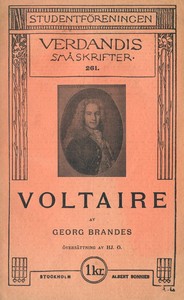
Two hundred years ago, on November 21st, 1604, a child emerged on the world at Paris. The baptismal register on the following day gave the name Francois Marie Arouet, and the youth afterwards christened himself Voltaire.(1) The flesh was so weakly that the babe was ondovc (the term employed for informal sprinkling with water at home), lest there might be no time for the ecclesiastical rite.
1. He was a younger son. The name Voltaire is, perhaps, an anagram of the Arouet 1. j. (le jeune) the u being converted into r, and the j into r. In like manner, an old college- tutor of his, Pere Thoulie, transformed himself, by a similar anagrammatic process, into the Abbe Olivet-- omitting the unnecessary h from his original name. This method of reforming a plebeian name into one more distinguished-looking seems not to have been uncommon in those times, as Jean Baptiste Pocquelin took the name of Moliere, and Charles Secondat that of Montesquieu.
Something may have been wrong with the performance of the sacred ceremony, since the child certainly grew up to think more of "the world, the flesh, and the devil" than of the other trinity of Father, Son, and Holy Ghost. His father was a respectable attorney, and his mother came of noble family. His godfather and early preceptor was the Abbe de Chateauneuf, who made no pietist of him, but introduced him to his friend, the famous Ninon l'Enclos, the antiquated Aspasia who is said to have inspired a passion in the l'Abbe Gedouin at the age of eighty, and who was sufficiently struck with young Voltaire to leave him a legacy of two thousand francs, wherewith to provide himself a library.
Voltaire showed when quite a child an unsurpassed facility for verse-making. He was educated at a Jesuit college, and the followers of Jesus have ever since reproached him with Jesuitism. Possibly he did imbibe some of their "policy" in the propaganda of his ideas. Certainly he saw sufficient of the hypocrisy and immorality of religious professors to disgust him with the black business, and he said in after-life that the Jesuits had taught him nothing worth learning.
He learnt a certain amount of Latin and a parcel of stupidities. But, indifferent as this education was, it served to encourage his already marked literary tendency. Voltaire is said to have told his father when he left college, at the age of fifteen, "I wish to be a man of letters, and nothing else." "That," M. Arouet is reported to have replied, "is the profession of a man who wishes to be a burden to his family and to die of starvation." He would have no such nonsense. Francois must study law; and to Paris he went with that intent. For three years he was supposed to do so, but he bestowed more attention on the gay society of the Temple, to which his godfather introduced him, "the most amusing fellow in the world," and which was presided over by the Abbe de Chaulieu. The time which he was compelled to spend in law studies, and at the desk of a procureur, was by no means lost to his future fortunes, whether in the pursuit of fame or wealth. During that hated apprenticeship he doubtless caught up some knowledge of law and business, which stood him in good stead in after years. He tells us that his father thought him lost, because he mixed with good society and wrote verses. For these he got sufficient reputation to be first exiled to Tulle, then to Sully, and finally thrown into the Bastille on suspicion of having written lampoons on the government. The current story tells how the Regent, walking one day in the Palais Royal, met Voltaire, and accosted him by offering to bet that he would show him what he had never seen before. "What is that?" asked Voltaire. "The Bastille." "Ah, monseigneur! I will take the Bastille as seen." On the next morning, in May, 1717, Voltaire was arrested in his bedroom and lodged in the Bastille.
After nearly a year's imprisonment, during which he gave the finishing touches to his tragedy of OEdipus, and sketched the epic Henriade, in which he depicts the massacre of Bartholomew, the horrors of religious bigotry, and the triumph of toleration under Henry IV., he was released and conducted to the Regent. While Voltaire awaited audience there was a thunderstorm. "Things could not go on worse," he said aloud, "if there was a Regency above." His conductor, introducing him to the Regent, said, repeating the remark, "I bring you a young man whom your Highness has just released from the Bastille, and whom you should send back again." The Regent laughed, and promised, if he behaved well, to provide for him. "I thank your Highness for taking charge of my board," returned Voltaire, "but I beseech you not to trouble yourself any more about my lodging."
In his first play, OEdipe, appeared the celebrated couplet:
"Nos pretres ne sont pas ce qu'un vain peuple pense!
Notre credulite fait toute leur science." (1)
1. "Our priests are not what foolish people suppose; all their science is derived from our credulity."
These lines were afterwards noted by Condorcet as "the first signal of a war, which not even the death of Voltaire could extinguish." It was at this period that he first took the name of Arouet de Voltaire. He produced two more tragedies, Artemire and Mariamne; a comedy, The Babbler; and prepared his world-famous Henriade. A portrait, painted by Largilliere at about this period, has often been engraved. It exhibits a handsome young gentleman, full of grace and spirit, with a smiling mouth, animated eyes, intellectual forehead, and a fine hand in a fine ruffle.
Hegira to England
The story of how Voltaire came to England is worth the telling, as it illustrates the condition of things in France in the early part of last century. Voltaire left France for England, which his acquaintance with Lord Bolingbroke induced him to desire to visit. It was his Hegira, whence he returned a full-fledged Prophet of the French. He went a poet, he returned a philosopher. Dining at the Duke of Sully's table he presumed to differ from the Chevalier de Rohan--Chabot, a relative of Cardinal Rohan. The aristocrat asked, "Who is that young fellow who talks so loudly?" "Monsieur le Chevalier," replied Voltaire, "it is a man who does not bear a great name but who knows how to honor the name he does bear."(1) It was insufferable that the son of a bourgeois should thus speak his mind to a Rohan. A few days afterwards, when again dining with the Duke, he was called out by a false message, and seized and caned by ruffians until a voice cried "Enough." That word was a fresh blow, for the young poet recognised the voice of the Chevalier. He returned to the Duke and asked him to assist in obtaining redress. His grace shrugged his shoulders and took no further notice of this insult to his guest. Voltaire never visited the Duke again, and, it is said, erased his ancestor's name from the Henriade. He was equally unsuccessful in seeking redress from the Regent. "You are a poet, and you have had a good thrashing; what can be more natural?" He retired, to study English and fencing; and reappeared with a challenge to the Chevalier, who accepted it, but informed his relations. It was against the law for a commoner to challenge a nobleman. Next morning, instead of meeting de Rohan, he met officers armed with a lettre de cachet consigning him to the Bastille. After nearly a month's incarceration he was liberated on condition that he left the country. Having no wish to spend a second year in prison, he had himself applied for permission to visit England. Voltaire felt keenly the indignity to which he had been subjected. In a letter of instruction written from England to his agent he says: "If my debtors profit by my misfortune and absence to refuse payment, you must not trouble to bring them to reason: 'tis but a trifle." Yet a book has been written on Voltaire's avarice.
1. Some of the accounts say that Voltaire said, "You, my lord, are the last of your house; I am the first of mine."
Voltaire was conducted to Calais and arrived in England on Whit-Monday, 1726. He landed near Greenwich and witnessed the Fair. All seemed bright. The park and river were full of animation. Here there was no Bastille, no fear of the persecution of the great or the spies of the police. He had excellent introductions. Bolingbroke he had met in exile at La Source in 1721, and he had learnt to regard the illustrious Englishman who possessed "all the learning of his country and all the politeness of ours." Voltaire, like Pope, may be said to have been, at any rate for a time, an eager disciple of the exiled English statesman. Now Voltaire was the exile; Bolingbroke, for a while, the host, at Dawley, near Uxbridge. But he had other English friends, notably Mr. (afterwards Sir Everard) Falkener, an English merchant trading in the Levant, from whose house at Wandsworth most of his letters are dated. For Sir Everard, Voltaire always retained the warmest feelings of friendship, and forty years later returned hospitality to his sons.
Voltaire spent two years and eight months in England, living during part of the time in Maiden Lane, Covent Garden, and during another part at Wandsworth. This visit was probably the most important event in his life. It was here he lit the torch of Freethought with which he fired the continent. Here he mastered the arguments of the English deists, Bolingbroke, Toland, Tindal, Shaftesbury, Chubb, Collins, and Woolston, which he afterwards used with such effect. Here he saw the benefits of parliamentary government. Here he imbibed the philosophy of Locke and the science of Newton. Indeed it may be said there is hardly one of Voltaire's important works but bears traces of his visit to our country. Yet of this momentous epoch of his life the records are scanty. When he grew famous every letter and anecdote was preserved, but in 1727 Voltaire was but a young man of promise. Carlyle, in the tenth book of his Frederick the Great, says: "But mere inanity and darkness visible reign in all his Biographies over this period of his life, which was above all others worth investigating." Messrs. J. C. Collins and A. Ballantyne have since done much to elucidate this noteworthy period.
Pope was one of the persons Voltaire desired to see. He had already described him as "the most elegant, most correct, and most harmonious poet they ever had in England." Pope could only speak French with difficulty, and Voltaire could not make himself understood. The result being unsatisfactory, Voltaire did not seek further company until he had acquired the language. An anecdote in Chetworth's History of the Stage relates that he was in the habit of attending the theatre with the play in his hand. By this method he obtained more proficiency in the language in a week than he could otherwise have obtained in a month. Madame de Genlis had the audacity to assert that Voltaire never knew English, yet it is certain he could, before he was many months in this country, both speak and write it with facility. By Nov. 16, 1726, he wrote to Pope, after that poet's accident while driving near Bolingbroke's estate at Dawley. In writing to his friend Thieriot, in France, he sometimes used English, for the same reason, he said, that Boileau wrote in Latin--not to be understood by too curious people. Voltaire is said to have once found his knowledge of English of practical use. The French were unpopular, and in one of his rambles he was menaced by a mob. He said: "Brave Englishmen, am I not already unhappy enough in not having been born among you?" His eloquence had such success that, according to Longchamp and Wagniere, the people wished to carry him on their shoulders to his house.