Public-domain ebook
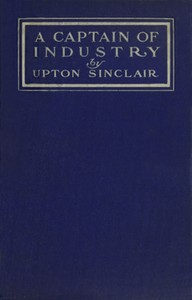
A Captain of Industry: Being the Story of a Civilized Man
Language: en359 downloads on Project Gutenberg
Subjects
In: Novels·American Literature
Public-domain ebook sourced from Project Gutenberg #39516.
Public-domain ebook
Language: en359 downloads on Project Gutenberg
Subjects
In: Novels·American Literature
Public-domain ebook sourced from Project Gutenberg #39516.
The opening · free to read
Every proverb, every slang phrase and colloquialism, is what one might call a petrified inspiration. Once upon a time it was a living thing, a lightning flash in some man's soul; and now it glides off our tongue without our ever thinking of its meaning. So, when the event transpired which marks the beginning of my story, the newspapers one and all remarked that Robert van Rensselaer was born with a silver spoon in his mouth.
Into the particular circumstances of the event it is not necessary to go, furthermore than to say that the arrival occasioned considerable discomfort, to the annoyance of my hero's mother, who had never experienced any discomfort before. His father, Mr. Chauncey van Rensselaer, was a respected member of our metropolitan high society, combining the major and minor desiderata of wealth and good-breeding, and residing in a twentieth-century palace at number four thousand eleven hundred and forty-four Fifth Avenue. At the time of the opening of our story van Rensselaer père had fled from the scene of the trouble and was passing the time playing billiards with some sympathetic friends, and when the telephone-bell rang they opened some champagne and drank to the health of van Rensselaer fils. Later on, when the father stood in the darkened apartment and gazed upon the red and purple mite of life, proud emotions swelled high in his heart, and he vowed that he would make a gentleman of Robert van Rensselaer,--a gentleman after the pattern of his father.
At the outset of the career of my hero I have to note the amount of attention which he received from the press, and from an anxious public. Mr. Chauncey van Rensselaer was wealthy, according to New York and Fifth Avenue standards, and Baby van Rensselaer was provided with an introductory outfit of costumes at an estimated cost of seventeen thousand dollars. I have a file of van Rensselaer clippings, and would quote the elaborate descriptions, and preserve them to a grateful posterity; but in the meantime Master Robert van Rensselaer would be grown up. I pass on to the time when he was a growing boy, with two governesses, and several tutors, and a groom, and such other attendants as every boy has to have.
Many lads would have been spoiled by so much attention; and so it is only fair to say at the outset that "Robbie" was never spoiled; that to the end of his days he was what is known as "a good fellow," and that it was only when he could not have what he wanted that anger ever appeared in his eyes.
Before many more years he went away to a great rich school, followed by the prayers of a family, and by the valet and the groom. There he had a suite of rooms, and two horses, and a pair of dogs with pedigrees longer than his own; and there he learned to smoke a brand of choice cigarettes, and to play poker, and to take a proper interest in race-track doings. There also, just when he was ready to come away and to take a great college by storm, Robbie met with an exciting adventure. This is a work of realism, and works of realism always go into detail as to such matters; and so it must be explained that Robbie fell desperately in love with a pretty girl who lived in the country near the school; and that Robbie was young and handsome and wealthy and witty, and by no means disposed to put up with not having his own way; and that he had it; and that when he came to leave school, the girl fled from home and followed him; and that there were some blissful months in the city, and then some complications; and that when the crisis came Robbie was just on the point of getting married when the curiosity of his father was excited by his heavy financial demands; and, finally, that Mr. Chauncey van Rensselaer and Mr. Robert van Rensselaer held an interview in the former's study.
"Now, Robbie," said he, "how long has this been going on?"
"About a year, sir," said Robbie, gazing at the floor.
"A year? Humph! And why didn't you tell me about it when you first got into trouble?"
"I--I didn't like to," said Robbie.
"To be sure," said the father, "boys have no business in such scrapes; but still, when you get in them, it is your duty to tell me. And so you want to get married?"
"I--I love her," said the other, turning various shades of red as he found the words sounding queer.
"But, Robbie," protested van Rensselaer père, "one doesn't marry all the women one loves."
Then, after a little pause, the father continued gravely, "Now, my boy, tell me where she is, and I'll arrange it for you."
Robbie started. "You won't be cross to her?" he pleaded.
"Of course not," said the father. "I am never cross with any one. It will all be settled happily, I promise you."
And so a day or two later it was announced that Robbie was going abroad for a year's tour; and when he sought Daisy to bid her good-by, it was reported that Daisy had left for the West--a circumstance which caused Robbie several days' anxiety.
My hero had gone abroad with a congenial friend a little older than himself, and the two stayed considerably over their time and enjoyed themselves immensely. They were plentifully provided with money, and Robbie had been told that he might do anything he liked, except get married. Therefore they wandered through all the cities of Europe, and saw all the beautiful things of the past, and all the gay things of the present. They stopped at the best hotels, and everywhere they went men bowed before them, and fled to do their bidding. Also there were many beautiful women who did their best to make Robbie happy. Robert was always a favorite with the girls, being a generous-hearted boy; he always paid for what he got, and paid the very highest prices in the market. He hired a pretty little yacht and took his friend and some congenial ladies for a beautiful trip upon the Mediterranean; and the sky was blue and the air warm, and Robbie stretched himself upon the deck, and basked in the sunlight and imbibed the soft fragrance of cigars and perfumes, and opened his heart and was happy as never in his life before.
After which the two travellers turned homeward again. There was some thought of Robbie's going to college; in fact, he hired chambers and started, at some expense. But it was only for a year, for Robbie had seen too much of the world to go back into a college chrysalis, and when it was evident that he could not get through his exams, he quit and came back to New York to stay.
And now you may behold him fairly settled at the task that fate had set before him,--that of being a gentleman like his father. No suggestions were offered--he managed it all in his own way. He took a suite of rooms, and furnished them so that they were a joy to the few eyes that ever beheld them, and were described by the society journals as one of the great educational influences of the city. Also he joined some of the clubs, and took a box at the opera, and did everything else that was necessary to a young man of his station. It must be understood that Robbie moved in the highest "circles," and was invited to dinner-parties and balls where only a choice two dozen could go. He had a reputation as a golfer and polo player, and was one of Newport's most far-famed yachtsmen; but of course it was upon his automobile records that his reputation really rested. He was daily to be seen speeding about the metropolis in his favorite machine, The Green Ghost, and now and then he sent his valet to court to pay his fines. On the one unfortunate occasion when he killed a little boy, the parents of the child were made happy forever by Robbie's princely munificence.
Also Robbie was making a reputation as a clubman and bon vivant. He knew a great deal about the world by that time; in fact, he knew everything there was to know about it; he had watched men, and understood them thoroughly, and all their ways. I would not have it imagined that he was a cynic, having already stated that he was the best-hearted fellow in the world; but he had a certain dry manner which was not to be imitated, and when he told an anecdote all the world stopped to listen. Robbie's stories were on all sorts of themes; but of course telling the truth about a man does not include telling his stories, even in the most realistic of biographies.
I would not have any one get the idea that my hero was bad; on the contrary, he was a member of a church whose orthodoxy and respectability were beyond cavil, and every Sunday morning he escorted some exquisitely gowned young lady of his set to listen to the famous eloquence of the rector, the Reverend Doctor Lettuce Spray. Also whenever the church gave a fair for the benefit of the Fiji Islanders, Robbie bought up all the shares left over in the raffles, and allowed the young ladies to pin bouquets in his button-hole. In addition he actually taught Sunday-school for six whole weeks, at a time when he was desperately enamoured of a certain young lady who did likewise; bearing bravely all the chaffing on the subject, he put away Les OEuvres de T. Gautier from his table and primed up every Saturday night and taught little boys how the good Lord made the fleece of Gideon to stay dry, and caused the soldiers to fall down to drink out of the stream, and did other unusual things calculated to impress little boys. Nothing came of this Sunday-school adventure, however, for van Rensselaer père was of the opinion that the young lady was nothing like the match Robbie ought to make; and so the young man's affections returned to an elegantly furnished flat on the West Side, where there was a liberal stock of champagne and fine cigars, and two young ladies of Robbie's acquaintance. Three or four evenings every week you might have seen his automobile, and the automobiles of several friends, drawn up before the door of this apartment-house, and might have heard evidence to the fact that Robbie was happy, as so good-hearted a young fellow deserved to be.
Enough has been told about Mr. Robert van Rensselaer's early period to indicate how those pleasant days were passed. Including the suite, the flat, and the clubs, the automobile, the yacht, and the polo stud, our friend's total expenses came to something in the neighborhood of three hundred thousand a year. And since, if he had been a master-poet, or an inspired musician, or a prophet with a new message for mankind, society would have paid about one one-thousandth of that sum to keep him alive, it is apparent that he was considered by society to be equivalent to one thousand such hypothetical persons.
This idyllic existence continued for about three years all together; and then one bright winter day Robbie was invited to pay a call upon his father at his office, where the two had a long and serious conversation.
"Now, Robbie," said van Rensselaer senior, "I haven't objected to your wild oats. That's every young fellow's right, and you haven't gone beyond the limit. I have always meant to give my son everything a gentleman ought to have; but now I think it's about time you'd had enough--don't you?"
The book keeps going
Reading is free forever. Sign up and watch scenes appear while you read.



Scenes Storieta drew for other classics.
New illustrated classics
Once or twice a month: the latest books to get full character casts, scene art, and free comic editions. No account needed.