
Public-domain ebook
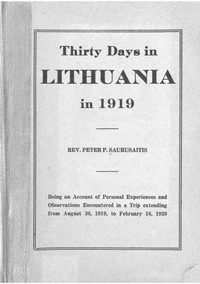
Thirty Days in Lithuania in 1919
Language: en245 downloads on Project Gutenberg
Subjects
In: Travel Writing·History - Modern (1750+)
Public-domain ebook sourced from Project Gutenberg #39888.
Public-domain ebook
Language: en245 downloads on Project Gutenberg
Subjects
In: Travel Writing·History - Modern (1750+)
Public-domain ebook sourced from Project Gutenberg #39888.
The opening · free to read
No matter how zealous patriots we may become in our adopted country, we should not forget altogether our native country. As I did not venture to visit Lithuania under the czar in 1910, when I was visiting other parts of Europe, I had a great desire to see my native land after the horrible war. Anyone would be anxious to visit his native country after thirty-six years' absence.
It was not an easy task for me to get a passport, as the United States government objected to letting me cross Germany. There being no American consul to Germany, our government would not take the responsibility of protecting me in that country. To avoid crossing Germany I was advised to ask for a passport through Denmark, Switzerland and Libow, which I did. But the consul at Denmark refused to put the visa on my passport unless I would send a cable to Denmark and get the consent of the government. I went to Washington to see the ambassador of Denmark personally, and he told me the same as the consul in New York. I then went to the State Department asking to have a change made in my passport which would permit me to go through France. This the State Department refused to do. Finally I went to Mr. Walsh, the Senator from Massachusetts, who sent his secretary with me to the State Department, and the change was made immediately. I then went to the French ambassador who put his visa on my passport, and I was ready to go by way of France. It took me about two months to get the passport.
On August 30th, 1919, I embarked from New York, West Fourteenth Street, on the ship Transatlantique La Lorraine, to Havre, France. The second night of my trip was very foggy. Our ship sounded fog horns all night. I felt that the ship was standing still and went on deck to see what had happened. I saw lights flashing in two places, as if two ships were sinking not far from each other. On making inquiry from the sailors I found that our ship had collided with a fishing boat from Canada, cutting it in two. Fortunately all the fishermen were saved by our ship. I saw them struggling in their small boats against the waves near our ship, till they came close and the ropes were let down, by means of which their small boats were pulled up to our ship and the men were saved. Next day a collection for the fishermen was taken up among our passengers which amounted to 3000 francs, and they were carried to Havre.
All the voyage to France was very stormy except one day at the beginning and one day near France. Eight days' trip from New York to Havre. Sunday night about eight o'clock we reached Havre, but we were obliged to sleep on the ship because Monday morning the inspectors came to examine all passports and luggage. It was after one o'clock in the afternoon when I reached Paris, where I called at the Lithuanian Legation to get directions for going by way of Switzerland and Libow to Lithuania. They directed me to cross Germany, assuring me that two Lithuanian priests just before me had crossed Germany without any trouble. They were ignorant of the fact that one of those priests lost in Germany two suit cases valued at about five hundred dollars. This priest told me this later, when I met him in Lithuania.
After remaining in Paris for three days, trusting the advice of the Lithuanian Legation, having seen all authorities of France and England, I started for Lithuania by way of Belgium, Cologne, Berlin, Eytkunen, to the first station of Lithuania, called Valkaviskis. My baggage was addressed by the same route and was carried on the same train. The train left Paris at 9:30 P. M. I had a chance to see some of the ruined cities of Belgium only in the morning--at night there was no possibility of seeing. When we came to the first station in Germany, Herbesthal, the German inspector of passports and baggage came to examine all trunks. I was told that the train would wait there at the station till all the trunks were carried back to the baggage room and the same train would carry them together with the passengers. But it was just to the contrary. When I returned from the station after unlocking and locking my trunk the train was gone, and my trunk was left in Herbesthal and my two suit cases were carried away to Cologne. I was obliged to take another train to Cologne. On the first train we were supposed to arrive in Cologne about 11:00 a. m.; on the second train we did not arrive until very near four p. m. I was afraid of losing both my suit case, portable altar and the trunk. The suit case and the portable altar I found in Cologne, with the help of the British soldiers, but my trunk, worth about five hundred dollars, is lost forever in Germany.
In Cologne I tried in vain to get breakfast about 4:30 p. m. If you do not drink beer you can get nothing to eat. Those who drink beer get some herrings without bread. Bread you get only once a day--two small thin slices, for supper. There are no dining rooms on the trains any more in Germany.
At 9:30 p. m. the train left Cologne for Berlin. Near Berlin the British inspector of passports told me: "I allow you this time to pass this way to Lithuania if you promise me not to return to America the same way." I said: "I will return by way of Libow." At 8:30 a. m. the train arrived in Berlin and left for Koenigsberg and Eytkunen at 9:30 p. m. The evening trip from Berlin was a regular torture to me which I shall never forget. It seems to me that on that evening there must have been some sort of revolution among the German parties. No matter what the classification of the ticket of any passenger, whether first, second, third or fourth class, there was no distinction in the service on the train. There was such a multitude of people flocking to the train, the stronger ones trampling over the weaker--especially the women. Even after the train was filled there were many left to stand and wait for another train. I had a second class ticket and was obliged to sit in the corridor on my suit case all night and the greater part of the day.
On the train were many armed German soldiers going to Latvia and a part of Lithuania. I heard them talking about Littau and Mittau Shauliai. After we passed Koeningsburg near the Eytkunen limit of Lithuania, some persons, one of them in the uniform of a soldier, began to speak the Lithuanian language. I asked them who they were and they told me they were Lithuanian officials returning from Berlin.
As soon as we arrived at Eytkunen, the German inspector asked to see our passports, and seeing on mine no visa by the German authority, I was told to return to Berlin for the necessary signature. I informed him that the consul of Switzerland in New York put the visa on my passport, permitting me to cross Germany. This was not sufficient as the Swiss consul had lost this authority at the termination of the war. Fortunately the Lithuanians whom I met at Eytkunen appealed to the Mayor of Virbalis, a city of Lithuania, who came to Eytkunen and obtained my release.
What a joy it was when a German soldier came to me while I was preparing to return to Berlin and told me to proceed to Lithuania. He led me to the train leaving for Vilkaviskis.
I was very anxious to see that part of the country for I was well acquainted with it thirty-six years ago. I saw that Lithuania is more devastated than Belgium. The Germans crossed through Belgium once only, while Lithuania had been the regular battlefield for the German and Russian armies. It was alternately captured and recaptured by the contending armies. When the Russian army was fleeing it destroyed whatever opportunity afforded, likewise the German army in its retreat carried everything in its wake, pillaged, burned and destroyed whatever it could not take. I noticed in particular one village which had been, only a few trees were visible. Numerous farm houses had been destroyed and burned to the ground. People now live in huts made partly of straw, old boards and clay. Not only the war, but nature has made changes in Lithuania. Rivers, such as the Seimena and Sirvinta, are only brooks. As we approached Vilkaviskis, my native town, the passengers called my attention to the station. My imagination failed to picture the rudely constructed hut as the same station of former years, which had been entirely destroyed by the invading army.
When I descended from the train, my sister's son-in-law, whom I had seen in Germany ten years ago, recognized me and conducted me to his home nearby. After spending a few happy hours with my friends and relatives I proceeded to the rectory. The next morning I was fortunate indeed to say mass for the first time in the church in which I was baptized. That afternoon at a meeting of the Lithuanian Sales Corporation, I lectured on American Lithuanians and Americans in general. Monday I went to Kaunas, or Kovno, to meet the [A]President of Lithuania, Anthony Smetona, to extend to him the congratulations of the Lithuanian Total Abstinance Organization of America.
[Footnote A: When I presented to the president of Lithuania, Mr. Anthony Smetona, the said recommendation of the Lithuanian Total Abstinance Organization in America, which is indeed a suggestion to introduce the prohibition of the manufacture and sale of intoxicating drinks in Lithuania--in other words, to imitate the American government in this respect, he expressed himself sufficiently in favor of it, but it is quite self-evident that he, as the President of Lithuania alone, cannot accomplish it. In our conversation he made a suggestion to me that I should strive to get a chance to speak publicly in Kaunas and in other places as much as possible on the subject of total abstinance, to which I expressed my hope that some of the priests of Kaunas, no doubt, would give me a chance there. Then the President said to me: "I have read in the Lithuanian American newspapers so much of you as the apostle of total abstinance among Lithuanians in America, I wish you would do the same here." In Lithuania the opportunity to speak to the people is offered only on Sunday, and in that case it is better in the church. So I had an opportunity on Sundays and delivered sermons in seven churches. In one a good number of priests as guests were assembled and listened to my sermon. They were pleased and at dinner table were discussing about American prohibition. A great many of them are boldly opposed to it; some even expressing their doubt about total abstinance. But they all were curious to know what those Lithuanians will do who were arrested and punished for manufacturing at home and selling intoxicants without the license of the government, after hearing of that sermon in the church. Lithuanians in Lithuania have learned from the Germans when they were in occupation, not only how to make intoxicants, but also soap, sugar, etc.
At first I considered it might be an insult to speak about total abstinance in Lithuania, after the horrible war; that those people could not get any attraction to intoxicants having witnessed such horrors of the war. But I was soon informed by some good souls of the necessity of total abstinance and of the dangers and temptations of many to intoxication. So I could not part with Lithuania without making an effort to sow the seed that might produce some good effects in the field of total abstinance.
The book keeps going
Reading is free forever. Sign up and watch scenes appear while you read.



Scenes Storieta drew for other classics.

New illustrated classics
Once or twice a month: the latest books to get full character casts, scene art, and free comic editions. No account needed.