Public-domain ebook
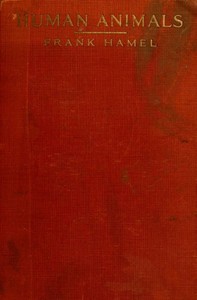
Human Animals
by Frank Hamel
Language: en1,549 downloads on Project Gutenberg
Subjects
In: Mythology, Legends & Folklore
Public-domain ebook sourced from Project Gutenberg #40772.
Public-domain ebook
by Frank Hamel
Language: en1,549 downloads on Project Gutenberg
Subjects
In: Mythology, Legends & Folklore
Public-domain ebook sourced from Project Gutenberg #40772.
Frank Hamel’s Human Animals is a scholarly survey of the folklore and occult beliefs surrounding shape‑shifting, especially the mythic “wer‑animal” who can become beast or man. The book opens with a systematic inventory of recorded instances, outlining the myriad ways transformation is said to occur, contact with a wer‑creature, donning its skin, magical ointments, enchanted girdles, or even specific rituals such as burning the animal skin or striking the brow with a silver bullet blessed in a chapel of St. Hubert. Hamel then sketches the legal and ritual consequences, noting that the penalty for being a wer‑animal is death unless the afflicted passes a trial involving boiling resin. From this introductory overview he promises a comprehensive treatment, moving through chapters that examine the metaphysical underpinnings, comparative myths, and the interplay of animal spirits, witchcraft, and totemic practices.
Written in a dense, early‑20th‑century academic voice, the work blends meticulous citation of sources like Frazer and Grimm with a prose style that is both erudite and descriptive. Its tone is that of a learned antiquarian rather than a sensationalist storyteller, making it most appealing to readers interested in anthropology, the history of magic, or comparative mythology. Scholars, folklore enthusiasts, and anyone fascinated by the cultural roots of lycanthropy will find Hamel’s exhaustive catalog of rites, legends, and legal customs a valuable, if demanding, reference.
The opening · free to read
From the abundant records and traditions dealing with the curious belief that certain men and women can transform themselves into animals I have collected a number of instances and examples which throw fresh light on the subject both from the point of view of folk-lore and occultism. The causes of transformation are various: contact with a wer-animal, touching what he has touched, wearing an animal skin, rubbing the body with ointment, slipping on a girdle, buckling on a strap, and many other expedients, magical and otherwise, may bring about the metamorphosis. Removing the skin, burning it, or piercing it with the stab of a knife, or the shot from a gun, so that blood is drawn, are among the best-known methods for causing the human shape to be resumed, but the stab should be on the brow or between the eyes, and the bullet should be made of silver and is all the better for having been blessed in a chapel of St. Hubert, otherwise the attempt to break the enchantment may fail. The penalty for being a wer-animal is death, but sentence is not passed until after some ordeal has been gone through, such as dipping the finger into boiling resin, innocence being established if the finger be drawn out unhurt. Any wound inflicted on the transformed animal is simultaneously inflicted on the human body, and in many other characteristics the nature of the wer-animal is similar to that of the witch or wizard.
In "Balder the Beautiful" Dr. J. G. Frazer, after telling many typical stories, endeavours to establish a parallelism between witches and wer-animals, the analogy appearing to confirm the view that the reason for burning a bewitched animal alive is a belief that the human being is in the animal, and that by burning you compel him to assume another shape. Since the sum of energy in the universe is held to be constant and invariable, the chain of transformation is thus continued, and form follows form, endlessly linked together. By some such theory the phenomena of life and death may be explained and the doctrine of immortality, usually applied only to the soul of man, can be reasonably extended to animals.
The belief that human and animal souls possess power and entity when externalised and apart from the living body is less widely held than that of persistence after death. It is one that bears strongly on the subject of animal transformation, as well as on the affinity which certain animals possess for some families, an affinity that is akin to totemism.
These preliminary suggestions will enable readers to grasp the scope of my book, which is intended to provide a comprehensive view of the subject and to familiarise them with the nature of the phenomena, even though it has been well-nigh impossible to classify and tabulate them fully, or to explain them satisfactorily.
I wish to express my thanks to Miss J. A. Middleton, author of "The Grey Ghost Book," for her kindness in reading my work in MS., and to her and others for suggesting interesting material.
The book keeps going
Reading is free forever. Sign up and watch scenes appear while you read.



Scenes Storieta drew for other classics.
New illustrated classics
Once or twice a month: the latest books to get full character casts, scene art, and free comic editions. No account needed.