Public-domain ebook
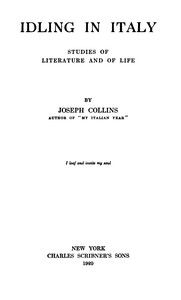
Idling in Italy: Studies of literature and of life
Language: en841 downloads on Project Gutenberg
Subjects
In: Italy·Essays, Letters & Speeches·Travel Writing
Public-domain ebook sourced from Project Gutenberg #41934.
Public-domain ebook
Language: en841 downloads on Project Gutenberg
Subjects
In: Italy·Essays, Letters & Speeches·Travel Writing
Public-domain ebook sourced from Project Gutenberg #41934.
The opening · free to read
There is something about the word Italy that causes an emotional glow in the hearts of most Americans. For them Italy is the cradle of modern civilization and of the Christian religion; the land where modern literature and science took their faltering first steps; the garden where the flowers of art first bloomed, then reached a magnificence that has never been equalled; the land that after having so long agonized under the tyrant finally rose in its might and delivered her children, carrying the principles of personal liberty to a new and noble elevation.
We have an admiration and affection for her that one has for a beautiful mother whose charm and redolency of accomplishment has increased with time.
In recent days there have been countless numbers on this western continent who feel that Italy has not had recognition from the world of her decision, her valor, and her accomplishment in shaping the World War to a successful end. Their interest in her has been quickened and their pride enhanced. They look forward with confidence to the time when she will again have a measure of that supremacy in the field of art and literature which once made her the cynosure of all eyes, the loadstone of all hearts. They hope to see her on a pedestal of political, social, and religious liberty worthy of the dreams of Mazzini, which shall be exposed to the admiring gaze of the whole world.
Already there are indications that she is making great strides in literature and a generation of young writers is forging ahead, heralding the coming of a new order.
It can scarcely be expected that Italy will achieve the position she had in the sixteenth century when Ariosto and Tasso, Machiavelli and Guicciardini, Bandello and Aretino, Cellini and Castiglione gave to literature an unrivalled supremacy. But it may be legitimately hoped that Italy will give up the servile admiration and imitation of foreign literature, and particularly of the French, which has been so evident during the past one hundred years, and at the same time while taking pride in her cinquecento accomplishments, even in the glories of her romantic period, realize that the vista which appeals to the children of men to-day is that obtained from looking forward and not backward.
I shall take a cursory glance over the literature of the nineteenth century preparatory to a survey of that of the twentieth, and note some trends and their significance: the dislocation of habitual ways of looking at things, of modes of thought, and of peeps into the future caused by the French Revolution; the outlook for the Italian people which seemed to be conditioned by the Napoleonic occupation; the imminence of a change in the way in which the world was likely to be ordered and administered suggested by the fall of thrones and governments. Such events could not fail to be reflected in the literature, particularly in imaginative literature as parallel conditions to-day are being reflected in literature, practically all of which is burdened with one topic: destruction of privilege and liberation from archaic convention that freedom and liberty shall have a larger significance--in brief, making a new estimate of human rights. With the powerful political and religious reaction that was manifest in all Europe after the French Revolution there developed a kind of contempt, indeed abhorrence, of antique art and literature because it was pagan and republican. The deeds of men, their longings, their aspirations, their loves, their hatreds, their melancholies; the beauties of nature, their potencies to influence the emotional state of man and particularly to contribute to his happiness; the liberation of mankind from galling tyranny and the universal happiness that would flow from further liberation were the themes of writers. These coupled with neglect and disdain of the heroes of antiquity, mythological and actual, caused a romantic literature which moved over Europe like an avalanche.
Italy contested every inch of the threatened encroachment upon its soil, and one of her poets, Vittorio Alfieri (1749-1803), who was most potent in resisting it, stood out to the end for the classic ideal. The period of his greatest mental activity and creativeness antedated the French Revolution, and although he was in Paris when it was at its height, its significance in so far as it is reflected in his writings was lost upon him. The same is true of Giuseppe Parini (1729-1799), who, during the last fifty years of the eighteenth century, had great vogue in Italy because of a poem called "Il Giorno" ("The Day"), in which "The Morning," "The Noon," "The Evening," and "The Night" of a Lombard gentleman was depicted to life and satirized.
The writings of Ugo Foscolo (1776-1827), which were given far higher rating by contemporaries than by posterity, foreshadowed the yielding of the classic traditions. But it was not until Cesarotti published a translation of MacPherson's "Ossian" that the floodgates of romance were opened for Italian literature. It was published at Padua (1763-1770). From that date imaginative and lyric literature of Italy began to devote itself to celebrating Italy's glorious past, to anticipating its future glories, to recounting and satirizing contemporaries, to pillorying the crimes of the tyrants who had fastened themselves upon Italy, and to exposing the corruptions of its governments.
Its promoters were obsessed with the idea that they must get away from the classic traditions. They sought to avoid the stern realities of life, its sufferings and its tragedies, and instead to depict beauty, pleasure, and happiness. They exalted the comedy and suppressed the tragedy of daily life.
It has often been said that Italian romantic literature had its origin in the Società del Caffè founded in Milan in 1746. But like many other dogmatic statements, it should not be accepted literally. "Il Caffè," published by the Accademia dei Pugni, was not romantic. Its iconoclastic attitude alone toward literary tradition may entitle it to a certain influence as a remote precursor of the romantic movement. The publication which fought the battle for Romanticism was the Conciliatore (1818-1819). Around it was constituted the Romantic school which produced Grossi and the others. Most of its followers in the beginning were Lombardians, therefore under the espionage of the Austrian Government. They were particularly Tommaso Grossi, the author of a romance of the fourteenth century entitled "Marco Visconti," of "Ildegonda," and "I Lombardi" (the best seller of its day), and Giovanni Berchet, who, though of French descent, was the most Italian of Italians, and spent a large part of his life in exile in Switzerland and England.
Soon the Romanticists were given a political complexion--they were resigned to their fate of being slaves to Austria--at least they were accused of this by the classicists. In truth they were digging the trenches in which were later implanted the bombs whose explosion put the Austrians to flight.
The predominant figure of the romantic period was Alessandro Manzoni (1785-1873). It is no exaggeration to say that he carried fame of Italian letters to greater numbers of people the world over than any writer save Dante. In 1827 he published a novel, "I Promessi Sposi" ("The Betrothed Ones"), which Walter Scott said was the best ever written, and this opinion was seconded by Goethe. He had shown his emancipation from classicism in two earlier plays, "Carmagnola" and "Adelchi," but it was not until the romance above mentioned and which earned his immortality that the romantic triumph can be said to have occurred in Italy. The men who carried the movement forward were Pellico, Niccolini, Grossi, D'Azeglio, Giordani, Leopardi, Giusti, and many others.
Among these the two who have been most favored by posterity are Silvio Pellico (1789-1854), principally because of the book in which he described his experiences in Austrian dungeons, "Le mie Prigioni" ("My Prisons"), and Leopardi, the intellectual giant of an arid epoch. The immortality of the former is founded in sentiment, of the latter in merit.
The poet who had greatest popularity in Italy at this time was Giuseppe Giusti (1809-1850), a satirist who chose verse as his medium. Although posterity has not given him a very high rating, his "Versi" are still widely read in Italy. His most appealing possession was ability to express in scannable, rememberable, singable verse what may be called every-day sentiment, to depict simple characters whose virtues every one would like to have, and to interlace political satires with the most panoplied, pathetic, patriotic sentiments. There is no safer way to sense to-day the sentiment of the first half of the nineteenth century of Italy than to read Giusti's poems. His "All'Amica Lontana" ("To the Friend Far Away"), "Gli Umanitari" ("The Humanitarians"), and his poems of spleen and of dream have a sprightliness and freshness as if they were of yesterday. Dario Niccodemi has recently borrowed the title "Prete Pero" from one of Giusti's poems for a comedy in which is depicted the conduct of a simple, honest, pious priest confronted with the conflict of ecclesiastical instructions and war problems. Giusti's brief life was a strange mixture of potential joy and actual suffering. In the vigor of his manhood he was seized by a painful disease, and to his sufferings was added the mental agony caused by fear of hydrophobia.
Giuseppina Guacci Nobile (1808-1848), of Naples, a contemporary of Giusti, had great popularity as a poetess of sentiment. She sang of love of country, of art, of husband, of children, of heaven, and when the sadness of the times was so profound that she needs must sing of hate she died.
Three poets of northern Italy must also be mentioned. Francesco Dall'Ongaro, who, though born in the Friuli, went to Venice when he was ten years old and lived for the rest of his life in the northern provinces, had a tremendous popularity in the revolutionary period of 1848 because of a little collection of lyrics called "Stornelli"; Giovanni Prati, of Dasindo, Trent, whose permanent reputation as a poet depends upon his ballads, became widely known through his poem "Edmenegarda"; and Aleardo Aleardi, born at Verona in the early years of the nineteenth century, whose best-known book, "Le Prime Storie," was extensively read.
The pillars of the romantic movement were soon erected in Central Italy by the writings of Leopardi, Niccolini, and Giusti.
Giacomo Leopardi (1798-1837) had a personality that has fastened itself upon Italy, even unto the present day, in a most extraordinary--one might even say, inexplicable--way. He was laconic, silent, morose, introspective, solitary, celibate. His filial love was readily overdrawn; he loathed his ancestral home and environment; he contended with ill health from infancy; he was denied the understanding friend, save one, whose behavior toward Leopardi has been criticised severely. He wandered solitarily about central Italy wrapped in the mantle of introspection and veiled in melancholy until 1833, when he settled at Naples, and there he remained four years, until he had attained his thirty-ninth year, when he died under most distressing circumstances. Ranieri, in his "Sette Anni di Sodalizio con Giacomo Leopardi," gives this description of Leopardi's appearance: he was of moderate height, bent and thin, with a fair complexion that inclined to pallor, a large head, a square, broad forehead, languid blue eyes, a short nose, and very delicate features; his voice was modest and rather weak; his smile ineffable and almost unearthly.
The book keeps going
Reading is free forever. Sign up and watch scenes appear while you read.



Scenes Storieta drew for other classics.
New illustrated classics
Once or twice a month: the latest books to get full character casts, scene art, and free comic editions. No account needed.