
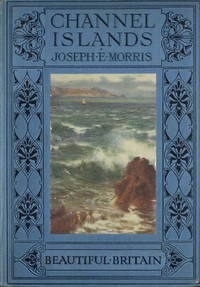
Public-domain ebook
The Channel Islands
Language: en401 downloads on Project Gutenberg
Subjects
In: Travel Writing·History - Other
Public-domain ebook sourced from Project Gutenberg #42495.
Public-domain ebook
Language: en401 downloads on Project Gutenberg
Subjects
In: Travel Writing·History - Other
Public-domain ebook sourced from Project Gutenberg #42495.
The opening · free to read
Elle est pour nous la France, et, dans son lit des fleurs, Elle en a le sourire et quelquefois les pleurs.
The impression thus gained is hardly diminished when we quit our lofty watch-tower and descend to the plain. The Channel Islands are doubtless destined in the end to be wholly anglicized, but the process is one of imperceptible transition. A curious French patois, that is really the last relics of the ancient Norman speech, is still the common language of the people. "It is probably," says Mr. Bicknell, in his charming Little Guide, "the nearest approach now extant to the French spoken at the time of the Norman Conquest by the Normans in England." French is also the language used commonly in the country churches; and it is strange to follow the familiar English liturgy rendered thus in a foreign tongue. The Channel Islands, though jealously retaining their ancient independence, and as separate in many respects from England as are Canada and Australia, are yet integrally part of the established English Church. The Reformation freed them from the yoke of Coutances only to subject them to the yoke of Winchester. French, too, or rather Norman, is the curious "Clameur de Haro" that plays so strange a part in the ancient island law. This is the regular machinery, in actions connected with real estate, to maintain the existing status in quo till the action can be fought out at length; and in Jersey is set in motion by the plaintiff himself, whereas in England it is necessary to invoke the Courts of Law. "At the disputed place the aggrieved person, in the presence of two witnesses, orders the aggressor or his agent to desist by exclaiming: 'Haro! Haro! Haro! A l'aide, mon Prince, on me fait tort.' After this he denounces the aggressor by exclaiming: 'Je vous ordonne de quitter cet ouvrage'; upon which, unless he desist instantly, he is liable to be punished for breach of the King's authority, the property being supposed to be under the King's special protection from the moment the 'cry' is made." Afterwards the action is tried; and, of course, if it prove that the complainant has invoked the "haro" wrongly (the word is said by some to be derived from the Frankish "haran," to cry out, or shout; but by others to be a corrupted form of "Ah Rollo"--the first Norman Duke--or "Ah Rou"--Oh my King), he is liable to be fined by the court. It is sometimes said that this strange process was in constant use in Normandy long before the arrival of Rollo and his fierce followers from the North.
French, again, is the architecture of the churches, that in some ways has no parallel in England. French, in many particulars, is the aspect of the towns, whose long rows of whitewashed houses, with their never-ending sun-blinds, testify to a warmth and sunlight too conspicuously rare in England. Actually French are many of the faces that one encounters in the streets or on the quays. The Channel Islands of late years have become a favourite touring-ground for summer visitors from France, who so seldom venture to cross the Channel to explore the beauties of England itself. The admirable little Guides Joanne now include a volume on the Iles Anglaises de la Manche. It is amusing, however, to read in this work that in one respect at least Jersey is still definitely English. "L'observation stricte du dimanche règne à Saint-Hélier comme en Angleterre. La ville déserte, avec ses boutiques fermées, offre un silence sépulchral." But the closed shops, if not the sepulchral silence, are now becoming common in France itself.
Mont Orgueil, where we stand, is not a bad starting-point from which to commence our exploration of Jersey. Happy, indeed, the visitor who arrives at this little port from France--and the steamer comes from Carteret in little more than an hour. Most English tourists, on the other hand, make Jersey first at St. Helier, which happens to be a town of considerable dulness, and compares very badly with St. Peter Port, in Guernsey. Mont Orgueil, however, may be reached at once from St. Helier by one of the two strange little railways that traverse the south coast of the island. The traveller should quit the train at the previous station of Gorey Village, and walk thence across Gorey Common to the Castle. This last, placed bravely on its boss of rugged rock, grows more and more impressive the nearer we approach it. Superb in situation, and unusually picturesque, this "hill of pride" has yet few features of real architectural interest. Parts of it date from about the end of the twelfth century, and the archæologist, of course, will gather "sermons" from every stone of it. But the ordinary sight-seer will be best delighted with the picturesque approach up long flights of steps past successive gateways; with the beautiful views of land and sea to be got from its towers; and, best of all, by the general view of the castle itself, dominating the little harbour that crouches below its walls. The structure is built of a soft-red granite, that is very pleasant to look on, and not least so in spring, when its broken walls are beautifully variegated with a thousand brilliantly orange wallflowers. One is reminded for a moment of the famous verse--
Mount Orgueil Castle is a lofty pile, Within the Easterne parts of Jersy Isle, Seated upon a Rocke, full large and high, Close by the Sea-shore, next to Normandie.
The poet then goes on to tell us how this stronghold is sometimes assaulted--but assaulted to no purpose--by sea and wind, "two boystrous foes":
For why this fort is built upon a Rocke, And so by Christs owne verdict free from shocke Of floods and winds; which on it oft may beate, Yet never shake it, but themselves defeate.
Less than a decade later and the walls of Mont Orgueil witnessed still blacker tragedy. The quarrel of the Bandinels and the Carterets is an ugly page of history that almost recalls in its unrelenting ferocity some of the worst clan "vendettas" of the Highlands. The trouble began, apparently, with the action of Sir Philip de Carteret, when Governor of Jersey, in attempting to deprive David Bandinel--the writer does not know the rights and wrongs of the quarrel--of part of his tithes as Dean of the island. Shortly after this the Civil War began in England, and the Channel Islands were immediately plunged into internecine strife. Philip de Carteret was leader of the Royalists, while Bandinel espoused the cause of the Parliament. The latter at first was triumphant, and Carteret and his wife, Elizabeth, were respectively besieged by the Parliamentary troops, the one in Elizabeth Castle, and the other in Mont Orgueil. Carteret was not quite sixty years old, but the severities of the siege were too great for him. There were wrongs, no doubt, on both sides; but the Puritans seem certainly to have acted on occasion with a surly lack of generosity that goes far to atone for the brutal persecution by the Royalist party of a man like Prynne. In 1644, when Colonel Morris was besieged in Pontefract, we read in the diary of Nathan Drake that "the enemy basely stayed all wine from coming to the Castle for serving of the Communion upon Easter Day, although Forbus (their Governor) had graunted p'tection for the same, and one Browne of Wakefield said if it was for our damnation we should have it, but not for our Solvation." Similarly, in Jersey, the Parliamentary Committee, of whom Dean Bandinel was one, refused the dying Sir Philip the last consolations of religion, and even (according to some accounts) the presence of his wife. This, too, after an appeal so piteous as might well have drawn
iron tears down Pluto's cheek, And made Hell grant what Love did seek.
Send me Mr. La Cloche, implored the sick man, "to administer unto me such comforts as are necessary and usual in these extremities, and that you would permitt my poor wife to come unto me, to doe me that last duty, as to close my eyes. The Lord forgive you, as I doe forgive you all." One is glad to read, however, in the Dictionary of National Biography, that Lady Carteret was in fact allowed to visit her husband, though almost at his very last gasp. "When the flooring of [St. Ouen's] church was altered 229 years afterwards, the body of Sir Philip enclosed in a leaden shell was uncovered, when it was found by the late Francis Le Maistre to be as white as wax, to have suffered very little decay, and to measure 6 feet 4 inches."
Presently the "jade Fortune" changed her favours, and the island was recovered for the King by Sir George Carteret, nephew and son-in-law to its former Governor. Dean Bandinel and his son James, the Rector of St. Mary's, were immediately clapped into prison in Mont Orgueil Castle, in the same cell that had formerly been occupied by Prynne. It does not appear that they were treated harshly, but Sir George was a man of cruel severity, and it may well be that they dreaded his further resentment. Anyhow, father and son resolved on a romantic escape. At about three o'clock in the morning, on the stormy night of February 10, 1644, they attempted to lower themselves from the window of their cell by a rope made of knotted napkins, sheets, and pieces of cord. "It is improbable that they had reconnoitred this place in the daytime," says Durell, "for had they been aware of the great elevation, they would never have made the attempt, as long as they were in their senses." Durell wrote in 1837, when the Tour de Mont (completed by Henry Paulet in 1553) was in existence for the whole of its height. This is said to have been 200 feet high, and the place of imprisonment of the Bandinels was immediately under its battlements. The building was supposed to be dangerous, and is now pulled down to its basement. Anyhow, when James Bandinel came to the bottom of the rope--he was the first to venture on the perilous descent--he found it was much too short. He allowed himself to drop on the rocks below, and was seriously hurt by the fall. His father, still less fortunate, was only halfway down, when the flimsy rope parted in two. He was thus dashed to the earth from a much greater height than his son, and was found lying there next morning in a dying condition. The son, after wrapping his insensible old father in his cloak, had attempted to make good his own escape. He was caught, however, a few days later, and conducted back in triumph to his cell. That same day the gates of Mont Orgueil had been opened to allow his father's body to be taken to the grave. David Bandinel was buried in St. Martin's Churchyard, two miles to the north-west of Mont Orgueil by the Faldouet road. I have searched for his grave on the east side of the churchyard, but there seems now to be no memorial, and the hawthorn that once marked it has vanished. It is said, however, to be in close proximity to the tombstones of Lucy and Mary Roche Jackson. His wife and son were afterwards laid by his side.
Mont Orgueil was unsuccessfully besieged by the French under the leadership of the Duc de Bourbon and the great Bertrand du Guesclin, Marshal of France (whose splendid tomb may still be seen in the north chapel of St. Laurent, at Le Puy), in 1374. It was in honour of this achievement that it received its present name from Thomas, Duke of Clarence, and brother of Henry V.
The book keeps going
Reading is free forever. Sign up and watch scenes appear while you read.



Scenes Storieta drew for other classics.

New illustrated classics
Once or twice a month: the latest books to get full character casts, scene art, and free comic editions. No account needed.