“Philip and Francis have no tombe, For great Christopher takes all the roome.”
Henry Holland, in his Monumenta Sepulchralia Sancti Pauli, 1614, tells us that there is “no doubt but the merry poet was the merry old man Stow himself.”
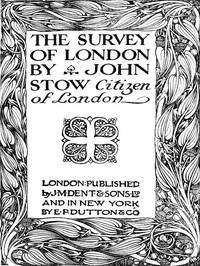
During the whole of his life Stow was indefatigable in his work, but he kept the best wine for the last. The first edition of the Survey of London was published in 1598, when he was past seventy years of age, but there can be no doubt that the whole of his previous life was a preparation for his great work. He always lived in London, and he was interested in every particular connected with his native city. Nothing of value in its history ever escaped him, and what he did not personally know, he often obtained information of from older men than himself. Some of his informants could tell what their fathers saw, so that their reminiscences often take us back to a long past time. It is this mixture of the personal remembrances of old men with his own memory of what he had seen, and his careful examination of places himself, in corroboration of tradition, which give such special value to his book.
Stow was always in search of information at first hand, and other authors were glad to avail themselves of his wide experience. Sir George Buck, when writing the History of Richard III., availed himself of Stow’s information that he had talked to old men who remembered that maligned king as “a comely prince.” Stow’s arrangement of his materials is admirable, and many modern topographers might imitate him with advantage. He himself acknowledged that the model for his Survey was his friend William Lambarde’s excellent Perambulation of Kent, 1576. Some of his explanations of the names of places, being grounded on historical evidence, are often of great value, but others are little better than crude guesses. This is not to the discredit of an author writing in the sixteenth century, but some modern writers, who ought to have a better knowledge of the origin of place names, have been unwise enough to quote these as possible etymologies. Mr. C. L. Kingsford, in his excellent edition of the Survey, has corrected most of these from trustworthy old documents. Stow improved his book in the second edition, published in 1603, two years before his death, but he omitted some passages in the first edition which are of interest to us, and which are noted in this edition.
Although it is chiefly the Survey which keeps Stow’s memory green in popular esteem, his other literary productions were highly appreciated by many distinguished contemporaries. He found a valuable patron in Archbishop Parker, for whom he edited some old chronicles. Among his many friends must be named Camden, Lambarde, Savile, Dr. Dee, Robert Glover, Somerset Herald, and Fleetwood the Recorder, who hung in his study a portrait of Stow inscribed, “Johannes Stowe, Antiquarius Angliæ.” The “antiquary” was very proud of this honour, and he told Massingham, who records the incident in his diary, that he thought himself “worthy of that title for his pains.”
Stow was born about the year 1525, and came of a good London stock, his grandfather and father were tallow chandlers, and supplied the church of St. Michael, Cornhill, with lamp oil and candles. Thomas Stow, the grandfather, died in 1527, and directed his body “to be buried in the little green churchyard of St. Michael, Cornhill, nigh the wall as may be by my father and mother.”
We have no particulars as to John Stow’s schooling, and Mr. Kingsford points out that his remarks in the “chapter of Schools and other houses of Learning,” respecting his seeing the scholars of divers grammar schools repair to the churchyard of St. Bartholomew, Smithfield, to a scholastic battle of disputation “hardly suggests that he took part in their exercises.”
The general opinion seems to be that he was self-taught, but it is strange that the son of a fairly well-to-do citizen should not have been a scholar at one of these free grammar schools. He did not follow his father’s business as a tallow chandler, but set up for himself as a tailor, in a house by the well within Aldgate, over which in later times a structure was erected widely known as Aldgate pump. Tailors have very generally had to put up with threadbare jokes on their trade, and Stow was no exception to the rule. Aubrey reports that Sir Henry Spelman said to Sir William Dugdale, “We are beholding to Mr. Speed and Stow for stitching up for us our English history,” and Aubrey adds, “It seems they were both tailors.” Stow was admitted to the freedom of the Merchant Taylors’ Company, on 25th November 1547, but was never called to the livery or any office in the company. At the same time he seems to have been highly esteemed, and was helpful to the company. He became a pensioner about 1578, and received four pounds a year until mid-summer 1600; this is sometimes called his “fee” and sometimes his “pension.” At the latter date, when he had fallen upon evil days, his pension was increased to ten pounds a year. This information is given by Mr. C. M. Clode, under the heading of “the loving brother of this mysterie, John Stowe,” in his Memorials of the Fraternity, 1875.
Stow’s first literary work is one that does him great credit, namely, the 1561 edition of Chaucer’s works, and subsequently he helped his “loving friend” Speght with notes from “divers records and monuments,” which that friend used in his edition of Chaucer published in 1597. He then turned to the publication of the results of his historical studies. In 1565, he brought out A Summarie of Englyshe Chronicles, which was frequently reprinted, also The Summarie abridged, first in 1566, and often reprinted. The Chronicles of England were published in 1580 and not reprinted. The Annals of England appeared first in 1592, other editions issued by Stow himself in 1601 and 1605. Editions continued by Edmond Howes were published in 1615 and 1631.
The Annals are much of a compilation, but Stow has made them interesting by the frequent insertion of his own opinions and remarks. The bibliography of these works is somewhat complicated, but Mr. Kingsford has set forth the dates and distinctive characters of the different books with much clearness.
Stow early fell into a discord with the chronicler Grafton, and the two belaboured one another in print, sometimes having resort to bad puns. Grafton sneered at the “Memories of superstitious foundations, fables foolishly stowed together,” and Stow replied by alluding to “empty townes and unfruitfull grafts of Momus’ offspring.”
Stow’s life was a stormy one, and he had much to endure, both publicly and in his own family, but his friends helped him through many of his difficulties. His younger brother Thomas was ungrateful, and a thorn in his side for many years.
In the early part of 1569 he was brought before the Lord Mayor for having in his possession a copy of the manifesto of the Spanish Ambassador on behalf of the Duke of Alva, but he seems to have been able to clear himself. The same matter was brought before the master and wardens of the Merchant Taylors’ Company. Mr. Clode remarks respecting this occurrence: “It is curious to note from the depositions of the several examinants how very shy of knowing much about the matter they appear to have been. The knowledge or memory of the nine taylors examined was too frequently failing them to bring guilt home to any brother of the craft.”
The trouble about the Alva manifesto drew the attention of the Queen’s Council to Stow’s library, and the Bishop of London (Grindal) was directed to have his house searched, and in reply the Bishop enclosed to Cecil a catalogue of “Stowe the taylour his unlawfull bookes,” amongst these are “a great store of folishe fabulous bokes of old prynt as of Sir Degory, Sir Tryamore,” etc., “old fantastical popish books printed in the old type.” Thomas Stapleton’s translation of Bede’s Ecclesiastical History is among the objectionable books. Nothing, however, came of all this pother.
Stow appears to have been fairly well off for some years of his life, when he spent a considerable amount of money on the extensive collection of manuscripts which he gathered together. This library was well known to and much appreciated by his fellow antiquaries. Many of the important documents are now in the British Museum and other public libraries.
He gave up his business in order to devote himself uninterruptedly to his antiquarian labours. Although these labours were much appreciated they were not profitable, and in consequence his means were very limited in his later years. His poverty was brought under the notice of James I., who acknowledged his claims, but instead of giving substantial aid the king granted letters patent, dated 8th March 1604, authorising John Stow and his deputies to collect money--the “voluntary contribution and kind gratuities” of the king’s subjects. This authority brought little money to the chronicler’s wasted coffers, and it was indeed a pitiful reward for the well-directed labours of a life-time.
Stow did not long survive this remarkable instance of royal favour. He died on the 6th April 1605, and was buried in the Church of St. Andrew Undershaft, Leadenhall Street, where his widow erected a terra cotta monument to his memory, this, which shows the man as he lived, is one of the most interesting monuments in the city of a past London worthy.
Edmond Howes, his literary executor, and continuator of his Annals, has left a vivid picture of the old chronicler, which completes this short notice of one of the most distinguished “Lovers of London.”
“He was tall of stature, lean of body and face, his eyes small and crystalline, of a pleasant and cheerful countenance; his sight and memory very good; very sober, mild, and courteous to any that required his instructions; and retained the true use of all his senses unto the day of his death, being of an excellent memory. He always protested never to have written anything either for malice, fear, or favour, nor to seek his own particular gain or vain-glory; and that his only pains and care was to write truth. He could never ride, but travelled on foot unto divers cathedral churches, and other chief places of the land to search records. He was very careless of scoffers, back-biters, and detractors. He lived peacefully, and died of the stone colic, being four-score years of age.”
Stow is greatly to be commended for printing as an appendix to his Survey, William Fitzstephen’s Descriptio Londoniæ, which originally formed an introduction to the same writer’s Life of Becket. It is a remarkable relic, and unique in its interest as a vivid description of London in the twelfth century. The author is carried away by his enthusiasm, and probably exaggerates the beauties of the city. But he is not blind to evils, for he wisely says, “The city is delightful indeed, if it has a good governor,” and we know that it did not always have that. The account of the sports of the citizens is particularly valuable, especially the early notice of the use of skates on the Moorfields during the winter time. We may be proud as Englishmen that no other city in Europe possesses so early a description of a mediæval town. It should be noted incidentally that “King Henry the Third” mentioned at the close of Fitzstephen’s account is not the king usually known by that name; but Henry the second son of Henry II. This prince was crowned during his father’s life-time; but died in 1182, seven years before his father. Matthew Paris also speaks of him as Henry III.