Public-domain ebook
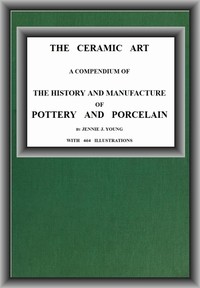
The Ceramic Art A Compendium of The History and Manufacture of Pottery and Porcelain
English2,165 downloads on Project GutenbergDownload EPUB
Public-domain ebook sourced from Project Gutenberg #43221.
Public-domain ebook
English2,165 downloads on Project GutenbergDownload EPUB
Public-domain ebook sourced from Project Gutenberg #43221.
The book is a scholarly compendium that seeks to answer the principal questions surrounding the history and manufacture of pottery and porcelain in a concise, lucid manner. Its opening pages explain that the author has distilled a vast and fragmented literature into a single, easily navigable volume, drawing on recent research and a wide range of foreign sources. The work is organized by geography and material, moving from the cradle of Egyptian ceramics through the traditions of the Near East, Asia, Europe, and finally the Americas, while interweaving technical discussions of composition, glazing, and kiln practices. Illustrations are drawn primarily from American collections, chosen to clarify the text and showcase exemplary pieces, and the author acknowledges the assistance of numerous collectors, museum curators, and manufacturers who contributed specimens and expertise.
Written in the measured, didactic voice of a late‑19th‑century scholar, the text combines detailed technical description with cultural commentary. Its style is formal yet accessible, avoiding overly specialized jargon while retaining academic rigor. Readers with a serious interest in the decorative arts, students of archaeology, museum professionals, collectors, or anyone fascinated by the evolution of ceramic technology and aesthetics, will find the systematic classification, extensive bibliography, and richly illustrated chapters especially rewarding.
The opening · free to read
In writing the present volume, the author’s object has been to answer as tersely and lucidly as possible the more important questions in connection with the history and manufacture of pottery and porcelain, and to bring the results of recent research to bear upon some of the unsolved problems of the “science of ceramics.” The literature of the subject is formidable in dimensions. Authors have divided the field into sections, and have in many cases presented learned and exhaustive special treatises. Notwithstanding the solid learning and critical acumen reflected in their pages, their form and voluminous character, however, detracted from their value as books for familiar and speedy reference, and left the acquirement of a general knowledge of the ceramic art a matter for wide research and prolonged study on the part of every reader and collector. The attempt has here been made to condense the leading points of the subject, to arrange them after a simple and easily intelligible method, and thus to present in one volume a comprehensive history. No hesitation has been shown in drawing upon foreign authors. Many of the later developments of the art have also been touched upon, and the results of the more recent efforts of artists and manufacturers have been illustrated and described. In treating of America, the author has endeavored to convey some idea of its wealth in materials and of the present condition and tendencies of the industry, and to do justice to those who have laid the foundation of its claim to recognition in the world of art.
The author has incurred obligations in many quarters for information and assistance. Mr. Samuel P. Avery, the Hon. Yoshida Kiyonari, Japanese Minister at Washington, General Di Cesnola, and the many private collectors whose cabinets are represented in the following pages, gave valuable aid both in obtaining illustrations and in other respects. Mr. Charles Edward Haviland, Mr. Theodore Haviland, and M. Bracquemond contributed many valuable hints upon technology and the manufacture and composition of different wares. The dealers of New York, Boston, Washington, Albany, and other cities took an active interest both in directing the author to collections and in furnishing specimens for illustration. Among American manufacturers, Mr. Thomas C. Smith, of Greenpoint; Mr. James Carr, of New York; Mr. Hugh C. Robertson, of Chelsea, Massachusetts; and Mr. J. Hart Brewer, of Trenton, are especially deserving of thanks for helping the author to a true insight into the past history, present condition, and prospects of the art in the United States.
In regard to the engravings, while it was, of course, found necessary in many cases to cull from the rich accumulations of ceramic treasures in Europe, in order to secure the proper illustration of the work, the preference has invariably been given to the collections of America. Such a course recommended itself for obvious reasons. It was thought that it would, in the first place, gratify those desirous of knowing where, in this country, the best representatives of the art of certain countries are to be found; and that, in the second place, it would direct artists where to study the best styles of decoration. One result of the author’s investigations in this matter has been the conviction that the American collector is cosmopolitan in his tastes, and that the American cabinet--in many instances the American tea-table--represents the amity of nations. The arts of all countries are found arrayed side by side in a profusion of which it would have been hard, a few years ago, to find a trace.
In choosing the pieces to be engraved, a threefold aim has been kept in view: the elucidation of the text, the representation of the greatest number of different wares by characteristic examples, and the introduction of as many beautiful works of art as possible consistently with the accomplishment of the two previous objects. The requirements of the student of decorative art have been fully considered, and due weight has been given to the fact that these requirements can be met better by the pencil than the pen.
In procuring specimens, the author has acknowledgments to express both to private collectors and to the curators of public institutions. Among the latter may be mentioned General Loring, of the Boston Museum of Fine Arts, and Mr. H. C. Hutchins, of the Metropolitan Museum of Art in this city, both of whom admitted the author to a close inspection of the collections under their charge, and personally superintended the taking of sketches and photographs. Similar favors were received from the trustees and Dr. M‘Leod, of the Corcoran Art Gallery; from Professor Baird and Mr. Cushing, of the Smithsonian Institution, in Washington; and from the officers of the United States Geological and Geographical Survey of the Territories. Mr. Edward Bierstadt of New York, and Mr. T. W. Smillie of Washington, also granted facilities and volunteered courtesies which proved invaluable.
Casual reference is made in the following pages to the marks of factories and artists, but after due deliberation it was decided not to make them the subject of special treatment or illustration. Several good manuals are already in the hands of the public, and a book of marks should never take any other form. It is comparatively useless unless easily portable and handy. Then, again, marks are, and always have been, imitated to such an extent that they are not the most trustworthy guides to the parentage of specimens. Collectors who buy pieces for the sake of the mark they bear may be deceived; those who buy for the sake of beauty may occasionally be mistaken; but a cultivated taste can never be deluded into finding beauty in the unbeautiful. The art, and not the mark, should be studied; and the fact that many of the finest and most highly valued specimens--Chinese, Japanese, Persian, Saracenic, Greek, Italian, and many modern wares--have no mark gives additional point to the observation.
If the present work should be found defective in certain points, it must be remembered that it could hardly be otherwise, considering its scope and limits. The author will be satisfied if, besides answering its primary purpose, it should increase the interest already awakened in the subject of which it treats, and lead students to appreciate and examine the collections at their command in this country.
RIGHT J. J. Y.
CONTENTS.
INTRODUCTION.
Advantages of the Study.--The Lost Origin of the Art.--Ascribed to the Gods.--Legends of China, Japan, Egypt, and Greece.--Keramos.--A Solution suggested.--How Pottery illustrates History.--How it explains the Customs of the Ancients.--Its Bearings upon Religion.--Examples from Egypt, Greece, and China.--The Art represented in Pottery.--Its Permanency.--As a Combination of Form with Drawing and Color.--Greek Art.--Its Merits and Defects.--The Orientals, and their Attention to Color.--Eastern Skill.--The Aim of Palissy.--The Highest Aim of the Ceramic Artist.--Painting on Porcelain.--Rules to be Observed in Decorating.--Where Color alone is a Worthy Object.--How the Art affords the Best Illustration of the Useful combined with the Beautiful.--Its Place in the Household.....Page 19
BOOK I.--NOMENCLATURE AND METHODS.
The book keeps going
Reading is free forever. Sign up and watch scenes appear while you read.



Scenes Storieta drew for other classics.
New illustrated classics
Once or twice a month: the latest books to get full character casts, scene art, and free comic editions. No account needed.