Public-domain ebook
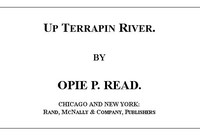
Up Terrapin River
Language: en382 downloads on Project Gutenberg
Subjects
In: Novels·American Literature
Public-domain ebook sourced from Project Gutenberg #44879.
Public-domain ebook
Language: en382 downloads on Project Gutenberg
Subjects
In: Novels·American Literature
Public-domain ebook sourced from Project Gutenberg #44879.
The opening · free to read
Terrapin River flows through the northern part of Arkansas. It is a small stream, winding its way among hills, which here with graceful slope, and there with rugged brows, overlook the smooth and gliding water. The water, when the current is not swollen, is so clear that the stream suggests the blended flow of countless dewdrops. The brooks that flow into Terrapin River seem to float down sun-beams, gathered in the hill-tops. Up the "hollow," the cow-bell's mellow clang floats away in slowly dying echo. The spring frog struggles through a miniature forest of rank ferns; the dew that has gathered on the rugged cliffs, trickles slowly down at the rising sun's command, like tears flowing along the wrinkles of a time-worn face. The soft air plays in gentle hide-and-seek, and the wild rose, leaning over, bathes its blushing face in the mirroring stream.
The country through which Upper Terrapin River flows is slow of agricultural development. Wild hogs abound in the cane-brakes, and on the hill-sides, where the dogwood saplings tangle their blooming boughs in perfumed network, the bristling deer kills the rattlesnake, and the wild turkey-gobbler struts in barbaric vanity. The shriek of the steam-whistle has never disturbed the blue jay's noontide nap, but the water-mill, with its rhythmic splash, grinds the corn which the whistling boy, barefoot and astride the sack, brings from over the hills.
The rankest of corn grows in the "bottoms," and on the uplands the passing breezes steal the fragrance of the mellowest of horse-apples. The people, the most of them at least, are rude of speech. To them the smooth sentences of culture are as over-ripe strawberries--unfit for use. The popular estimate of a man's mental strength in this neighborhood is based upon the roughness of his expressions. There are schools, but, save in the winter, they are ill attended, for the children, so soon as they are old enough to study, are also large enough to lend important aid to the cultivation of the crops. Among those people there are many peculiar characters. They know of no country but America, and are therefore strictly American. They have a half-formed idea that there is an outside world, and that Andrew Jackson whipped it; and tradition tells them that George Washington became involved in a quarrel with a king, an awful monster with horns of gold, boxed his jaws, knocked off his horns, and sent him howling home. Their ignorance is not of the pernicious sort, but of that humorous kind which finds bright laughter clinging to the very semblance of a joke.
One afternoon a boy was plowing corn in a field not far from the river. He was apparently about sixteen years old. Under the sunburn on his face there could be seen the soft color of sadness. He was tall and well formed, and his eyes, when he looked up to tell the time of day by the sun, showed, by their wide-open earnestness--if there be anything in such surmises--that his nature was deep and his disposition frank. He had reached the end of the row, near a rail fence along whose zig-zag way there ran a road half overgrown with briers, and, after turning his horse about, was fanning himself with his broad-brim straw hat, when someone called out:
"Halloa, young man!"
The plowboy looked around and saw a man standing on the road-side, with his arms resting on the top rail of the fence. The man was of uncommon height, and his hair and bushy beard were of such fiery red as they caught a sunbeam that came down through the wavering boughs of an oak, that the boy, bursting into a laugh, cried out: "Ef you ain't on fire, I never seed er bresh heap a burnin'."
"Well," the man replied, with a smile of good nature, "I'm not exactly burning, but I am pretty warm. Drive your horse up there in the shade, and come over and sit down awhile. You look as if you are tired, and besides, I feel disposed to talk to someone."
"I am tired," the boy rejoined, "but ef my uncle wuz ter ketch me er settin' erroun', he mout norate it about that I'm lazy.
"The fresh-stirred soil shows that you have plowed many furrows to day. If your uncle should circulate such a report," he added, with another good-natured smile, "I will go with you about the neighborhood, and assist you in correcting it. Come, for I know that in talking with me, you would not be ill-spending your time."
"Then I reckon you air a school-teacher."
"No, I am nothing--nothing but an everyday sort of wayward man."
"B'l'eve I'll jine you wunst jest fur luck."
He drove his horse into a fence-corner, where the tall alder bushes cast an inviting shadow, and joined the man, who had sat down with his back against a tree.
"What is your name?" the man asked.
"John Lucas. What's yo'n?"
"Sam Potter."
"You air a mighty big man, Mr. Potter, an' I reckon you'd be a powerful fine han' ter break a yoke uv steers. Peers ter me like ef I wuz ez strong ez you air, I'd go roun' the country an' grab er-holt uv cattle, an' hold em' jest fur the fun uv seein' 'em kick." He laughed boisterously, and then, when his many shouts had ceased, Potter saw the soft color of sadness, under the sunburn on his face.
"Just now you spoke of your uncle," said Potter; "do you live with him?"
"Yes, sir. My daddy an' mammy wuz drownded a long time ergo, in the river up yander at the fo'd. Did you come that er way?"
"Yes."
"Did you see er tall rock stickin' up outen the groun'?"
"I think I did."
"Wall, I put that rock thar when I got big ernuff. It's ther tombstone."
"Are they buried there?"
"No; they wuz washed erway, an' never wuz found, an' I put that rock thar becaze it is the place whar they wuz last seed. Thar's a caterpiller on yo' neck. Let me bresh him off."
"John, I rather like you."
"Much erbleeged ter you, sir."
"And I think that there is about you excellent material for the making of a man."
"I dunno; but that's what old Alf says."
"Who is old Alf?"
"He's a nigger; but lemme tell you thar ain't no whiter man nowhar than he is. He works fur my uncle, ur ruther sorter craps it on the sheers. He don't peer to kere fur nobody much but me an' his daughter, that's all crippled up with the rheumatiz, an' when she cries in the night with her pains, it don't make no diffunce how hard he has worked durin' the day, he takes her up in his arms, an' walks erbout with her till she hushes. That's what I call a white man. Whar air you frum, Mr. Potter?"
"From almost everywhere."
"Whar do you live?"
"Nearly everywhere."
"Ain't you got nothin' ter bind you down ter one place?"
"No."
"Then you ain't ez well off ez old Alf, fur he has got that little crippled-up gal."
Potter bent upon the boy a look of contemplation, and addressing himself more than his companion, said: "Ah, young man, you do not know the force of your own philosophy. From the woods there often come the simple words of truest wisdom. Any tie of life that holds us to someone, although at times its straining may fall little short of agony, is better far than slip-shod freedom from responsibilty."
"You talk like er preacher," said the boy. "Air you one?"
"No. As I told you, I am not anything, except a tramp. I used to be a sort of lawyer, but my neglect of law texts and love for other books drove my clients away. What's that noise?"
The book keeps going
Reading is free forever. Sign up and watch scenes appear while you read.



Scenes Storieta drew for other classics.
New illustrated classics
Once or twice a month: the latest books to get full character casts, scene art, and free comic editions. No account needed.