Public-domain ebook
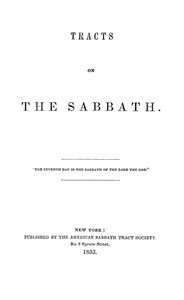
Tracts on the Sabbath
Language: en451 downloads on Project Gutenberg
Subjects
In: History - American·Religion/Spirituality
Public-domain ebook sourced from Project Gutenberg #45310.
Public-domain ebook
Language: en451 downloads on Project Gutenberg
Subjects
In: History - American·Religion/Spirituality
Public-domain ebook sourced from Project Gutenberg #45310.
The opening · free to read
6.--Twenty Reasons for keeping holy, in each week, the Seventh Day instead of the First Day. 4 pp.
7.--Thirty-six Plain Questions, presenting the main points in the Sabbath Controversy: A Dialogue between a Minister of the Gospel and a Sabbatarian; Counterfeit Coin. 8 pp.
8.--The Sabbath Controversy: The True Issue. 4 pp.
9.--The Fourth Commandment: False Exposition. 4 pp.
10.--The True Sabbath Embraced and Observed. 16 pp.
11.--Religious Liberty Endangered by Legislative Enactments. 16 pp.
12.--Misuse of the term "Sabbath." 8 pp.
13.--The Bible Sabbath. 24 pp.
14.--Delaying Obedience. 4 pp.
15.--An Appeal for the Restoration of the Bible Sabbath, in an Address to the Baptists, from the Seventh-day Baptist General Conference. 36 pp.
16.--The Royal Law contended for. By Edward Stennett. 60 pp.
17.--Vindication of the True Sabbath. By J. W. Morton, late Missionary of the Reformed Presbyterian Church. 60 pp.
[No. 1.]
REASONS FOR INTRODUCING THE SABBATH OF THE FOURTH COMMANDMENT
TO THE CONSIDERATION OF THE CHRISTIAN PUBLIC.
NEW YORK: PUBLISHED BY THE AMERICAN SABBATH TRACT SOCIETY, No. 9 Spruce-Street.
To search for the knowledge of our duty, as subjects of the Divine Government, is of the highest importance to Christians and to all men. "None of us liveth to himself, and no man dieth to himself," but "whether we live or die, we are the Lord's." It behooves us, therefore, to inquire, diligently and prayerfully, what God would have us to do, and how we may best glorify Him and save our generation? We should "seek wisdom as silver, and search for it as for hid treasure;" and we should labor after the knowledge, not only of some duties, but of every duty. "Obey my voice," is the reiterated mandate of Jehovah. To give full proof of our friendship for Christ, we must "do whatsoever he hath commanded us." Hence the importance of "searching the Scriptures," and of carefully pondering the testimonies of God. All should pursue this course, and feel this responsibility; for "every one of us shall give account of himself unto God." Hence the propriety and necessity, in many cases, of individuals dissenting from the views and decisions of collective bodies, and of minorities dissenting from majorities, and protesting against what they discover to be erroneous, unequal, and oppressive, in their resolves and measures--accompanying the same with a particular statement of their reasons. Such a course expresses a determination "not to be partakers of other men's sins," and is often the means of leading to investigation and reform.
This duty is acknowledged, and this privilege is claimed, by the observers of the seventh day, in relation to the subject of the Sabbath. Compared with the many who assume the Christian name, we are a _minority_--a _mere remnant_--and our reasons and motives for dissent from the great mass of believers, have been by most but partially, if at all, examined and weighed. Believing, as we do, that we have a full and explicit Divine warrant for our practice, we regard it as our duty to make renewed efforts to sustain the claims of the original Sabbath of God's appointment, enlighten the public mind, disarm our neighbors and fellow Christians of their prejudices, and promote a more thorough and impartial attention to this item of religious practice. The object of this Tract is not to enter fully upon the proofs of our doctrine and practice, but to invite attention to the subject, and impress the reader with the importance of correct views and of being sustained in Sabbath principles and efforts by an explicit warrant from God himself, in order the more effectually to secure the sanctification of this precious institution. Accordingly, we proceed to state some of our Reasons for introducing the Sabbath of the Fourth Commandment to the consideration of the Christian Public.
I. The general concession that the weekly Sabbath is a needful, wise, and valuable institution. Being a weekly rest from secular business and labor, it contributes to the health and vigor both of man and beast, encourages habits of cleanliness and decency, gives opportunity to cultivate the social virtues, makes man acquainted with man, and inspires a mutual regard for the interests of society; and, what is much more, it furnishes a proper and necessary season for mental improvement, public worship and instruction, private meditation and self-examination, the training up of children in the knowledge of God and of Heaven, and the deepening of our impressions of the value of time, and of the importance of preparing for eternity. These and similar considerations sensibly arrest the attention of sober and enlightened Christians, and secure a conscientious regard to the institution. This fact evinces the importance of being able to bring a divine sanction for a day so evidently desirable, and so generally esteemed--of being assured that it rests upon no doubtful authority, that it is not a mere human provision or a matter of expediency and accommodation, but that in observing it we are conforming to the clearly-manifested will of God. It is evident, that this consideration will give a value to the institution which can be supplied by no other, and secure a love and respect for it, and a delight in it, which nothing else can so effectually produce. Hence the question is presented, with a high and impressive claim to a true and definite answer, Is any other than the seventh day of the week sustained by the important and indisputable sanction of divine authority? If this, and this only, be the Sabbath of God's appointment, for general and permanent use, then, by the substitution of another day, the institution is shorn of its chief excellence and force--yea, it is virtually annulled. It no longer exists as God ordained it, for the express reason that he gave for it. This is a point which it becomes Christians seriously to look at.
II. It is not the province of Rulers, Bishops, or Councils, to legislate for the Church, and to bind the consciences of men in this or any other matter. Man's appointment of another day than the one contained in the Divine Enactment, does not make it the Sabbath of the Lord. It is only a human law, resting on human authority. Therefore, all attempts to enforce the observance of such an institution as being of divine authority, are calculated to mislead and ensnare souls. It is "teaching for doctrine the commandments of men." Our faith in this matter "should not stand in the wisdom of men, but in the power of God." The question is not, What day have men judged most proper? and, What reasons for the institution have they deemed the most appropriate? and, What day have civil rulers sanctioned by their decrees and penalties?--but it is, What day has God sanctified and blessed as a day of rest? It is manifest that no man should stop his inquiries until he is able to produce a clear divine warrant for his practice.
III. The fact that there is a lamentable division among professors of religion in regard to the true design of the weekly Sabbath, and the proper day to be observed, evinces the great importance of investigation, and of arriving at a correct knowledge of the Divine Will. This division is not likely to cease till a more general and thorough knowledge of the subject is obtained, and a deeper interest therein is felt. Can it reasonably be supposed that the whole church will become united in the observance of the first day of the week, if it is not the Sabbath of the Bible? Will it ever be the case, that God will have no witnesses for his own unrepealed and unadulterated institution?--none that shall call the Sabbath of his own appointment "a delight, the holy of the Lord, honorable, and shall honor him therein?" No--this will never be! Admitting that the Sabbath of the fourth commandment is still binding, there is no doubt that there will ever be a remnant, at least, who will conscientiously observe it. For his great name's sake, God will not suffer this prominent part of his law to be universally corrupted and profaned. And hence, if a preference continues to be given, as it is now, to a day which He has not designated and made holy, there will, of necessity, be a protracted division in the ranks of Zion, and the cause of the Redeemer will, on this account, continue to suffer. The faithful witnesses will unquestionably continue to prophecy, though clothed in sackcloth, and to bear testimony against the innovation. And no earthly power can prevent them. Resolves, and proscriptions, and gibbets, will not wholly suppress their testimony in favor of the Sabbath of the fourth commandment. Therefore, the occasion of the present division must be put away by a general return to the uncorrupted appointment of God, or the same cause for regret and mourning which now exists will continue to afflict the church. Let those who regard the unity and peace of Zion, seriously lay to heart this consequence.
IV. It must be admitted, that in so important a matter as a weekly Sabbath, our great moral Legislator has sufficiently declared his will to enable honest and impartial inquirers to arrive at a true result. If it would be reasonable to expect explicit information of his will concerning any point, it would certainly be reasonable to expect it concerning this, seeing the claims of this law would come in direct contact with the cupidity of men, and sensibly influence the arrangements of business and pleasure--yea, deeply affect the general interests of society. Were the data furnished, from which contemplative and well-disposed minds might infer a weekly Sabbath, its observance and its ends could not be extensively secured without an explicit warrant. Therefore, if God intended there should be a Sabbath--yea, we might with propriety say, that if he intended his religion and worship should be preserved in the world--he would have given an explicit law upon this subject--one, of course, which could be easily discovered, and the permanent obligation of which could be readily traced.
V. It is an obvious fact, that God has legislated upon this subject--that he has once made a law for the observance of the seventh day as a weekly Sabbath. He did this at the close of his creative operations. Excepting marriage, the seventh-day Sabbath is the oldest institution in the world. Moreover, God gave a new edition of this law at the promulgation of the Decalogue upon Mount Sinai, under circumstances of peculiar and awful solemnity and majesty; first pronouncing it, in connection with the other nine commandments, with an audible voice from the Mount, in the hearing of all Israel, amidst thunders, and flames, and tempests; and afterwards writing the entire ten on two tables of stone, for a perpetual rule of action. It is obvious, also, that obedience to this institution, so solemnly stated and defined, and enforced by so plain and adequate a reason, was regarded as a prominent item of duty, and received his marked approbation, whereas disobedience received his marked disapprobation. It is also clear, that good men throughout the times of the Old Testament were peculiarly zealous for this institution, and sought diligently to prevent its neglect or desecration, and to secure its legitimate advantages. Thus far all is plain, and is generally conceded.
The book keeps going
Reading is free forever. Sign up and watch scenes appear while you read.



Scenes Storieta drew for other classics.
New illustrated classics
Once or twice a month: the latest books to get full character casts, scene art, and free comic editions. No account needed.