Public-domain ebook
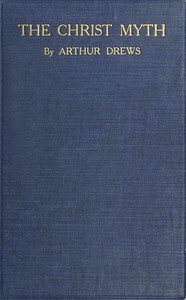
The Christ Myth
by Arthur Drews
Language: en927 downloads on Project Gutenberg
Subjects
In: History - Religious·Philosophy & Ethics·Religion/Spirituality
Public-domain ebook sourced from Project Gutenberg #45540.
Public-domain ebook
by Arthur Drews
Language: en927 downloads on Project Gutenberg
Subjects
In: History - Religious·Philosophy & Ethics·Religion/Spirituality
Public-domain ebook sourced from Project Gutenberg #45540.
The opening · free to read
"If you see a man undaunted by dangers, undisturbed by passions, happy when fortune frowns, calm in the midst of storms, will you not be filled with reverence for him? Will you not say that here is something too great and grand to be regarded as of the same nature as the trivial body in which it dwells? A divine force has descended here--a heavenly power moves a soul so wonderful, so calm, one which passes through all life as though it were of small account, and smiles at all our hopes and fears. Nothing so great can exist without the help of God, and therefore in the main it belongs to that from which it came down. Just as the rays of the sun touch the earth, but belong to that from which they are sent, so a great and holy spirit, sent here that we may have a more intimate knowledge of deity, lives indeed in our midst, but remains in contact with its source. On that it depends, thither its eyes are turned, thither its life tends: among men it dwells as a noble guest. What then is this soul? One which relies upon no goodness but its own. What is proper to man is his soul and the perfect reason in the soul: for man is a rational animal: therefore his highest good is reached when he is filled with that of which he is born."
With these words the Roman philosopher Seneca (4 B.C.-65 A.D.) portrays the ideally great and good man that we may be moved to imitate him. [14] "We must choose some good man," he says, "and always have him before our eyes; and we must live and act as if he were watching us. A great number of sins would remain uncommitted were there a witness present to those about to sin. Our heart must have someone whom it honours, and by whose example its inner life can be inspired. Happy is he whose reverence for another enables him to fashion his life after the picture living in his memory. We need some one upon whose life we may model our own: without the rule you cannot correct what is amiss" (Ep. 11). "Rely on the mind of a great man and detach yourself from the opinions of the mob. Hold fast to the image of the most beautiful and exalted virtue, which must be worshipped not with crowns but with sweat and blood" (Ep. 67). "Could we but gaze upon the soul of a good man, what a beautiful picture should we see, how worthy of our reverence in its loftiness and peace. There would justice shine forth and courage and prudence and wisdom: and humanity, that rare virtue, would pour its light over all. Every one would declare him worthy of honour and of love. If any one saw that face, more lofty and splendid than any usually found among men, would he not stand in dumb wonder as before a God, and silently pray that it might be for his good to have seen it? Then, overcome by the inviting grace of the vision, he would kneel in prayer, and after long meditation, filled with wondering awe, he would break forth into Virgil's words: 'Hail to thee, whoe'er thou art! O lighten thou our cares!' There is no one, I repeat, who would not be inflamed with love were it given him to gaze upon such an ideal. Now indeed much obscures our vision: but if we would only make our eyes pure and remove the veil that covers them, we should be able to behold virtue even though covered by the body, and clouded by poverty, lowliness and shame. We should see its loveliness even through the most sordid veils" (Ep. 115).
The attitude expressed in these words was widespread in the whole of the civilised world at the beginning of the Christian era. A feeling of the uncertainty of all things human weighed like a ghastly dream upon most minds. The general distress of the time, the collapse of the nation states under the rough hand of the Roman conquerors, the loss of independence, the uncertainty of political and social conditions, the incessant warfare and the heavy death-roll it involved--all this forced men back upon their own inner life, and compelled them to seek there for some support against the loss of outer happiness in a philosophy which raised and invigorated the soul. But the ancient philosophy had spent itself. The naïve interplay of nature and spirit, that ingenuous trust in external reality which had been the expression of a youthful vigour in the Mediterranean peoples, from which indeed the ancient civilisation was derived, now was shattered. To the eyes of men at that time Nature and Spirit stood opposed as hostile and irreconcilable facts. All efforts to restore the shattered unity were frustrated by the impossibility of regaining the primitive attitude. A fruitless scepticism which satisfied no one, but out of which no way was known, paralysed all joy in outward or inner activities, and prevented men from having any pleasure in life. Therefore all eyes were turned towards a supernatural support, a direct divine enlightenment, a revelation; and the desire arose of finding once again the lost certainty in the ordering of life by dependence upon an ideal and superhuman being.
Many saw in the exalted person of the Emperor the incarnation of such a divine being. It was not then always pure flattery, but often enough the expression of real gratitude towards individual Imperial benefactors, combined with a longing for direct proximity with and visible presence of a god, which gave to the worship of the Emperor its great significance throughout the whole Roman Empire.
An Augustus who had put an end to the horrors of the civil war must, in spite of everything, have appeared as a prince of peace and a saviour in the uttermost extremity, who had come to renew the world and to bring back the fair days of the Golden Age. He had again given to mankind an aim in life and to existence some meaning. As the head of the Roman State religion, a person through whose hands the threads of the policy of the whole world passed, as the ruler of an empire such as the world had never before seen, he might well appear to men as a God, as Jupiter himself come down to earth, to dwell among men. "Now at length the time is passed," runs an inscription, apparently of the ninth year before Christ, found at Priene not long ago, "when man had to lament that he had been born. That providence, which directs all life, has sent this man as a saviour to us and the generations to come. He will put an end to all feuds, and dispose all things nobly. In his appearance are the hopes of the past fulfilled. All earlier benefactors of mankind he has surpassed. It is impossible that a greater should come. The birthday of the God has brought for the world the messages of salvation (Gospels) which attend him. From his birth a new epoch must begin." [15]
It was not only the longing of mankind for a new structure of society, for peace, justice, and happiness upon earth, which lay at the root of the cult of the Emperors. Deeper minds sought not only an improvement in political and social circumstances, but felt disturbed by thoughts of death and the fate of the soul after its parting from its bodily shell. They trembled at the expectation of the early occurrence of a world-wide catastrophe, which would put a terrible end to all existence. The apocalyptic frame of mind was so widespread at the commencement of the Christian era that even a Seneca could not keep his thoughts from the early arrival of the end of the world. Finally, there also grew up a superstitious fear of evil spirits and Dæmons, which we can scarcely exaggerate. And here no philosophic musings could offer a support to anxious minds, but religion alone. Seldom in the history of mankind has the need for religion been so strongly felt as in the last century before and the first century after Christ. But it was not from the old hereditary national religions that deliverance was expected. It was from the unrestrained commingling and unification of all existing religions, a religious syncretism, which was specially furthered by acquaintance with the strange, but on that account all the more attractive, religions of the East. Already Rome had become a Pantheon of almost all religions which one could believe, while in the Far East, in Nearer Asia, that breeding-place of ancient Gods and cults, there were continually appearing new, more daring and secret forms of religious activity. These, too, in a short while obtained their place in the consciousness of Western humanity. Where the public worship of the recognised Gods did not suffice, men sought a deeper satisfaction in the numberless mystic associations of that time, or formed themselves with others of like mind into private religious bodies or pious brotherhoods, in order to nourish in the quiet of private ritualistic observance an individual religious life apart from the official State religion.
In the struggle of the two opposing worlds, according to Persian ideas, Mithras stood in the foreground, the spirit of light, truth, and justice, the divine "friend" of men, the "mediator," "deliverer," and "saviour" of the world. He shared his office with Honover, Ahuramazda's Word of creation and revelation; and indeed in most things their attributes were mingled. An incarnation of fire or the sun, above all of the struggling, suffering, triumphant light, which presses victoriously through night and darkness, Mithras was also connected with death and immortality, and passed as guide of souls and judge in the under-world. He was the "divine son," of whom it was said that Ahuramazda had fashioned him as great and worthy of reverence as his own self. Indeed, he was in essence Ahuramazda himself, proceeding from his supernatural light, and given a concrete individuality. As companion in creation and "protector" of the world he kept the universe standing in its struggle against its enemies. At the head of the heavenly host he fought for God, and with his sword of flame he drove the Dæmons of Darkness in terror back into the shadows. To take part in this combat on the side of God, to build up the future kingdom of God by the work of a life-giving civilisation, by the rendering fruitful of sterile wastes, the extinction of noxious animals, and by moral self-education, seemed the proper end of human existence. But when the time should have been fulfilled and the present epoch come to an end, according to Persian belief, Ahuramazda was then to raise up from the seed of Zarathustra, the founder of this religion, the "virgin's son," Saoshyant (Sraosha, Sosiosch, which signifies the Saviour), or, as it ran according to another rendering, Mithras himself should descend upon the earth and in a last fierce struggle overwhelm Angromainyu and his hosts, and cast them down into the Nether World. He would then raise the dead in bodily shape, and after a General Judgment of the whole world, in which the wicked should be condemned to the punishments of hell and the good raised to heavenly glory, establish the "millennial Kingdom of Peace." Hell itself was not to last for ever, for a great reconciliation was to be finally held out even to the damned. Then Angromainyu also would make peace with Ahuramazda, and upon a new earth beneath a new heaven all were to be united to one another in everlasting blessedness.
The book keeps going
Reading is free forever. Sign up and watch scenes appear while you read.



Scenes Storieta drew for other classics.
New illustrated classics
Once or twice a month: the latest books to get full character casts, scene art, and free comic editions. No account needed.