Public-domain ebook
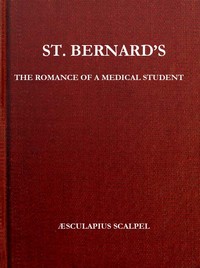
St. Bernard's: The Romance of a Medical Student
Language: en544 downloads on Project Gutenberg
Subjects
Public-domain ebook sourced from Project Gutenberg #46431.
Public-domain ebook
Language: en544 downloads on Project Gutenberg
Subjects
Public-domain ebook sourced from Project Gutenberg #46431.
The opening · free to read
“The learn’d physician, skilled our wounds to heal, Is more than armies to the public weal,”
he will, if he join the Army Medical Service, be looked down upon as only a superior kind of camp follower; that, as Dr. Abernethy used to say, if he does not claim his fees “while the tears are about,” he stands a good chance of losing them—so prone is an ungrateful country and a forgetful client to ignore the doctor when the danger is over. Notwithstanding all these drawbacks, however, he is assured he will find in the commendation of his own conscience an ever-sufficient reward for his devotion to suffering humanity. All successful professional men talk more or less of this pessimistic cant, like the Chancery judge who addressed a batch of newly admitted barristers-at-law in these terms: “Gentlemen, I cannot congratulate you on the profession which you have chosen. It is one in which very few succeed, and most of those who succeed wish they had failed.” The fact is, with professions and business, as with wives, men get just as much success as they deserve. These sentiments produce on the newly entered pupils their profoundest effect, but they are totally lost on the older ones, who declare them all humbug, and only intended to gull the public who will read them in the daily papers. Many of the seats are always filled by medical men who were educated in the hospital and school attached, who like to hear these time-honoured sentiments, reminding them of the happy period when they entered their Alma Mater with an enthusiasm long since damped by contact with the harsh world without. After the address, the prizes won by the successful students are usually distributed, and the teaching staff dine together, and the students go off to make a night of it, and show their new companions a little life about town.
On this particular first of October with which the present history is concerned, Harrowby Elsworth affiliated himself to the old and honoured medical school attached to St. Bernard’s Hospital, London—an hospital of high reputation, with a great and renowned school of medicine. He had distinguished himself at Oxford, and had selected his profession with the determination to do well in it, as he had done with all he had hitherto put his hand to.
He was a tall, slim fellow, standing six feet one in his stockings, so dark in the complexion that he might have passed for a native of Southern Europe. Although rather an Apollo amongst men, his graceful bearing and manly carriage were not the characteristics that gave him a passport at first hand to every one he met. It was the full, deep, earnest, clear, and honest eye, by which you could look into his soul. At a glance you took this in; there was no mistaking that, in the handsome young fellow who confronted you, there dwelt a spirit as brave, strong, and well braced as the frame that held it.
He had long since lost his mother—so long ago that he could but just recall her image as that of a tall, fair, delicate, blue-eyed woman, who had left her heart on his lips on the day she died.
His father was a retired Indian officer, who had seen much service, and had greatly distinguished himself in the Indian Mutiny. He had been severely wounded, and returned to England. Having recruited his health after several years’ stay in Cheltenham, he went back to the scenes of his former victories to occupy himself with investigations concerning the ancient literature of the Hindoos. He soon became so completely engrossed in this work, in which he hoped to cover himself with no less glory than in his campaigns, that he determined not to trouble himself with his native country or its affairs till he was able to announce to the learned societies of Europe the full fruition of his labours. He was a good man, and had been a kind and generous father, but became so enwrapped in his musty literature as to be practically dead to his duties to his only son, who, with all his kinsmen and friends of his fatherland, had become of very much less importance to him than the Sanskrit poem he had just discovered hidden in an image of a cross-legged Buddha serenely contemplating his epigastrium. So it having been finally settled that Harrowby was to be made a doctor, Major Elsworth arranged with his agents in England to pay the necessary fees, and settled on his son a sum of £300 a year for life, so that he might be free to pursue his own calling untroubled by the smaller anxieties of life till his profession should afford him a more ample subsistence. All these matters having been finally concluded, at the expense of much distraction from the Mahâbhârata research, the old gentleman felt disburdened of a long-standing load which had often impeded the even tenor of his work, and once more settled down to the classic heroes of Indian song and the legends of his mythic age. He felt that Harrowby was off his hands, and gave him very plainly to understand that, pending the completion of his great work on the Origin of the Mahâbhârata Poems, he must have no disturbing communications requiring any reply from him. Acting upon these hints, Harrowby very rarely troubled his father with any letters, and still more rarely had any replies to them. He made up his mind that when he had done all the work at the hospital he wanted to do, he would go out to his father, and spend a year or two with him before finally settling down to practice.
Elsworth entered the profession of medicine with a large stock of a commodity just now rather out of fashion with our young men. This limp and degenerate age seems unable to supply our youth with backbone enough to make them enthusiasts about anything beyond dress, the Opera Comique, and the quality of their tobacco. They adopt a profession without at all intending it shall absorb them; they consider it a sign of weakness to show a consuming interest in great subjects, and their energies are frittered away on the most trivial concerns. How many men enter the Church, not as though Heaven-sent messengers, but as affording them a pleasant way of getting on in life! As for a message to mankind or a call from God, it would be too much in the way of the Methodists and Salvation Army people to be consistent with their notions of propriety. What they have to offer the world may be taken or left without interfering in the least with their peace of mind. Hence so many empty churches, while our courts and alleys are full of folk perishing for lack of knowledge which nobody is sufficiently interested to impart, except in a perfunctory manner. It may be all very well for good Mr. Spurgeon to be consumed with desire to save souls; that sort of thing may be consistent with life in the “region of the three D’s” (Dirt, Dissent, and Dulness), over the water. But fancy anybody in Pall Mall or the Row being “so dreadfully in earnest, don’t you know!”
Such being too commonly the case with the Church, what can be expected of medicine? Inaugural addresses and the classic poets notwithstanding, it is rather too much, they say, to expect fellows in the nineteenth century to live up to an ideal guild of St. Luke. Now, by a beautiful instance of the law of compensation ever active in Nature, just as men are voting enthusiasm bad form, women are taking up the work men are too limp and too selfish to perform, and the spectacle is presented to the eye of hundreds of noble, clever, earnest, indefatigable women coming forward to fill the places which men decline, and leaving work more congenial to their habits and tastes, because men lack the energy and sympathy required to effect the necessary reforms. The salt of the earth is now fast becoming a feminine compound.
But the man of our story was a true man, not a nineteenth century sham; he had his enthusiasms and was not ashamed of them, was a sentimentalist if you will, and was proud of the title. He had an idea that no good had ever been wrought in this world except by enthusiasts and sentimentalists. He felt that sentiment was thought sublimed, and enthusiasm the holy fire that exalted it; his prayer was to be classed with the band of workers who had helped their world; and when he decided to enter the portals of a great hospital, it was not to make his account with fame, to exploit the poor and suffering for his own advancement, but just simply to have the satisfaction day by day of having, by even ever so little, diminished the awful sum of human misery. It was a perfectly contemptible ideal, an absurdly insufficient goal to nineteen-twentieths of the men who that day had enrolled their names in the books of the hospitals of the kingdom; but it was just simply his ideal and his goal, and he thought no other profession would help him to attain these like medicine. “The parson,” he used to say, “sees men at their best, the lawyer at their worst, but the doctor as they are. I will be a doctor.” Now of all things which Elsworth was not, least was he a prig; so that he had no idea of the very unusual nature of the impetus that was driving him on a medical career. He thought, in his ingenuous way, that such impulses moved his fellow-aspirants. This sentiment was to be modified.
In what a world he found himself! He had several friends on the staff, and some half-dozen of his fellow-students were more or less known to him; but to what others was he introduced! In a couple of hundred young men one looks for variety, one expects that some will be heedless, vain, indolent, or vicious, while others are earnest, industrious, and true. But who were these men he saw to-day, and how came they to adopt the sacred ministry of healing, the work of the great Physician Himself?
Rough, rowdy, vulgar, and decidedly unintellectual as many of them appeared, with all the characteristics of the fast man about town, the profession they had chosen to follow seemed likely to suffer at their hands, if these men were fair samples. It has long been the habit of society to view with great leniency the peculiarly Bohemian manners and customs of medical students. The very term has become the symbol for rollicking rowdyism that would be tolerated in no other class. Their boisterous mirth, rude violence, and disregard of the ordinary proprieties of civilized existence have become recognised as their appropriate conduct, partly no doubt because their lugubrious occupation at the schools needs relaxation of a pronounced kind, and especially perhaps that as they must when in actual practice become the gravest and most “respectable” of men, it must be permitted to them to compress into their student life the follies, the riotousness, and the highly flavoured pleasures that must suffice for the rest of their mundane existence.
Be this as it may, it is certain that from the patient in the hospital ward to the magistrate on the bench, conduct that would be considered in other men as intolerable and worthy of the severest punishment is in their case lightly passed over. On the part of the public at large, and on behalf of the men themselves, this is a great error, and has its foundation in a wrong conception, both of the work the students have to do and the sort of relaxation it requires. On behalf of the suffering humanity soon to become dependant upon such men for their help in sickness, a revolution in such a false system of education is no less urgently demanded. Unpleasant as the work of the dissecting, post-mortem rooms, and hospital wards, may seem to the outside world, its daily recurrence makes it so familiar to all engaged in it that it very soon ceases to be any more unpleasant than many other occupations. The men who take real interest in their work very speedily forget or do not recognise any of its disagreeables, while those who do not acquire this real interest in their occupation become mere hangers-on at the schools, and grow rowdy for want of better employment. The real students, with their hearts in business, do not seek or take such methods of unbending the bow; for the rest it should not be permitted them to insult their noble calling by behaviour that would disgrace savages in unexplored tracts of equatorial Africa.
The book keeps going
Reading is free forever. Sign up and watch scenes appear while you read.



Scenes Storieta drew for other classics.
New illustrated classics
Once or twice a month: the latest books to get full character casts, scene art, and free comic editions. No account needed.