A Literal Application to the Play of Hamlet of the Cipher System of MR. IGNATIUS DONNELLY.
By J. GILPIN PYLE, Assistant Editor of The Saint Paul Pioneer Press.
“As I do live by foode, I met a foole, When I did heare The motley Foole, thus morall on the time, My Lungs began to crow like Chanticleere, That Fooles should be so deepe contemplative; And I did laugh, sans intermission, An houre by his diall. Oh noble foole, A worthy foole: Motley’s the onely weare.” AS YOU LIKE IT: II., 7.
Saint Paul. The Pioneer Press Co. 1888.
Copyright, 1888. BY J. GILPIN PYLE. ALL RIGHTS RESERVED.
Author’s Note.
A considerable portion of the contents of these pages appeared first as an editorial article in the Pioneer Press. By request of many friends, this practical application of Mr. Donnelly’s cipher system to six pages of Hamlet is presented, revised and enlarged, to the general public.
J. G. P.
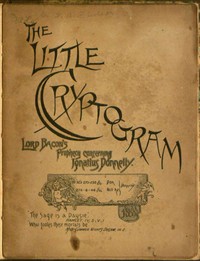
The Little Cryptogram.
“The Great Cryptogram,” the monumental work in which Mr. Ignatius Donnelly essays to prove that the so-called Shakespeare plays contain a cipher story, discoverable by a system which he has worked out with infinite labor, is at last in the hands of an expectant public. No book so thoroughly advertised has appeared for many a year. For months and months the eye has been assailed by paragraphs and pages in the literature of two worlds, contending for or against the existence in the Shakespeare plays of a cipher that would assign the honor of their authorship to Lord Bacon. It has been admitted on all sides, and declared by Mr. Donnelly himself, that the appearance of this volume would rid the world of a delusion forever, and stamp the successful explorer of the mystery with undying fame, or write him down as the most daring and stupendous literary fraud that all the ages have produced. The author has challenged the test. It is his due that the results of his labor should have a candid and impartial investigation.
Those who are interested in knowing whether “The Great Cryptogram” is a record of discovery or a record of ingenious and plausible invention may pass quickly over the first book of the volume, which deals with “The Argument,” because in this Mr. Donnelly does not lay claim to originality. It is devoted to a careful and systematic marshaling of the circumstantial evidence used in the past to prove that the historical Shakespeare did not write the plays commonly ascribed to him. There is, as every literary man knows, a great deal of evidence that will pass muster under this head. There is an inconsistency between such fragments of a life of Shakespeare as have come down to us, and the experiences and the acquirements which we should declare indispensable to the writing of that matchless drama. It is dwelt upon but lightly here; not because any part of Mr. Donnelly’s work should be slighted, but because it is the cipher discovery by which he must stand or fall. For the same reason it will be unnecessary to deal with the historical objections, equally numerous and unanswerable, to the theory of Baconian authorship. That Mr. Donnelly has made out a plausible and not unreasonable case, no one will deny. As a collector and editor of the works of others; as a curator of the museum in which patches and shreds of fact and theory, gathered from diverse sources, are to be arranged and classified in orderly succession, Mr. Donnelly is a master. His “Atlantis” and “Ragnarok” gave proof of a marvelous memory and a rare ability to dovetail disconnected and discordant facts into a homogeneous whole, such as few can equal. Able to forget what does not accord with his preconceived theory, blessed with a memory as serviceable in dismissing as in retaining, and thoroughly possessed, for the time being, with a conviction that he is pursuing truth, he is the most dexterous of workmen. It is only natural, therefore, that his cumulative evidence from history and fable and gossip should be well presented. He has browsed in the pastures of Delia Bacon and Judge Holmes and Appleton Morgan and Mrs. Potts. He has republished the best of their work, joining the crevices skillfully, and the reader will find himself entertained if not converted by this argument, which occupies more than half of the bulky volume devoted to the cryptogram. This, however, is a well-trodden field. These arguments are but a rehearsal of the clever counsel’s brief. Not to these, but to the Cæsar of the cipher, has Mr. Donnelly appealed for judgment. To the cipher and its mathematical demonstrations he shall go.
Mr. Donnelly claims that there is concealed in the plays not only a declaration that Bacon wrote them, but a detailed history of the times. This is to be read by means of a word cipher, depending on a series of fixed numbers. The root numbers which he gives as the starting point are 505, 506, 513, 516, 523. These numbers are combined, at pleasure, with a vast number of “modifiers.” The latter consist of the number of words in a column, page or subdivision of the play selected; and of these numbers plus or minus the hyphenated and bracketed words. By this method the first two pages attacked yield him the following thirty-four “modifying” numbers: 27, 28, 29, 30, 31, 32, 50, 51, 62, 63, 79, 80, 90, 91, 141, 142, 167, 168, 169, 189, 208, 209, 211, 212, 218, 219, 237, 240, 283, 284, 291, 294, 301, and 302. Counting forward or backward, at pleasure, from the top or the bottom of each page, and from the beginning or the end of each scene, he finds himself directed to the specific words that tell the tale; each new count supplying a new “modifier.” He does not tell whence he derives his root numbers—and the world loses little by that—because he is informed by his publishers that there is nothing in our law of copyright to prevent some ingenious fellow, less conscientious than himself, from studying out his whole system, applying it to the rest of the plays, and bursting upon the world with the remainder of the story, which Mr. Donnelly wants to reserve for a future volume and future profits. How well grounded were his apprehensions the appearance of this lesser cryptogram may serve to show. Therefore he wraps himself in congenial mystery, and both his root numbers and his modifiers must be taken on faith. It is hard for the average man, at this point, to repress his scepticism, and to refuse straightforward treatment to a man who advertises for two years a great discovery and then reserves it for the future. There is a strong flavor of the Keeley motor about the process. But not thus unjustly shall the public deal with Minnesota’s gifted son. We, the people, want to get at the bottom of this cipher, and re-read our history of the Elizabethan era and its literature.
The first step is to take an actual illustration of the cipher and Mr. Donnelly’s use of it, in order that the public may see just how the thing works. The names “Shakespeare” and “Cecil” do not occur in the plays. To obtain them, Mr. Donnelly’s arithmetical process points him to the words “shakes” and “peere,” and to the other words “seas” and “ill;” combining the former he gets Shakespeare, and the latter give him Cecil. Now if the reader is the happy possessor of a copy of “The Great Cryptogram,” let him turn to page 718 as a base of operations. If his library is not so enriched, what he finds here is ample for purposes of illustration. This chapter deals with the revelations growing out of the root number 516, judiciously modified. There are 167 words in the second column of page 74 of King Henry IV, following the subdivision made by a stage direction. There are 21 words in brackets, and one hyphenated word, making 22 in all. Add 22 to 167, and you have 189. Subtract 189 from 516, and you have 327. This 327 is combined with other numbers, derived from previous operations; the number of words on an antecedent page or a former column, or some of the “modifiers” that wait modestly till their assistance is needed. Out of these additions and subtractions, perfectly arbitrary in their nature, comes finally a number which directs the searcher to a word on page 76. How intricate are these mathematical operations will be perceived only upon examination. Therefore, the following, taken literally from pages 718, 719, is subjoined as fairly illustrative of the cipher gambols:
WORD PAGE AND COLUMN 516-167=349-22_b_ & _h_=327 182 76:1 Seas} 498-327=171+1=172+10_b_ & _h_=182 516-167=349-22_b_ & _h_=327 447-327=120+1= 121 75:1 ill} 516-167=349-22_b_ & _h_=327-30=297-50 (76:1)= 247 76:2 said 516-167=349-22_b_ & _h_=327-284=43 408 75:1 that 447-43=404+1=405+3_b_=408 516-167=349-22_b_ & _h_=327-254=73-15_b_ & _h_=58 391 76:1 More} 448-58=390+1 = 391 516-167=349-22_b_ & _h_=327-50=277-50 226 74:1 low} (74:2)=227-1_h_=226 516-167=349-22_b_ & _h_=327-254=73-50 22 76:1 or (76:2)=23-1_h_=22 516-167=349-22_b_ & _h_=327-30=297-254=43-15_b_ & 28 75:2 Shak’st} _h_=28 516-167=349-22_b_ & _h_=327-248=79 (121) 75:1 spar} 193-79=114+1=115_b_ & _h_=(121) 516-167=349-22_b_ & _h_=327-254=73-15_b_ & _h_=58 441 76:1 never 498-58=440+1=441 516-167=349-22_b_ & _h_=327-50=227-7_b_ & _h_= 220 76:2 writ 516-167=349-22_b_ & _h_=327 327 76:1 a 516-167=349-22_b_ & _h_=327-145 (76:2)=182 317 76:1 word 498-182=316+1=317 516-167=349-22_b_ & _h_=327-193=134 115 74:2 of 248-134=114+1=115 516-167=349-22_b_ & _h_=327-254=73-15_b_ & 53 74:1 them _h_=58-5_b_=53
Before I proceed to the obviously fair and conclusive test of applying the same numbers and the same method elsewhere, there are some reflections to be noted, which will occur spontaneously to almost every reader. In the first place, the cipher seems, like the man who claimed that he never borrowed the kettle, that he had returned it and that it was cracked when he borrowed it, to prove too much. If it led directly to important disclosures concerning the authorship of the plays or historical events of the time when they were written, and to these alone, it might lay claim to credibility. But this cipher, prepared by Bacon to prevent Shakespeare from stealing his laurels, requires the appropriation of page after page to describe minutely Shakespeare’s personal appearance. A glance at the sample printed will show how great the labor required to encase such a story, by mathematical rule, in the body of the plays. Yet this labor Bacon must have undergone, to tell the coming ages that “He,” Shakespeare, “is troubled with several dangerous diseases; he is subject to the gout in his great toe; and I hear moreover he hath fallen into a consumption.” The spectacle of Bacon, holding weary vigil to complete, at infinite labor, the cipher story, and devoting hours to the construction of a play in which the movement of the plot, the fate of the personæ and the majesty of the dialogue should be unconsidered trifles, subordinated to the all-important infolded chronicle of the fact that Shakespeare had the gout in his great toe, is one for gods to weep at. Nor was this the limit of the Baconian genius. Complicated as is the work of reading this involved tale by the cipher’s help, it bears no comparison to the work of incorporating originally that story in the plays. To write the Donnelly memoirs first, and then so to write the dramas that each word of the one shall fit into its appropriate place in the other, by mathematical rule, would fall little short of miracle. From Archimedes to Olney, there has lived no man who would dare attempt this task. Admiration for Bacon the dramatist, is swallowed up in reverence for Bacon the mathematician, whose equal the world has never seen.