Public-domain ebook
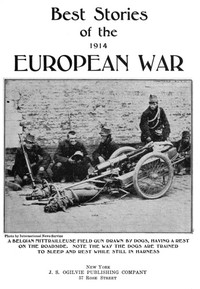
Best Stories of the 1914 European War
by Various
Language: en351 downloads on Project Gutenberg
Subjects
In: Short Stories·History - European·History - Modern (1750+)
Public-domain ebook sourced from Project Gutenberg #48029.
Public-domain ebook
by Various
Language: en351 downloads on Project Gutenberg
Subjects
In: Short Stories·History - European·History - Modern (1750+)
Public-domain ebook sourced from Project Gutenberg #48029.
The opening · free to read
“Taking advantage of the lull we got out of Namur early this morning, taking crossroads and lanes in front of the Belgian and French lines. The allied forces were pushing the Germans back under great guns placed along the northern line. The fields and low hills were alive with moving troops, columns of cavalry with light guns moving into position and long snakes of infantry.
“An officer warned us in a lane to wait there. He said: ‘We’ve run down some Uhlans in those woods.’ We waited half an hour. No movement in the sunny fields, nothing to be seen. Then suddenly out of a wood we saw four horsemen dash and we heard the snap of rifle shots on the far side of a field.
“The next instant there was a running fire of invisible muskets. Three of the horses fell. The fourth man fell from the saddle and was dragged through the stubble, his foot being caught in the stirrup. One of the others got up, leaving his horse and walking a few steps. He then fell.
“We were accompanied by a squad to Mazy. There we were blocked for two hours. Slowly through the village (no peasants or children showing now) defiled regiment after regiment of French cavalry, glorious fellows with their helmets covered with dust, their colored cuirasses dull with rust, dusty trappings and uneasy horses. It was not the glitter of a parade, but the infinitely more impressive savage, bronzed columns of war.
“A line of Belgian artillery, then light horse and lancers, and finally cyclists and a detachment of the Red Cross ambulances passed up the lanes out to the hills with a sort of rustling, intense silence. There was no drum nor music. This is war. For many of these grave and bronzed men, with here and there a fierce negroid African, we were the last link with the life of the towns. In a few days, perhaps in a few hours, they will be lying in long, nameless trenches in the fields.”
“The fighting started at Geetbetz at dawn. At 3.30 A. M. a German aeroplane flew low over our front. Several volleys were fired and the aeroplane fell within the German lines. After several feints the attack developed about 6 o’clock. Strong forces of German cavalry and infantry, supported by artillery, including machine guns, poured down on the village and a furious battle was soon raging all along the seven-mile front.
“While the Belgian cavalry were acting as infantry behind the earthworks part of the German cavalry got behind them and shot the horses. Inch by inch the ground was fought. Hundreds of Germans were slain. In the relentless move forward the Belgian defenders suffered rather serious losses.
“At Bubingen the resistance was equally praiseworthy. In a trench where seven cavalrymen were making a great fight, Lieut. Count Wolfgangen Durel was struck by a bullet in the head. His companions pressed around him as he fell. ‘It’s all up with me,’ he said. ‘Leave me and do your duty.’ He breathed his last a few minutes later.
“At this point two Belgian squadrons, about 240 men, showed magnificent bravery. They held 2,000 Germans back. In spite of the superior numbers the enemy had no distinct advantage over this handful of determined fellows. They would have died to a man, but their mission of holding the enemy in check for a few hours terminated when the retreat was sounded.”
The book keeps going
Reading is free forever. Sign up and watch scenes appear while you read.



Scenes Storieta drew for other classics.
New illustrated classics
Once or twice a month: the latest books to get full character casts, scene art, and free comic editions. No account needed.