Public-domain ebook
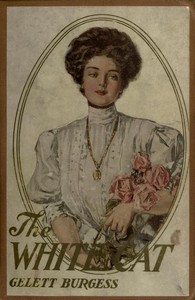
The White Cat
Language: en778 downloads on Project Gutenberg
Subjects
In: Novels
Public-domain ebook sourced from Project Gutenberg #48084.
Public-domain ebook
Language: en778 downloads on Project Gutenberg
Subjects
In: Novels
Public-domain ebook sourced from Project Gutenberg #48084.
The opening · free to read
I came to myself with a disturbing sense that something was wrong with me. My discomfort, increasing steadily, resolved itself into two distinct factors--a pain in my side at every breath and a throbbing ache in the top of my head. I realized that I was in bed, and the first strangeness of it struck me. I could not account for it. The wild, spicy odor of flowers came to me, adding to my perplexity. Then I opened my eyes.
The place was so dimly lighted that for some seconds my sluggish wits were unable to interpret the blotches of shadow and the vague glimmering spots. These, however, gradually resolved themselves into comprehensible forms. I perceived that I was in a strange room, large and airy; for even in the obscurity I got a feeling of free, clean space, and of that chaste emptiness which is apt to distinguish the guest-chamber of a well-kept house. I heard, now, the steady, deliberate ticking of a clock a little way off, and somewhere below was a small grinding sound, so low as to be almost a mere vibration, like a coffee-mill in operation. Near by, a door closed and latched softly.
I moved and attempted to sit up, but a sharp stab in my side warned me that my hurt was perhaps more serious than I had thought. There was a lump on my head, too, which probably accounted for my lapse of consciousness.
Setting my memory painfully to work, groping back through the darkness of my mind for something to explain the mystery, much as one might descend a dark, unlighted stairway, I came upon the last fact that had been recorded by my brain. I had been putting on speed--the road through the woods was straight, level and deserted--hoping to get up to town early in the afternoon. The steering-gear of my motor-car had given way. I had felt the wheels suddenly veer, then, before I put on my brake, the front of the car went down and the rear was thrown up and over with the momentum, sending me flying through the air.
I wondered, lazily, how much the machine had suffered. Then, I must have dropped off to sleep again, for when I next opened my eyes there was a flickering ray of light in the room. This time I was keenly alert mentally, desirous of some explanation of my situation. Where was I, and who had cared for me?
The light grew brighter, still wavering, slanting across the wall where it rocked and shifted, casting long, distorted shadows that danced up and down. Some one was evidently coming up-stairs with a light. The door was hidden by a projecting angle of the wall, however, and so for a few moments I saw nobody.
In those seconds the room was illuminated gradually more and more, showing a white-painted wainscot with a dull green wall above, where a few Japanese prints hung. Opposite my bed was a window with small, old-fashioned panes; there was another beside me. The rays glinted on the polished sides of several pieces of old mahogany furniture and flared yellow on brass candle-sticks and on the gilded frame of an eagle mirror. Finally the glare stopped its undulating, the shadows grew steadier on the wall, and, as I gazed eagerly for a first glimpse of my visitor, a young woman, bearing a silver candlestick, came into the room. She looked immediately over to where I lay, and then, catching my surprised stare, her expression changed wonderfully from a rather pathetic abstraction to an animated interest. With something not quite a smile on her face she walked nearer my bed, and stood for a moment without speaking, still looking at me. Her attitude hinted that she saw in me something--as if, for instance, it were a sort of picturesqueness which was unexpected enough to appeal to her imagination. She rested for a moment, poised and calm, but intensely attentive, fascinated.
And I, at the same time, was instantly conscious of so curious a sentiment that I must stop to attempt to describe it.
I conceived myself to be a connoisseur in women, and I estimated her at first sight as one unique, even extraordinary. But though to my mind she was indubitably beautiful, it was not her beauty that for the moment thrilled me. It was chiefly her "newness," the very novelty of her visitation. I felt a sudden, compelling desire to prolong the mystery of her presence rather than to have it explained. I tried, mentally, to delay her first word, to hold her back from any definite explanation till my eyes had had their fill of her--till they had, so to speak, solved her equation--till my wonder had spent itself in the vision, exhausting all its possibilities of delight. Her charm was, in its unexpectedness, so alluring, that she was like a pleasant dream which one lingers with and detains.
She was small, but her head was so exquisitely proportioned to her body that one did not notice her size. I have called her young, though she was twenty-seven, for her graceful figure and pose were still girlishly maintained. The shape of her small head was defined by a quaint coiffure, the dark, fine hair being banded in an encircling plait up past her tiny ears and over, like a coronal, showing a sweeping high-bred curve over her low brow. All this gave her a tender, virginal aspect; but her soft, deep brown eyes were so saddened by warm shadows below the lids, her mouth was so tremulously sensitive, with its slightly parted lips, and the little lines that women fear had begun to write her history so suggestively upon her face, that, as I gazed at her, I saw a woman who had lived and suffered, a woman as intense as she was delicate in all her moods.
She was clad in a bewilderingly feminine peignoir of lace and embroidery, open at the neck, and covered with another long, straightly hanging garment of shimmering pale-green silk, richly decorated with odd patterns. This gave her to my wondering eyes quite the appearance of a medieval princess, or the heroine of some old fairy tale. The impression was intensified by the long chain she wore, set with fire opals which flashed in the candle-light. From it, below her waist, there hung a golden star.
And, strangest of all, most provocative to my fancy, she also appeared, with extraordinary sympathy, almost with prescience, to feel something of my wonder as she paused and stood silent, retarding her greeting, in answer to my unspoken thought. While our eyes held each other in that marvelous communion, she did not smile; it was rather from her quivering mouth that I got the idea that she, too, was touched by the spell, and was keenly alive to the potentiality of the situation. She seemed to hold her breath lest the wonder should pass too soon.
That moment was as sublimely unreal as anything I have ever known, and, within its unmeasurable limits, as potent. It was tense, instinct with fine, secret emotions too faint for analysis. Messages came and went, electric. It was, in short, the psychological moment that comes but once to any friendship, and, coming, is usually hurried past without appreciation of its mysterious charm. It was that most suggestive of preludes, an instinctive, conscious pause upon the magic threshold of Romance. That she felt its quality also overpowered me. The minute passed like a falling star, and in its glory we seemed to travel miles together.
Then, with a visible effort, she spoke.
Her voice was light and clear, so expressively modulated that I have, despite myself, to compare it only to fairy footsteps passing over flower-tops. Its tones poised and hovered as if on the wing, though they were as sure as the melody of an old song. It was, above all else, graceful, and usually it held a trace of mental eagerness, but its characteristic quality came more from delicate nuances of feeling than from any vibrant intensity. It had the fluidity of running water.
With her first word she smiled, and some of the melancholy escaped from her eyes.
"Oh, you are better now! I'm so glad!"
The silver thread of magic that had bound as was broken, and the episode became real and humorous on the instant. I could not help smiling in my turn, for assuredly, from my point of view, I was, physically, decidedly the worse. I took it from her, by her remark, that I had been ill.
"Yes," I replied, "I suppose I must be better, since you say so, but I seem to be quite bad enough. How long have I been here?"
"Twenty-four hours. You have been a little delirious, you know. I was getting quite anxious about you, though the doctor said there was no danger."
She came nearer, and put her small beautiful hand upon my cheek. I noticed that she wore no rings. The touch of her fingers was soft and cool.
"I'm glad your fever has gone," she said, "Have you much pain?"
I felt sore all over, and there was trouble with my side when I moved; my head seemed to be splitting. But I was so much more interested in her, and how I came to be there, that I dismissed my symptoms with a shrug, and asked what had happened.
"You were thrown from your automobile," she said, "and you were pretty badly shaken up. There was a rib broken, and a slight concussion of the brain, I believe, but nothing serious. You'll have to stay here several days, at least, and keep quiet. Doctor Copin had to go back to town, and I must notify him that you are all right now. You mustn't fret about it, for you are perfectly welcome to stay here and it won't trouble us in the least. Only I'm afraid you'll be terribly bored. It's quiet here, and I'll be rather dull company."
"I'm not worrying, I assure you," I said. "I'm in no hurry to get well."
She smiled again, faintly but with a quick appreciation, and took a seat in an arm-chair which stood beside my bed. I caught a glimpse of a green silk stocking and an exquisitely small foot in a fantastically shaped slipper. She went on:
"I have been a good deal troubled because we have, of course, no idea who you are. I was afraid that some of your friends might be alarmed about you. So, if there is any one we can notify, or send for, give me the address and the message, and I'll send it over to the telegraph office at the Harbor, or I can telephone for you, if there's any one in town. Doctor Copin could call and explain your condition, if you prefer."
As she leaned her face on her slender hand and looked at me, she added: "Your motor has been taken care of, so you needn't worry about that. Uncle Jerdon hauled it into the stable, and it can stay there until you have a chance to have it repaired."
"You were good to take me in and to get a doctor," I said, watching the tiny vertical lines come and go in her forehead.
"Oh, Doctor Copin happened to be with me when you were brought in by Uncle Jerdon. I really don't know how you managed to escape with your life."
"I didn't deserve to escape. I was running considerably over the speed limit, I imagine. I wanted to get back to town early." How much rather would I have discussed the queer little corners of her lips that changed so distractingly, and the transparent shadow under her cheek-bone that spiritualized her whole expression now and again!
"Oh, I must take your message!" she exclaimed, a little embarrassed by the pause that had fallen.
The book keeps going
Reading is free forever. Sign up and watch scenes appear while you read.



Scenes Storieta drew for other classics.
New illustrated classics
Once or twice a month: the latest books to get full character casts, scene art, and free comic editions. No account needed.