Public-domain ebook
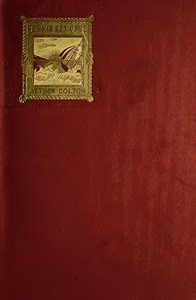
Bennie Ben Cree: Being the Story of His Adventure to Southward in the Year '62
Language: en373 downloads on Project Gutenberg
Subjects
In: Historical Novels·Adventure
Public-domain ebook sourced from Project Gutenberg #48147.
Public-domain ebook
Language: en373 downloads on Project Gutenberg
Subjects
In: Historical Novels·Adventure
Public-domain ebook sourced from Project Gutenberg #48147.
The opening · free to read
CHAPTER I.--BENSON AND CREE--THE COMMODORE INN, FORE AND AFT; AND A POINT STATED BY MY UNCLE BENSON.
|If anyone would understand how Ben Cree comes to be what he is for better or worse, he should know first the Commodore Inn and what it meant in those days to have the great wharves for a playground. And I cannot conceive to this day how one can amuse oneself, or be satisfied with any neat door-yard or inland village street, unless one is born a girl with a starched pinafore, which I should think would be a pity.
First, then, you should picture the Commodore Inn; its red bricks streaked with the rain and the beat of damp winds; its high veranda, with the paint coming off the white pillars, and the worn stone steps leading underneath. In front is the brick sidewalk, the cobbled street, the bit of open space with Harrier's junk-shop on the right corner; and then the warehouses on either side, all leading down to the slip, Doty's Slip, which is flanked by noble wharves, with huge piles leaning awry and very slippery. The warehouses are roomy and full of queer smells, as if the varied merchandize of fifty years had left something for its old friends, the warehouses, to remember it by. The contents of these warehouses changed continually: cotton, tobacco, slabs of crude rubber, and multitudes of boxes whose contents might be learned sometimes by asking the wharf-master, if you did not mind his cuffing you on the ears. Next there would be the river and its hurrying tides, its choppy waves, the ferryboats, sailboats, and tugs going to and fro: to right and left--seen well by climbing the warehouse roofs--are masts of many ships with innumerable amusing ropes, other wharves with the like slippery brown piles and dark places underneath where the water thieves hid and bored holes up through the planks into the molasses barrels. Mr. Hooley, the wharf policeman, told me of that, and there was much that was attractive in it. For there was a time, before my ideas became settled, when I thought of many different careers. To be a wharf policeman seemed too ambitious a thought, too vain and far away; so that I asked Mr. Hooley's advice about water thieving, having respect for his opinion.
“Naw, Bennie Ben,” he said, “'tis low. 'Tis not for the son of yer father, an' yer mother a lady as was ever bor-rn.”
“Do you think I could be a wharf policeman, Mr. Hooley?”
“Ah,” he said, looking mysterious, “who knows that? Don't ye let young Dillon lick ye, an' maybe--but 'tis a long way fer ye to grow.”
But I was speaking of the river. The navy yard lay nearly opposite, and the Wallabout, as that water is called behind the Government Cob Dock. And that stretch of busy river, with its tumult and tides, I love still no less, and love the thick smell of the wharves and warehouses.
My two grandfathers, Benson and Cree, were shipping merchants together, “Benson & Cree,” long ago, when you did not have to go beyond the Harlem for a bit of country. Indeed, my Grandmother Cree, I am told, had a great flower and vegetable garden, and there was an orchard behind the house, where in my time was but a little yard. The house was built for some colonial gentleman's residence, and my grandfathers bought it when prosperity came to them. And there they lived together with their families, and there were my father and mother born, for they were cousins, and also Uncle Benson and the two others who went down off Barnegat: a great, warmhearted house, red-walled and white-pillared.
The firm in its best days owned five ships. And by an odd arrangement one of them was always sailed by a member of the firm. They had their turns, one abroad and one at home. From this came the rhyme,
"Benson and Cree,
my father used to sing it, when absent-minded, to a queer haphazard tune. And I have heard Harrier, the junk-shop man, sing it too. But my father, if he saw me listening, would stop and seem ashamed, which I could not explain at first.
My father was an only child, and my mother an only daughter, but there were once three Benson boys. I am not sure of my Grandfather Cree, nor of my two grandmothers, at what dates they died, but in the year 1838 three of the five ships were lost: one of them with Grandfather Benson (in what waters is unknown), one of them with two of his sons off Bamegat, and one of them left a tilted wreck in the mid-Atlantic. And that same year my father made his last voyage, though still young in a way; for he came back with his knee crushed by the smack of a loose spar in a heavy sea, and walked with a crutch forever after.
When my time came, there was no firm of Benson & Cree. Our fortunes had not fallen altogether, but were moderate enough. Only three persons remained of the two families. Uncle Ben Benson was captain and part owner of the Saratoga, a good ship, carrying steam and sail, and landing merchandize at Doty's Slip. The house was now the Commodore Inn, kept by Tom Cree, my father. Ah, that was a brave man, loud-voiced, joyful! I believe I would break my knee willingly, and carry a crutch to the end of my days, to be so good a man, so simple and full of the pleasure of things.
My mother was singularly quiet in her ways, but I think the success of the Commodore came from my father's popularity and my mother's management, and it was her hand that was on the tiller.
And now, speaking of the Commodore as if it were a ship, I come to what is properly the beginning of this story.
Very few of those who came to the Commodore--and they were mostly seafaring folk of the better class--ever saw my mother. She never appeared on the front porch with the pillars, where my father sat often and shouted heartily to any friend in sight; but she was always above, and often in her sewing-room that looked out on the little garden in the rear. I never knew her to come out of the front door, or to look from the windows on the slip; but whenever she went abroad it was through the back door and the little garden, gliding so quietly, so gently, that it seemed wonderful to me, who could not move, any more than could my father, without a thunderous racket. I can see her plainly, with her black shawl and sweet still face under an overhanging bonnet, going out through the little garden.
How early or in what way I learned it I am not sure, but it seems as if it had always been a settled thing that I must not speak to her of the slip, or the river, or the ships, or anything in view from the front porch; but things which could be seen from the windows of her sewing-room, the garden, the people in the other street, the carriages and 'busses, steeples and distant roofs, these I might talk about. When Uncle Benson came home, once a year perhaps, the difference between the porch or inn parlour and the sewing-room was notable. For below the talk was all of the sea, winds, and islands, and full queer phrases of the shipping.
My father loud and merry, and my uncle full of dry stories; my father's huge beard rumpled on his chest with laughter; Uncle Benson, as always when ashore, clean shaven and very natty in his clothes. But when we went above to the sewing-room, my mother would make tea on the hob, while the two men played backgammon, and you would have thought, for all that was said of it, that there was no sea at all, flowing and wrapped about the world. It was all quiet talk of the house, the new minister at the Broadway Church, and how it were well for Bennie to mind better his books.
All this did not seem strange to me until it was explained, and then it seemed strange. For the things one is accustomed to when a little child appear only a part of common nature, whatever they are, and no more to be wondered at than tides and the flight of gulls.
I had learned the story of that sudden, disastrous year, '38, though not from my father. He was a man curiously without shrewdness to suspect what I might be thinking, and without that kind of courage--if I may say so with affection--which enables a man to approach at need a subject which is sad or sore to him inwardly. So that, while I had my own thoughts, the thing was not all explained till I was a well-grown, clumsy lad.
In this while it had come slowly upon me, until at last it was a great conviction, that I must be neither a water-thief, nor policeman, nor a doctor driving his carriage, nor a preacher in a carpeted pulpit, but a seaman and sometime a ship-captain like Uncle Benson, which idea became a hunger and thirst. But when I told my father of it, he looked at me queerly, and told me to mind my books. And I noticed that he would talk no more of sea matters when I was near, and would send me away from the inn parlour to go up to the sewing-room. So, whenever I pressed him to say I was to be a sailor, he would put it aside with a look on his face that puzzled me, for it was not only sadness, but fear. The sweat would come on his forehead and his hand shake. I think I was little comfort to anyone in those days, knocking about the streets and wharves, idle, sullen, and restless, wronging those in my thoughts who loved me most.
That old song I took to humming to myself--
"Benson and Cree,
and the lilt of the tune never failed to put a beating in my ears and a burning in my eyes, and fill my head with foolish fancies. I would sing it to Harrier in his shop, and Harrier would say, “Aye, aye, sonny! Them's new words.”
So it was come the year '61; and late in the month of May the Saratoga lay in the slip being fitted out for government use to blockade Southern ports, and sometime, then or later, was towed across to the navy yard. She was sold to the service, with the option of repurchase if not destroyed, and Uncle Benson was enlisted to command her, and looked a fit proper man in his uniform, which excited me almost beyond endurance.
Now I am come to a scene in the little inn parlour behind the public room. It was my father's office, and in a manner his room of state. You should see in mind a square room with pleasant curtains and a gay carpet on the floor, a round stove with no fire in it at this time; there are six or eight stout chairs of varied shape, about the number of my father's cronies, who came evenings to pack themselves in, and make the air white with smoke and salty with old sea memories. In the corner is a snug desk, and about the walls models of “Benson & Cree's” five ships; portraits of the family, and a painting of an unlikely looking coast; on one side shelves with a few books, but mainly pink and white shells, and stuffed fishes.
Uncle Benson and my father are sitting looking at me, who am standing awkwardly enough and shifting my feet about. Uncle Benson is saying, “We're going to put it to you, Ben,” and my father bursts in nervously:
“That's it, Ben. We're going to put it to you, just how it is, don't you see?” My uncle coughed, and beginning in an oddly stiff and formal way told the story of the year 1838, for the most part what I knew already, as I told him, not meaning to be impolite.
“Aye, Ben,” said he, quietly, “but I'm going on. You don't know that your mother, for a year or more----”
The book keeps going
Reading is free forever. Sign up and watch scenes appear while you read.



Scenes Storieta drew for other classics.
New illustrated classics
Once or twice a month: the latest books to get full character casts, scene art, and free comic editions. No account needed.