Public-domain ebook
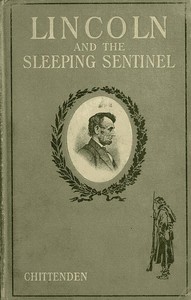
Lincoln and the Sleeping Sentinel: The True Story
Language: en329 downloads on Project Gutenberg
Subjects
In: Biographies·History - American·History - Warfare
Public-domain ebook sourced from Project Gutenberg #48319.
Public-domain ebook
Language: en329 downloads on Project Gutenberg
Subjects
In: Biographies·History - American·History - Warfare
Public-domain ebook sourced from Project Gutenberg #48319.
The opening · free to read
The truth is always and everywhere attractive. The child loves, and never outgrows its love, for a real true story. The story of this young soldier, as it was presented to me, so touchingly reveals some of the kindlier qualities of the President’s character that it seldom fails to charm those to whom it is related. I shall give its facts as I understood them, and I think I can guarantee their general accuracy.
On a dark September morning in 1861, when I reached my office I found waiting there a party of soldiers, none of whom I personally knew. They were greatly excited, all speaking at the same time, and consequently unintelligible. One of them wore the bars of a captain. I said to them pleasantly: “Boys, I cannot understand you. Pray, let your captain say what you want and what I can do for you.” They complied, and the captain put me in possession of the following facts:
They belonged to the Third Vermont Regiment, raised, with the exception of one company, on the eastern slope of the Green Mountains, and mustered into service while the battle of Bull Run was progressing. They were immediately sent to Washington, and since their arrival, during the last days of July, had been stationed at the Chain Bridge, some three miles above Georgetown. Company K, to which most of them belonged, was largely made up of farmer boys, many of them still in their minority.
The sterile flanks of the mountains of Vermont have, to some extent, been abandoned for the more fertile regions of the West, and are now open to immigration from the more barren soils of Scandinavia and the Alps. Fifty years ago these Vermont mountains reared men who have since left their impress upon the enterprise of the world. The hard conditions of life in these mountains then required the most unbroken regularity in the continuous struggle for existence. To rise and retire with the sun, working through all the hours of daylight, sleeping through all the hours of night, was the universal rule. Such industry, practised from childhood, united to a thrift and economy no longer known in the republic, enabled the Vermonter to pay his taxes and train up his family in obedience to the laws of God and his country. Nowhere under the sun were charity, benevolence, mutual help, and similar virtues more finely developed or universally practised than among these hard-handed, kind-hearted mountaineers.
The story which I extracted from the “boys” was, in substance, this: William Scott, one of these mountain boys, just of age, had enlisted in Company K. Accustomed to his regular sound and healthy sleep, not yet inured to the life of the camp, he had volunteered to take the place of a sick comrade who had been detailed for picket duty, and had passed the night as a sentinel on guard. The next day he was himself detailed for the same duty, and undertook its performance. But he found it impossible to keep awake for two nights in succession, and had been found by the relief sound asleep on his post. For this offence he had been tried by a court-martial, found guilty, and sentenced to be shot within twenty-four hours after his trial, and on the second morning after his offence was committed.
Scott’s comrades had set about saving him in a characteristic way. They had called a meeting, appointed a committee, with power to use all the resources of the regiment in his behalf. Strangers in Washington, the committee had resolved to call on me for advice, because I was a Vermonter, and they had already marched from the camp to my office since daylight that morning.
The captain took all the blame from Scott upon himself. Scott’s mother opposed his enlistment on the ground of his inexperience, and had only consented on the captain’s promise to look after him as if he were his own son. This he had wholly failed to do. He must have been asleep or stupid himself, he said, when he paid no attention to the boy’s statement that he had fallen asleep during the day, and feared he could not keep awake the second night on picket. Instead of sending some one, or going himself in Scott’s place, as he should, he had let him go to his death. He alone was guilty--“if any one ought to be shot, I am the fellow, and everybody at home would have the right to say so. There must be some way to save him, Judge!” (They all called me Judge.) “He is as good a boy as there is in the army, and he ain’t to blame. You will help us, now, won’t you?” he said, almost with tears.
The other members of the committee had a definite if not a practicable plan. They insisted that Scott had not been tried, and gave this account of the proceeding. He was asked what he had to say to the charge, and said he would tell them just how it all happened. He had never been up all night that he remembered. He was “all beat out” by the night before, and knew he should have a hard fight to keep awake; he thought of hiring one of the boys to go in his place, but they might think he was afraid to do his duty, and he decided to “chance it.” Twice he went to sleep and woke himself while he was marching, and then--he could not tell anything about it--all he knew was that he was sound asleep when the guard came. It was very wrong, he knew. He wanted to be a good soldier and do all his duty. What else did he enlist for? They could shoot him, and perhaps they ought to, but he could not have tried harder; and if he was in the same place again he could no more help going to sleep than he could fly.
One must have been made of sterner stuff than I was not to be touched by the earnest manner with which these men offered to devote even their farms to the aid of their comrade. The captain and the others had no need of words to express their emotions. I saw that the situation was surrounded by difficulties of which they knew nothing. They had subscribed a sum of money to pay counsel, and offered to pledge their credit to any amount necessary to secure him a fair trial.
“Put up your money,” I said. “It will be long after this when one of my name takes money for helping a Vermont soldier. I know facts which touch this case of which you know nothing. I fear that nothing effectual can be done for your comrade. The courts and lawyers can do nothing. I fear that we can do no more; but we can try.”
I must digress here to say that the Chain Bridge across the Potomac was one of the positions upon which the safety of Washington depended. The Confederates had fortified the approach to it on the Virginia side, and the Federals on the hills of Maryland opposite. Here, for months, the opposing forces had confronted each other. There had been no fighting; the men, and even the officers, had gradually contracted an intimacy, and, having nothing better to do, had swapped stories and other property until they had come to live upon the footing of good neighbors rather than mortal enemies. This relation was equally inconsistent with the safety of Washington and the stern discipline of war. Its discovery had excited alarm, and immediate measures were taken to break it up. General W. F. Smith, better known as “Baldy” Smith, had been appointed colonel of the Third Vermont Regiment, placed in command of the post, and undertook to correct the irregularity.
General Smith, a Vermonter by birth, a West-Pointer by education, was a soldier from spur to crown. Possibly he had natural sympathies, but they were so subordinated to the demands of his profession that they might as well not have existed. He regarded a soldier as so much valuable material, to be used with economy, like powder and lead, to the best advantage. The soldier was not worth much to him until his individuality was suppressed and converted into the unit of an army. He must be taught obedience; discipline must never be relaxed. In the demoralization which existed at the Chain Bridge, in his opinion, the occasional execution of a soldier would tend to enforce discipline, and in the end promote economy of life. He had issued orders declaring the penalty of death for military offences, among others that of a sentinel sleeping upon his post. His orders were made to be obeyed. Scott was, apparently, their first victim. It went without saying that any appeal in his behalf to General Smith would lead to nothing but loss of time.
The more I reflected upon what I was to do, the more hopeless the case appeared. Thought was useless. I must act upon impulse or I should not act at all. “Come,” I said, “there is only one man on earth who can save your comrade. Fortunately, he is the best man on the continent. We will go to President Lincoln.”
I went swiftly out of the Treasury over to the White House, and up the stairway to the little office where the President was writing. The boys followed in a procession. I did not give the thought time to get any hold on me that I, an officer of the government, was committing an impropriety in thus rushing a matter upon the President’s attention. The President was the first to speak.
“What is this?” he asked. “An expedition to kidnap somebody, or to get another brigadier appointed, or for a furlough to go home to vote? I cannot do it, gentlemen. Brigadiers are thicker than drum-majors, and I couldn’t get a furlough for myself if I asked it from the War Department.”
There was hope in the tone in which he spoke. I went straight to my point. “Mr. President,” I said, “these men want nothing for themselves. They are Green Mountain boys of the Third Vermont, who have come to stay as long as you need good soldiers. They don’t want promotion until they earn it. But they do want something that you alone can give them--the life of a comrade.”
“What has he done?” asked the President. “You Vermonters are not a bad lot, generally. Has he committed murder or mutiny, or what other felony?”
“Tell him,” I whispered to the captain.
“I cannot! I cannot! I should stammer like a fool! You can do it better!”
“Captain,” I said, pushing him forward, “Scott’s life depends on you. You must tell the President the story. I only know it from hearsay.”
He commenced like the man by the Sea of Galilee, who had an impediment in his speech; but very soon the string of his tongue was loosened, and he spoke plain. He began to word-paint a picture with the hand of a master. As the words burst from his lips they stirred my own blood. He gave a graphic account of the whole story, and ended by saying: “He is as brave a boy as there is in your army, sir. Scott is no coward. Our mountains breed no cowards. They are the homes of thirty thousand men who voted for Abraham Lincoln. They will not be able to see that the best thing to be done with William Scott will be to shoot him like a traitor and bury him like a dog! Oh, Mr. Lincoln, can you?”
Illustration: LINCOLN AND HIS SON THOMAS, KNOWN AS “TAD”
“Do your Green Mountain boys fight as well as they talk? If they do, I don’t wonder at the legends about Ethan Allen.” Then his face softened as he said: “But what can I do? What do you expect me to do? As you know, I have not much influence with the departments?”
The book keeps going
Reading is free forever. Sign up and watch scenes appear while you read.



Scenes Storieta drew for other classics.
New illustrated classics
Once or twice a month: the latest books to get full character casts, scene art, and free comic editions. No account needed.