Public-domain ebook
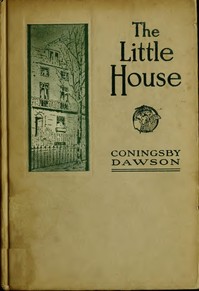
The Little House
Language: en377 downloads on Project Gutenberg
Subjects
Public-domain ebook sourced from Project Gutenberg #50274.
Public-domain ebook
Language: en377 downloads on Project Gutenberg
Subjects
Public-domain ebook sourced from Project Gutenberg #50274.
The opening · free to read
HE little house, tell this story. It was lived within my walls; not a line is invented and it was I, by my interfering, who brought about the happy ending. Who wants a story that does not end happily, especially a Christmas story? To have been responsible for the happy ending is pretty nearly as clever as to have made the story up out of one's own head or, as we houses say, out of one's own walls.
Perhaps you never heard before of a house telling a story. If that be so, it is because you don't listen or because you go to bed too early. Unlike people, we houses sleep all day long; but after midnight we wake up and talk. When the clock strikes twelve, our stairs begin to crack and our windows to rattle and our floors to creak. If you ever hear these sounds, don't be frightened; they simply mean that the kind old walls that shelter you have begun to remember and to think. And we have so many things to remember and to think about, especially we old houses who have been standing for almost two hundred years. We have seen so much; we have been the friends of so many generations. More little children have been born beneath our roofs than we have stairs on which to count. We reckon things on our stairs, just as people reckon things on their fingers. When our stairs crack after midnight, it's usually because we're counting' the births and love-makings and marriages we have watched. We very often get them wrong because there are so many of them. Then the doors and windows and floors will chip in to correct us. “Ha,” a window will rattle, “you've forgotten the little girl who used to gaze through my panes in 1760 or thereabouts.” One of the doors will swing slowly on its hinges and, if anyone disputes with it, will bang, shouting angrily, “Wrong again--all wrong.” Then the walls and the windows and the doors and the floors all start whispering, trying to add up correctly the joys and sorrows they have witnessed in the years beyond recall.
When that happens, if you're awake and listening, you'll hear us start adding afresh, from the lowest to the topmost stair.
I am a London house and a very little house, standing in a fashionable square near Hyde Park. I have known my ups and downs. Once was the time when I was almost in the country and the link-boys used to make a fuss at having to escort my lady so far in her sedan-chair. It's a long way to the country now, for the city has spread out miles beyond me. Within sight through the trees at the end of the square red motor-buses pass, bumping their way rowdily down to Hammersmith and Kew. In my young days these places were villages, but I am told they are full of noises now. I have at least escaped that, for our square is a backwater of quiet and leads to nowhere, having an entrance only at one end. All the houses in the square were built at the same time as I was, which makes things companionable. We all look very much alike, with tiny areas, three stone steps leading up from the pavement, one window blinking out from the ground-floor, two blinking out from each of the other floors and a verandah running straight across us. In summer-time the verandah is gay with flowers. Our only difference is the colour we are painted, especially the colour of our doors. Mine is white; but some of our neighbours' are blue, some green, some red. We're very proud of the front-doors in our square. In the middle stands a railed-in garden, to which none but our owners have access. Its trees are as ancient as ourselves. Behind us, so hidden that it is almost forgotten, stands the grey parish-church, surrounded by a graveyard in which many of the people who have been merry in us rest.
For some years we were what is known as a “gone down neighborhood,” till a gentleman who writes books bought us cheap, put us in repair and rented us to his friends. This has made us very select; since then we have become again fashionable.
Now you know all that is necessary to form a mental picture of us. Because we are so small, we are sometimes spoken of as “Dolls' House Square.” All the things that I shall tell you I do not pretend to have witnessed, for houses have to spend their lives always in the one place--they cannot ride in taxis and move about. We gain our knowledge of how the world is changing by listening to the conversations of people who inhabit us; when night has fallen we mutter among ourselves, passing on to one another beneath the starlight down the lamp-lit streets the gossip we have overheard. Whatever of importance we miss, the churchbells tell us. Big Ben, with his sweet tenor voice, booming out the hours, is in this respect particularly thoughtful.
So now, having explained myself, I come to my story of the little lady who needed to be loved, but did not know it, and the wounded officer who wanted rest.
HE little lady who needed to be loved, but did not know it, discovered me quite by accident. This story is a series of accidents; if it had not been for the ifs and the perhaps's and the possibilities there wouldn't have been any story to tell.
I was empty when she found me, for my late tenants had grown frightened and had moved into the country on account of airraids. They said that I was too near the giant searchlights and anti-aircraft guns of Hyde Park Corner to be healthy. If they weren't killed by bombs, sooner or later they would be struck by our own expended shell-cases that came toppling from two miles out of the clouds. So they had made their exit hurriedly in November, taking all their furniture and leaving me to spend my one-hundred-and-ninety-eighth Christmas in the company of a caretaker.
It was shortly before Christmas when I first saw her. Night had settled peacefully down; it was about nine o'clock when the maroons and sirens began to give warning that the enemy was approaching. In an instant, like a lamp extinguished, the lights of London flickered and sank. Down the forests of streets innumerable doors swiftly opened and people came pattering out. Dragging half-clad children by the hand and carrying babies snatched up from their warm beds, they commenced to run hither and thither, seeking the faint red lights of shelters, where cellars and overhead protection might be found. Policemen, mounted on bicycles, rode up and down the thoroughfares, blowing whistles. Ambulances dashed by, tooting horns and clanging bells. From far and near out of the swamp of darkness rose a medley of panic and sound. Prodding the sky, like detectives with lanterns, searchlights hunted and turned back the edges of the clouds. Then ominously, with solemn anger, the guns opened up and in fierce defiance the first bomb fell. The pattering of feet ceased suddenly. Streets grew forlorn and empty. The commotion of living and the terror of dying were transferred from the earth to the air.
I was standing deserted with my door wide open, for at the first signs of clamour the old woman, who was supposed to take care of me, had hobbled up from her basement and out on to the pavement in search of the nearest Tube Station. In her fear for her safety, she had forgotten to close my door, so there I stood with the damp air drifting into my hall, at the mercy of any chance vagrant.
The guns had been booming for perhaps five minutes when I heard running footsteps entering the square. Our square is so shut in and small that it echoes like a church; every sound is startling and can be heard in every part of it. I could not see to whom the footsteps belonged on account of the trees and the darkness. They entered on the side farthest from me, from the street where the red motor-buses pass. When they had reached the top, from which there is no exit, they hesitated; then came hurrying back along the side on which they would have to pass me. Tip-a-tap, tip-a-tap, tip-a-tap and panting breath--the sound of a woman's high-heeled shoes against the pavement. Accompanying the tip-a-tap were funny, more frequent, shuffling noises, indistinct and confused. Three shadows grew out of the gloom, a small one on either side and a bigger one in the centre; as they drew near they resolved themselves into a lady in an evening-wrap and two children.
I was more glad than I cared to own, for I'd been feeling lonely. Now that peace has come and we've won the war, I don't mind acknowledging that I'd been feeling frightened; at the time I wouldn't have confessed it for the world lest the Huns should have got to know it. We London houses, trying to live up to the example of our soldiers, always pretended that we liked the excitement of airraids. We didn't really; we quaked in all our bricks and mortar. One's foundations aren't what they were when one is a hundred-and-ninety-eight years old. So I'm not ashamed to tell you that I was delighted when the lady and her children came in my direction. I tried to push my front-door wider that they might guess that they were welcome. I was terribly nervous that they might pass in their haste without seeing that I was anxious to give them shelter. It was shelter that they were looking for. In coming into the square they had been seeking a shortcut home.
They drew level without slackening their steps and had almost gone by me when, less than a quarter of a mile away, a bomb crashed deafeningly. Everything seemed to reel. Far and near you could hear the tinkling of splintered glass. The world leapt up red for a handful of seconds as though the door of a gigantic furnace had been flung open. Against the glow you could see the crouching roofs of houses, the crooked chimney-pots and the net-work of trees in the garden with their branches stripped and bare. The lady clutched at my railings to steady herself. Her face was white and her eyes were dark with terror. The last bomb had been so very close that it seemed as though the next must fall in the square itself. One of the searchlights had spotted the enemy and was following his plane through the clouds, holding it in its glare.
“Mummy, it's all right. Don't be frightened. You've got me to take care of you.” It was the little boy speaking. Then he saw my To Let sign above and pointed, “We'll go in here till it's over. Look, the door's wide open.”
He tugged on her hand. With her arm about the shoulder of the little girl on the other side of her, she followed. The glow died down and faded. Soon the square was as secret and shadowy as it had been before--a tank full of darkness in which nothing stirred.
EVER since I had been built had any visit quite as unceremonious as this occurred. Who was the strange lady? What was she doing wandering the streets at this hour unescorted? She was beautiful and richly gowned; her face was young, but very sad. I was anxious to learn more, so I listened intently.
At first on entering, they halted just across the threshold, huddled together, the little lady with an arm flung about each of the children. She seemed to think that someone might be hidden in the darkness watching--someone to whom I belonged--for presently she addressed that supposed someone tremblingly: “We hope you don't mind, but the car forgot to come for us. Grandfather had been giving us a party. When we heard the warning, we tried to run home before the raid started; but we got lost. The Tube Stations were all so crowded that... And we found your door open, so we hope you don't mind us entering.”
The book keeps going
Reading is free forever. Sign up and watch scenes appear while you read.



Scenes Storieta drew for other classics.
New illustrated classics
Once or twice a month: the latest books to get full character casts, scene art, and free comic editions. No account needed.