PREFACE BY THE TRANSLATOR.
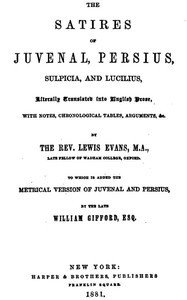
While the poetical versions of Juvenal deservedly hold a very high place in the literature of this country, it is a curious fact that there exists no single prose translation which can stand the test of even ordinary criticism. Whether it be that the temptation to a metrical version of a poetical writer is too great with some, or whether the labor of faithfully representing the genius of confessedly the most difficult writer in the Latin language has deterred others, the fact is undeniable, that there is no prose version from which the unclassical reader can form any adequate idea of the writings of the greatest of Satirists.
Madan, though faithful, is utterly unintelligible to any one who has not the Latin before him. Sheridan is far too free, in every sense of the word, to be either a fair expositor of his original, or to suit the taste of the present day; and without any disparagement of the labors of Sterling, Nuttall, Smart, or Wallace, it was found impossible to adopt any one of them even as the basis of a version which should be worthy of a place in the present series.
The accompanying translation, therefore, is entirely original; and the translator is not aware of having copied a single line from any previous version. How far he has succeeded in giving a faithful transcript of the author, and in, at the same time, infusing some spark of the fire and spirit of the original, must be for others to determine; all that he dares venture to assert is, that he has brought to the task an enthusiastic admiration of his author, and a careful study of many years. The same remarks apply to the translation of Persius.
The notes are to a considerable extent original, and the English, perhaps even the classical, reader may not be displeased at the occasional introduction of passages from metrical versions in which the sense appeared to be the most forcibly given.
A Chronological Table has been added, which the labors of Mr. Clinton have enabled the Translator to present in a far more correct form than heretofore.
The poetical version by Gifford has been annexed, as having the greatest hold on the public favor, and as being perhaps the best, because the most equal; though, unquestionably, in all the Satires which Dryden translated, he has immeasurably surpassed Gifford in fire and spirit, as Hodgson has in elegance and poetic genius, and Badham in taste, scholarship, and terse and vigorous rendering. But Gifford is always equal, and generally faithful.
The remains of Sulpicia and Lucilius appear now for the first time in English. Of the value of the latter, and of the propriety of appending his Fragments to a translation of the great Roman Satirists, no scholar-like reader of Juvenal and Horace can entertain a doubt. The recent labors of foreign scholars have presented us with the text in a purer form than almost any collection of Fragments of the older Latin writers. In the Arguments prefixed to the several Books, and in the notes, will be found the essence of the criticisms of Jan. Dousa, Van Heusde, Corpet, Schoenbeck, Schmidt, Petermann, and especially of Gerlach, whose readings have in general been preferred.
L. E.
CONTENTS.
The book keeps going
Keep reading, and see it illustrated
Reading is free forever. Sign up and watch scenes appear while you read.
Scenes Storieta drew for other classics.