Public-domain ebook
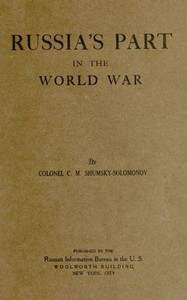
Russia's Part in the World War
Language: en301 downloads on Project Gutenberg
Subjects
In: History - Other·History - European·History - Modern (1750+)
Public-domain ebook sourced from Project Gutenberg #50956.
Public-domain ebook
Language: en301 downloads on Project Gutenberg
Subjects
In: History - Other·History - European·History - Modern (1750+)
Public-domain ebook sourced from Project Gutenberg #50956.
The opening · free to read
Was it Possible for Germany to Win the War?
In discussing Russia's role in the past World War, it is customary to cite the losses sustained by the Russian Army, losses numbering many millions. There is no doubt that Russia's sacrifices were great, and it is just as true that her losses were greater than those sustained by any of the other Allies. Nevertheless, these sacrifices are by far not the only standard of measurement of Russia's participation in this gigantic struggle. Russia's role must be gauged, first of all, by the efforts made by the Russian Army to blast the German war plans during the first years of the War, when neither America, nor Italy, nor Roumania were among the belligerents, and the British Army was still in the process of formation.
Russia's role must in addition be gauged by the efforts put forth by the Russian Army to save the situation at other critical moments of the War. And of such, we know, there were not a few until the Allies succeeded in gaining their victory over the stubborn and powerful enemy.
Lastly, and this is the main thing, the role played by the Russian Army must be considered also in this respect that the strenuous campaign waged by Russia, with her 180 millions of inhabitants, for three years against Germany, Austro-Hungary and Turkey, sapped the resources of the enemy and thereby made possible the delivery of the final blow. This weakening of the powers of the enemy by Russia was already bound at various stages of the War to facilitate correspondingly the various operations of the Allies. Therefore at the end of the War three years of effort on the part of Russia, which had devoured the enemy's forces, were destined to enable the Allies finally to crush the enemy. The final catastrophe of the Central Powers was the direct consequence of the offensive of the Allies in 1918, but Russia made possible this collapse to a considerable degree, having effected, in common with the others, the weakening of Germany, and having consumed during the three years of strenuous fighting countless reserves, forces and resources of the Central Powers.
Could Germany have won the war? A careful analysis of this question brings home the conviction that Germany was very close to victory, and that it required unusual straining of efforts on the part of France and Russia to prevent Germany from "winning out."
The plan of the old Field Marshal, Moltke, was far from worthless. It is a fact that it took from six weeks to two months to mobilize the armed forces of Russia, during which period Russia was unprepared for action. The population of Germany was 70 million and that of Austria-Hungary 52 million, a total of 122 million persons. During these two months of forced inaction those 122 millions of Teutons were faced only by 40 million Frenchmen, for Russia was not yet ready. A threefold superiority in numbers, in addition to an equal degree of military skill, technical equipment and culture, was bound to crush lone France.
It is true that for the complete realization of this scheme it was necessary that the Austrian Army, as well, involve France. This should have been anticipated, as military science does not admit of the division of forces. Just to the contrary, it demands "the concentration of all forces in the decisive hour and at the deciding point,"--in France, upon this particular occasion.
It may be said that Russia could have occupied Galicia and East Prussia had the Austrian Army left for France. Well, the fact is that both these provinces were occupied by Russia anyhow. But if in the first battle of the Marne, when the Germans felt the shortage of the two or three corps dispatched back into Prussia, they would have had these troops at their disposal in addition to half a million Austrians, Joffre's condition would have been rendered critical. The loss of the Marne would have been equivalent to the loss of the War by France, and, consequently, to the loss of the entire War.
The outcome was different. The concentrated attack upon France failed because of the fact that of the 104 German divisions and the 50 Austrian divisions only about 92 or 94 divisions were on the scene of action in France. The Russian Army, unprepared for action for another 40 days, nevertheless rushed into East Prussia in an impulse of self-sacrifice and received in addition the full strength of the blow from the Austro-Hungarian Army. This generous move on the part of Russia destroyed the Moltke plan and his basic idea "the concentration of all forces against France", as a part of the German force had been diverted from that front. The plan collapsed, and the only actual chance which the Germans had of winning a victory was lost with it. Later, when Russia was prepared, when the English Army began to grow, and Italy, Roumania and America had abandoned their neutrality, Germany's chances for a final victory vanished.
It is the recognition of these facts that should prompt every impartial historian of the War to admit that the self-sacrifice of the unprepared Russian Army during the first days of the War played an enormous role in the only period when Germany had victory almost within her grasp. It is to be regretted that the extraordinary conditions which developed in Russia towards the end of the War are obscuring the true historic role of Russia in the sanguine World struggle. It is simple enough to understand that during the two or three years, while the British Army was still in the process of formation, and Italy, Roumania and America were neutral, the entire burden of fighting the Central Powers devolved upon the Armies of France and Russia. It is just as simple to understand that during that period, when the enemy was most powerful and undemoralized, when he was operating with his best troops, that the most difficult and responsible part of the problem had to be performed. It is just as easy--from an examination of the maps of the first three years of the War, maps which speak only of two principal fronts, the French and the Russian, and no other--to grasp the significance of the gigantic role played in this War by great Russia and the millions of sacrifices she consecrated to the common cause of the Allies. Sadly enough, this only correct criterion of Russia's historic role in the War is becoming more and more obscured from the public opinion of the world.
In the recently published memoirs of General Ludendorf, the defeated German military leader, in an endeavor to clear himself, attempts to slander the Russian Army and discredit all the great sacrifices and heroic efforts contributed by Russia to the Allied cause. Taking advantage of the scant familiarity of the general public with military matters, Ludendorf uses false data, cites wrong figures and consciously distorts the historic perspective of the War.
It is difficult to understand how a serious-minded military leader can stoop to employ, in a supposedly serious work, methods fit for the yellow press, such as accusing Russian generals of treason, etc., etc. These memoirs, as a whole, were met at the time of their publication by sharp and adverse criticism in the foreign, and even the German, press. Ludendorf's memoirs are especially misleading in the part describing the first Russian advance in East Prussia, the advance that played such a decisive role in the defeat which the Germans suffered on the Marne. It should never be forgotten that this event proved fatal and brought about the final defeat of the Germans in this sonov.[2]
Ludendorf commences his recital of events on the Russian front with the statement that in 1914, in East Prussia, with a force of only two German corps, he destroyed 250,000 Russians--six army corps--under the command of General Samsonov, and that General Rennenkampf, who was only within two or three days' march from Samsonov, had designedly failed to aid Samsonov.
This statement by General Ludendorf is absolutely false from beginning to end. It can be very easily proven that Ludendorf attacked Samsonov not with two army corps, but with more than 240,000 German troops. With this army he attacked not 250,000 Russians, but only two Russian army corps, i. e., 80,000 men--the 1st and the 6th Russian Army Corps. Thus, Ludendorf had a force three times larger than his adversary.
It may be easily seen from this that while Ludendorf gives Samsonov twice as many men as he had in reality, he, at the same time, credits Rennenkampf with three times the number he actually had. His own force Ludendorf puts, on paper, at one-third of what he had in fact.
Rennenkampf knew nothing about the events on the Samsonov front until August 30, whereas the latter was surrounded on August 28. (See Gurko's book, "War and Revolution.")
The cause of the Russian defeat in that battle was not the "genius" of Ludendorf, but lay rather in the fact that the Russian Army, in its eagerness to relieve Paris, advanced too quickly, with not fully mobilized and insufficient forces, and in two separate Armies, coupled with the difficulty of reconnoitering and obtaining information about the enemy in a country where the entire population was in a state of armed belligerency. The death of Samsonov and of a part of his staff and the disruption of liaison were other causes.[3]
In her haste to aid her Allies, Russia risked much, and she lost a battle on account of the precariousness of the operation, insufficiency of forces and an unfortunate accident. But she succeeded in diverting several German corps from France, and the Russian blood shed at Tannenberg thus helped win the First Battle of the Marne.
It may thus be seen from the descriptions of the first battles in East Prussia that Ludendorf, for the sake of German martial glory and probably also for the glorification of his own role, makes use of a very primitive and naive expedient. He multiplies the number of Russian troops several times, and also diminishes his own forces several times. This creates the impression that Ludendorf with "inconsiderable" forces smashed the "many times larger" forces of the Russians. As a matter of fact, however, as we have seen, Ludendorf had in these engagements, 1½, 2, and sometimes even 3 times as many men as the Russians. How excessive this superiority of numbers was may be inferred from the fact that the Germans themselves went to France with but 1½ times as many men and that they considered this sufficient for a decisive victory over the French Army. However, no matter how much Ludendorf may distort the facts in his memoirs, he cannot refrain, albeit only by 2-3 words, from mentioning the strategical catastrophe which overtook Germany through the invasion of East Prussia by the Russian troops. Ludendorf himself admits that "_the transfer of the two army corps from the French front to Eastern Prussia had fatal consequences for Germany. The German advance on France was turned into a retreat._"
This admission from Ludendorf characterizes the importance of all the events of the first few weeks of the War and it contains an involuntary appreciation of the historic role and self-sacrificing efforts of Russia. The enemy, albeit indirectly, admits that Russian blood was not shed in vain on the fields of East Prussia; it was precisely for this reason that Germany was unable to win the War at the only moment at which she could ever have won, taking advantage of Russia's unpreparedness and the temporary isolation of France.
The book keeps going
Reading is free forever. Sign up and watch scenes appear while you read.



Scenes Storieta drew for other classics.
New illustrated classics
Once or twice a month: the latest books to get full character casts, scene art, and free comic editions. No account needed.