FIRST FLAG OF THE UNION.
DEDICATED TO THE LADIES OF THE UNITED STATES.
BY COL. J. FRANKLIN REIGART, Author of the “Life of Robert Fulton.”
HARRISBURG, PA. LANE S. HART, PRINTER AND BINDER. 1878.
Entered according to Act of Congress, in the year 1878, by LANE S. HART, in the Office of the Librarian of Congress, at Washington, D. C.
PREFACE.
IN 1824, when General Lafayette arrived at Philadelphia, and was nobly welcomed as “The Nation’s Guest,” the writer of this book was staying several weeks at the hospitable home of his amiable and kind relative, Mrs. BETSY ROSS. The arrival of Lafayette excited and brightened her extraordinary memory, as she very cheerfully entertained all her friends, by relating the most interesting facts of the Revolution, and its FLAG of Victory. Her words we well remember. She objected, as a member of the society of “Friends,” to sit for her portrait, nevertheless, a miniature of her in crayon was made, and is now highly prized; and at this late day, we deem it our duty to publish the true history of the origin of the first FLAG of our Country, and the patriotism of America’s most illustrious Heroine.
The BRAVEST of the brave demands our song, Who made the FLAG so firm and strong, Of all earth’s emblems the brightest diadem, The FREEMEN’S shield, the PATRIOT’S gem.
Listen to her thrilling, cheering voice, her soul-inspiring, martial song, whilst a dozen of the ladies of her household joined in the chorus, as she handed over each Flag to the gallant troops, on their way to camp, and roused their enthusiasm to the highest pitch. The ladies of the Revolution loved her for her magnanimous and modest Quaker deportment, and the army of Washington applauded her dignified admonitions, so full of patriotism and power of song. Quakers very seldom sing, but BETSY ROSS always said, “_My voice shall be devoted to God and my country, and whenever the spirit moves me, I’ll sing and shout for liberty!_”—and with an enthusiasm for INDEPENDENCE, exhibiting a spirit power, only to be equalled by absolute phrensy, she waved her Flag aloft, and she did sing to the gallant volunteers, the
“WAR SONG OF INDEPENDENCE.”
“Come on, my hearts of temper’d steel, Away! away! to arms!! No foreign slaves shall give us law, No British tyrants reign; ’Tis INDEPENDENCE makes us free, And FREEDOM we’ll maintain. And to conquest we will go! will go! will go! With the red, white and blue, To conquest we will go.
“A soldier is a gentleman, His honor is his life, And he that won’t stand by his FLAG, Will ne’er stand by his WIFE. And to conquest we will go! will go! will go! With the red, white and blue, To conquest we will go.
“Then hark! to arms! to arms!! to arms!!! ’Tis the time that tries men’s souls! The rising world shall sing of you, A THOUSAND YEARS to come, And to your children’s children TELL The WONDERS you have done. When to conquest you did go! did go! did go! With the red, white and blue, To conquest you did go.”
Many inspired songs (after the close of the war for American Independence) were carried home by Gen. Lafayette, (the companion of Washington,) Rochambeau, and many of the French engineers and soldiers, on their return to France, having proved their chivalry and united their hearts, blood, songs and arms with Americans, for the liberties of America; and, but for the “WAR SONG” of BETSY ROSS, the “Marseillaise Hymn” would not have been written by Rouget de Lille, a French officer of engineers, in 1791. Marshal Luckner commanded the French Revolutionary army at that time on their march from Marseilles to Paris; that whole army became phrensied by the words of the “WAR SONGS” of American Independence, that they had helped to gain, and Rouget de Lille caught the inspiratory words, “_And hark, away to arms! to conquest we will go!_” and quickly composed the song that he entitled the “_Chant de Guerre de l’ Armée du Rhin_,” the “War Song of the Army of the Rhine,” which the Parisians, some years afterwards, named the “_Hymne des Marseillaise_.” Thus the “_War Song of Independence_” became combined, in word and spirit, in the “_Marseillaise Hymn_,” and has ever since enlivened the march of the armies of France to conquest and played an important part in the revolutions, not only of France, but of other Continental States.
In 1870, William J. Canby, Esq., (the grandson of Mrs. John Ross,) of Philadelphia, read before the Historical Society of Pennsylvania, a very interesting paper on the subject of the “Centennial Anniversary of the American Flag,” in which he stated that his maternal grandmother, “Betsy Ross,” was the first maker of the “Stars and Stripes.” She lived in Arch street at the time, and continued in the business of making Flags for many years.
MISS ELIZABETH GRISCOM was born 1742, in Philadelphia, and was married in 1762 to Mr. John Ross, a merchant of that city. She was a strict member of The Society of Friends, and by them always called “BETSY ROSS.” She was unsurpassed in fine needlework, and well known throughout Philadelphia and New York cities as the most artistic upholstress in America. She used the most superior, richest and finest of imported embroidered velvets, satins, silks and woolens, that were brought to this country by the packet ships of Caleb and Thomas Cope, Boyd & Reed, and John Ross, agreeably to her express orders; and she had a dozen or more of her sisters, daughters and nieces constantly employed sewing and finishing variegated needlework, in the very best manner, as she directed them; and thus no other upholsterer could possibly compete with her. She was a natural artist, an inventive genius, who fully understood the best effects of complimentary colors, and the grandeur of the primary colors; yet, strange as it may appear, though one of the plainest of “QUAKERS,” she invariably used cloths of the very brightest, and in every instance the primary colors combined, so as to be distinguished from all other objects, and she quickly judged and comprehended the styles that would best please her customers. Her brilliant draperies and tri-colored curtains, in the public halls, hotel parlors, and drawing rooms, were greatly admired; whilst General Washington, General Hand, Thomas Mifflin, George Clymer, Jared Ingersoll, J. Koch, Gouveneur Morris, Robert Morris, Judge James Wilson, Frederick A. Muhlenberg, Joseph Wilson, Caleb and Thomas Cope, Thomas Wilson, Timothy Matlack, James Trimble, and William Shippen, are some of the names on her store-books, as her generous and kind friends and patrons, whose heirs still possess beautiful curtains and magnificent quilts of variegated silks and satins, unsurpassed, at this day, for beauty of utility, justness of composition, that none but a perfect artist could produce; and the constant use of materials of primary colors were her praise, excellence, and fame.
Colonel George Ross, (a member of the Continental Congress,) and James Trimble, (afterwards Deputy Secretary of Pennsylvania,) were her brothers-in-law, and through their suggestions, she adorned, with drapery, the Hall of Congress, and the Governor’s reception room. Her upholstery in the ladies’ cabins and state rooms of Caleb and Thomas Cope’s packet ships was unrivalled and not equalled by the state rooms of the European packets; whilst from the topmasts of Cope’s packets, her waving red, white, and blue STREAMERS made glad the travelers of the seas, several years before the Revolution of 1776. Some of the theatres and public halls of Philadelphia were embellished and decorated with curtains of white, mazarine, and scarlet velvets and silks in waves, festoons, and pendents, and in many instances the curtains were embroidered with gold and silver figures of vines, leaves, and stars that glittered with superb brilliancy, whilst the curtains were invariably supported by a golden spread eagle, with lightning darts in its talons and a silvery olive branch in its beak; and these were the original and wonderful handiwork of Betsy Ross. She could not think of or invent anything brighter or more graceful than her most celebrated gay and glittering primary colored curtains, spangled with stars and supported by a golden eagle, that already ornamented and adorned the interior of the chief HALLS of the land. They were her daily delight and divinely brilliant dreams by night. With her scissors she cut the form of a small shield, upon which she sewed five-pointed stars and tri-colored stripes, in imitation of General Washington’s coat-of-arms, which embraced stars and pales upon his escutcheon; this shield she fastened upon the eagle’s breast; and, inspired with one bright thought, she seized her meritorious daily work, flung it to the breeze, hung it “UPON THE OUTER WALLS,” and the Freemen of Columbia cheered, and hailed it “THE FLAG OF THE UNION!” And that one independent FLING made all the people KING!
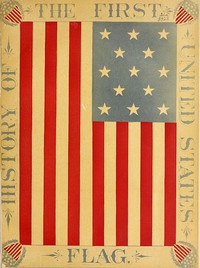
At the request of Dr. Franklin, Mr. Robert Morris and Col. George Ross, she designed and made the first FLAG of the United States, consisting of thirteen red and white stripes, a blue field as a square, on the left and upper corner, and upon the blue field was a spread eagle, with thirteen stars, in a circle of rays of glory, surrounding its head, and the United States SEAL was afterwards made from the same design of the United States Flag, viz: A red, white and blue shield on the breast of an American Eagle, holding in its talons an olive branch and thirteen arrows; in its beak a scroll inscribed with this motto, “_E Pluribus Unum_,” and above its head thirteen stars arranged in a circle of glory. These designs were approved and adopted by the Committee and Congress, and they were made before the words “United States of America,” were legally used. The country was called “Columbia,” the Congress was styled the “Continental Congress,” the States were called “Colonies,”; every petition sent to the King of Great Britain, and every public document, were issued by “The North American Colonies;” our Country had no name until BETSY ROSS marked upon her Flags, “THE UNITED STATES OF AMERICA.” Dr. Franklin, John Adams and Thomas Jefferson had been appointed (December, 1775, by Congress, a Secret Committee) to prepare a FLAG, and a device for a SEAL for the Colonies, and Dr. Rittenhouse was requested by the Committee, to engrave the Seal corresponding with the eagle on the Flag.
On the 4th day of July, 1776, the Declaration of Independence was finished and signed, and the Rev. Dr. Duché, Chaplain of Congress, had offered up his celebrated “_Prayer of Independence_,” the STAR SPANGLED BANNER was unfurled, and emblazoned the Hall of Independence, and hung around the spire of the Old State House Bell, as it sounded its tones of warning beyond the city limits, re-echoed across the Delaware, and proclaimed the liberty of the land, amidst the thundering shouts of Freemen, the roaring of cannons, musketry, firearms, and bonfires; then the Secret Committee, Franklin, Jefferson and Adams, was publicly announced by the President of Congress, and the SEAL (already made) of the “_United Colonies_,” was used that day. Aye! the Flags waved, the Seal was engraved, and the thirteen “UNITED STATES OF AMERICA” were saved.