UNITED STATES OF AMERICA?
By Franklin Hanford.
SCOTTSVILLE, N. Y.
ISAAC VAN HOOSER. PRINTER.
1917.
DID BETSY ROSS DESIGN THE FLAG OF THE UNITED STATES OF AMERICA?
By Franklin Hanford.
A paper read before the Scottsville Literary Society, January 22, 1917.
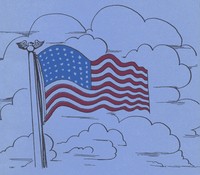
On Saturday, the fourteenth of June, 1777, the Continental Congress, then in session in Philadelphia, adopted a resolution which reads as follows: “Resolved, that the flag of the thirteen United States be thirteen stripes, alternate red and white; that the Union be thirteen stars, white in a blue field, representing a new constellation.”
“The Journal of Congress is silent as to the name of the member or committee that introduced this resolution and neither is there any record of the discussions that may have preceded the adoption of our national emblem.” “It is a matter of great regret that no record of the circumstances attending the birth of the Stars and Stripes has ever been found,” for we should like to know who designed our present flag, and also, though a matter of less interest, who made, that is manufactured, the first one.
Some years ago I happened to see upon the wall at Mrs. Emma H. Miller’s house in Scottsville, a very attractive picture in colors. This picture represented General Washington seated on the left and Robert Morris and the Hon. George Ross standing near him, while, seated on the right, was Betsey Ross with a =completed= flag of thirteen stripes, and thirteen stars in a blue field, in her lap. “C. H. Weisberger, Copyright 1903,” was inscribed near the bottom of the picture. Underneath it was this legend; “Birth of our nation’s flag. The first American flag accepted by Congress and adopted by resolution of Congress June 14, 1777, as the national standard, was made by Betsey Ross, in 1776 at 239 Arch Street, Philadelphia, in the room represented in this picture. The Committee, Robert Morris and Hon. George Ross, accompanied by General George Washington, called upon this celebrated woman and together with her suggestions, produced our beautiful emblem of liberty.”
The legend under this picture led me to make some inquiries as to Betsey Ross. Who was she? And did she assist in designing and did she make the first flag or ensign of the United States of America? If not Betsey Ross, who did design and make it? Endeavoring to answer these questions, I have consulted some thirteen works relating wholly or in part to the flag of the United States. A list of them is appended to this paper.
Betsey or Elizabeth Griscom was the fifth daughter of Samuel and Rebecca (James) Griscom and was born January 1, 1752. She was married when quite young to John Ross, son of the Reverend Aeneas Ross, an Episcopal clergyman of Newcastle, Delaware, whose brother, the Hon. George Ross, became one of the signers of the Declaration of Independence. George Ross was interested in the furnishing of cannon-balls, with perhaps other military stores for the Colonial defence, and it was while on guard at night over these, with other young men, that the nephew, John Ross, Betsey’s first husband, received an injury from the effects of which he died in January, 1776.
It was during her widowhood that Betsey Ross is said to have made the first Stars and Stripes. For a second husband she married a sea-captain, John or Joseph Ashburne, who died in Mill Prison, England, in 1782. The following year, she married Ashburne’s prison-mate, John Claypoole, who died in 1817.
Betsey Ross died in her daughter’s home in Philadelphia January 30, 1836, aged eighty-four. She was buried in the Cemetery of the Society of Free Quakers on South Fifth Street, from which place her remains were transferred in 1857 to Mount Moriah Cemetery. Four of her daughters grew up and married. Betsey Ross’ first husband was an upholsterer. She continued his business and for fifty years was an expert needlewoman, lace-maker and flag-maker. After her death, Mrs. Clarissa Wilson, one of her daughters, succeeded to the business and continued to make flags for the arsenals and navy-yards and for the mercantile marine for many years. But being conscientious on the subject of war, Mrs. Wilson gave up the Government business but continued to make flags for the merchant marine until 1857.
The earliest “History of the National Flag,” of which I have knowledge, was written by Captain Schuyler Hamilton, U. S. Army, and published at Philadelphia in 1853, sixty-four years ago. Captain Hamilton makes no mention of Betsey Ross, and does not give to any one person or group of persons the honor of designing our flag.
The next “History of Our Flag” was written by Ferdinand L. Sarmiento and published in 1864, during the Civil War, at Philadelphia. Sarmiento, like Captain Hamilton, does not mention Betsey Ross and does not credit the origin of our flag to any one person or to any committee, or group of persons, but considers honor due to many individuals who assisted, more or less, in the =development= of our flag.
So far as I can learn, no mention of Mrs. Ross occurs in any history of our country or in any of the many biographies of Washington, prior to 1870, ninety-three years after the flag was adopted. In that year, however, “Mr. Wm. J. Canby of Philadelphia, read before the Historical Society of Pennsylvania, a paper on the history of the American flag, in which he stated that his maternal grandmother, Mrs. John Ross, was the first maker and partial designer of the Stars and Stripes.” Mr. Canby said that Mrs. Ross received a call in June, 1776, from General Washington, Col. George Ross, and Robert Morris, who told her they were a Committee of Congress and wanted her to make a flag from a rough drawing they had, which drawing, upon her suggestion, was redrawn by Washington in pencil. This was prior to the Declaration of Independence. Mr. Canby claimed that he had heard his grandmother tell the story when he was a boy eleven years old, and that three of Mrs. Ross’ daughters then living in 1870 and a niece, aged ninety-five, confirmed his statements.
In the picture I have referred to, Mrs. Ross is represented as having a =completed= Stars and Stripes in her lap, although, at the time of the visit of the Committee to her, according to Mr. Canby’s statement, the flag had not even been designed or manufactured.
The best and most complete “History of the Flag of the U. S. of America” was written by Rear Admiral George H. Preble, U. S. Navy. The first edition was published in 1872 and the second, revised, edition, in 1880. Rear-Admiral Preble gives Mr. Canby’s story about Mrs. Ross in full, and he considers it probable that Mrs. Ross did manufacture or have manufactured at different times flags of the United States of various designs. His conclusion, however, is that “it will probably never be known who designed our union of stars, the records of Congress being silent on the subject and there being no mention or suggestion of it in any of the voluminous correspondence or diaries of the time, public or private, which have ever been published.”
In 1878, a ridiculous pamphlet was published, entitled “The History of the First United States Flag and the Patriotism of Betsey Ross, the Immortal Heroine that Originated the First Flag of the Union. Dedicated to the Ladies of the United States by Col. J. Franklin Reigart.” This was published at Harrisburg, Pennsylvania.
In Reigart’s book, the claim is made that Mrs. Ross “=originated=” our flag. Mr. Canby, Mrs. Ross’ grandson, had claimed only that she =manufactured= it and that she suggested some changes in the sketch shown her by the committee. In Reigart’s book there is a pretended portrait of Betsey Ross making the first flag. This was really the portrait of a Quaker lady of Lancaster and was taken from a photograph. Mr. Canby repudiated Reigart’s book and said he did not correctly present his grandmother or her claim.
In 1876 Mr. J. C. Julius Langbein wrote a small history of our flag and he accepts Mr. Canby’s account of Mrs. Ross making the first flag and suggesting some change in the original design.
Learning that a book entitled “Betsey Ross” had been published in 1901, I procured a copy thinking it biographical or historical but it proved to be a romance, pure and simple, woven about Mrs. Ross who is represented as the heroine of her day and the principal designer of the flag.
Since 1891, several small works on the flag have been published, written by members of the Daughters of the American Revolution and dedicated to that organization. In those works great honor is given Mrs. Ross, indeed, the members of the D. A. R. as a whole, seem to have accepted Mr. Canby’s story as beyond dispute.
In 1908, Mr. John H. Fow published at Philadelphia a book of fifty-four pages entitled “The True Story of the American Flag.” Mr. Fow devotes considerable space to the claims made for Mrs. Ross and considers them without any documentary or record proof. He says, “If Mrs. Ross made a flag in an Arch Street house as claimed, it was made after a design that had been conceived and born somewhere else, and her contribution was no more than the labor that is given by any girl or woman in a flag manufactory. Even according to the paper which was read (by Mr. Canby) before the (Historical) Society in 1870, it is admitted that a design made by someone else was taken to her but that she made some changes in it. Now,” says Mr. Fow, “that is all there is in the Betsey Ross claim. Yet the growing youths of the nation are being misled and taught an historical untruth.” Mr. Fow also says that the Canby claim “is practically charging Washington and the rest of the Committee with seeking to establish and set up in June, 1776, a national ensign before we had declared ourselves a free people on July 4, of the same year, and without any delegated authority to do so, the record of Congress being silent on the subject.”
I will not quote further from Mr. Fow’s book, as to do so would unduly lengthen this paper, but the book itself can be found in the Scottsville Free Library.
I have lately found in the “Manual of Patriotism for Use in the Public Schools of the State of New York, Edition of 1904, Compiled, Arranged and Edited under direction of Charles R. Skinner, State Superintendent of Public Instruction” the following in relation to the origin of our flag, “A Committee of Congress accompanied by Washington sought out the home and services of Mrs. Elizabeth Ross of Philadelphia—better known as Betsey Ross—to aid them in the flag-making. Her skillful hands and willing heart soon worked out a plan and gave to this country that red, white and blue banner which is the admiration of all nations and the unfailing joy of every true American.” All of which is a very fine example of what may be called “patriotic gush.”
Here you observe that Mr. Skinner gives Mrs. Ross =all= the credit for working out and giving us the flag. As it seemed to me that that sort of history and patriotism is all wrong and as there is, I believe, no warrant for that statement, I wrote on September 16, 1916, to the State Superintendent of Public Instruction at Albany, and asked to be furnished with the authority upon which that statement was based. A reply came very promptly signed “Wilmer L. Hall, Sub-librarian in history,” to whom my letter had been referred for reply. Mr. Hall says, “The statement you quote =may= be based upon one or more of the several histories of the American Flag. See for example; Peleg D. Harrison, The Stars and Stripes, 5th edition, 1914., and C. W. Stewart, The Stars and Stripes, 1915. These accounts do not assert that Betsey Ross originated the American flag but allow her the credit of making the first one. =It is said= that Congress appointed a Committee consisting of General Washington, Col. George Ross and Robert Morris, who called upon Mrs. Ross and submitted to her a rough drawing of the flag. As the American flag is a growth rather than a creation, its exact origin is not determined; =nor is the date of the manufacture= of the first one by Mrs. Ross and the date of its first use matters of exact knowledge.”