Public-domain ebook
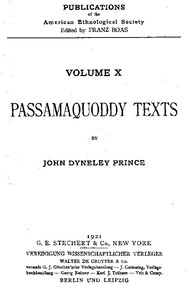
Passamaquoddy Texts
Language: en449 downloads on Project Gutenberg
Subjects
In: Mythology, Legends & Folklore·Archaeology & Anthropology
Public-domain ebook sourced from Project Gutenberg #51200.
Public-domain ebook
Language: en449 downloads on Project Gutenberg
Subjects
In: Mythology, Legends & Folklore·Archaeology & Anthropology
Public-domain ebook sourced from Project Gutenberg #51200.
The opening · free to read
For the eastern Wabanaki group, cf. my articles: "Notes on the Language of the Eastern Algonquin Tribes," Amer. Jour. Phil. IX, pp. 310-316; "Forgotten Indian Place-names in the Adirondacks," Jour. Amer. Folk-lore, 1900, pp. 123-128; "The Modem Dialect of the Canadian Abenaki." Miscellanea Linguistica in Onore di Graziodio Ascoli, 1901, pp. 343-362; Leland and Prince, "Kuloskap the Master," Funk and Wagnalls, New York, 1902; "The Penobscot and Canadian Abenaki Dialects," Amer. Anthrop. 1902, N. S. 4, pp. 17-32; "The Penobscot Language of Maine," Amer. Anthrop., 1910, N. S. 12, pp. 183-208; "A Micmac Manuscript," Proceedings of the Congress of Americanists, Quebec, 1908. Cf. also the articles quoted below in the present Preface. General articles: "The Algonquin Noun," Proceedings of the Congress of Orientalists, Rome, 1904; "Algonquin Religion," Hastings, Dictionary of Religions, s. v. "God."
The name "Passamaquoddy" is a corruption of pestumo‛kat 'one who catches pollock-fish' (Gadus Pollachius) = peska‛tum. This term has been applied to the tribe only in comparatively recent times.
The Passamaquoddy of Maine now live at Sipayik or Pleasant Point, near Eastport, Me., and near Princeton, Me., while the Maliseet have their chief settlement near Fredericton, N. B. At Pleasant Point, which is the modern headquarters, dwelt Sopiel Selmo, the keeper of the Wampum Records, a mnemonic system of wampum shells arranged on strings in such a manner, that certain combinations suggested certain sentences or certain ideas to the narrator, who, of course, knew his record by heart and was merely aided by the association of the shell combinations in his mind with incidents of the tale or record which he was rendering. With Selmo, however, died the secret of this curious system, but some of the wampum strings are still to be seen at Pleasant Point and there are a few in the possession of Mr. Wallace Brown at Calais, Me. The laws and customs thereby recorded are published in the first Series of the following texts in a more exact form than that given in my former publication of this record in "Proceedings of the American Philosophical Society," 1897, pp. 479-495.
There is also a large amount of oral literature handed down by these Indians, a quantity of which existed in the manuscripts of the late Hon. Lewis Mitchell, former Indian member of the Maine Legislature. These documents, together with Mitchell's version of the Wampum Records, came into my possession some years ago, but were all destroyed by fire in 1911, since which time Mr. Mitchell industriously reproduced them at my request from memory. They are herein presented to Americanists for the first time in the original in Series 2, 3 and 4 of the following texts. Other matter of this character has already appeared in the Philosophical Society's Proceedings, XXXVIII, pp. 181-189: "Some Passamaquoddy Witchcraft Tales;" American Anthropologist (N. S.), XI, No. 4, pp. 628-650: "A Passamaquoddy Aviator."
Of the texts in the present work only the Wampum Records (former publication cited above) and part of Series 4, "Songs" (N. Y. Academy of Sciences, XI, No. 15, pp. 369-377 and XIII, No. 4, pp. 381-386) have been published before in an imperfect form. Poetical and inexact English renderings of some of the Kuloskap material (Series 2 below) have appeared in Leland and Prince "Kuloskap the Master," New York, 1902, a popular exposition of eastern Algonquin folk-lore.
The phonetics of the Passamaquoddy dialect are comparatively simple. In the Mitchell manuscripts, the scribe followed a spelling influenced variously by both English and French, frequently using b, d, g, for p, t, k; j for tc, and a purely arbitrary system of vocalization employing a, u, e for the indeterminate vowel u or ', often omitting entirely the rough breathing ‛, or representing it by h. It was, therefore, clearly impossible to reproduce Mitchell's texts literally, so I have followed, as far as was feasible, the system used in my "Morphology of the Passamaquoddy Language of Maine," Proceedings of the American Philosophical Society, LIII, pp. 92-117, the principles of which follow herewith:
a = short o in 'bother'.
ā = a in 'father'.
â = aw in 'awful'.
' = the indeterminate vowel (Schwund).
u = oo in 'foot'.
There are no nasal vowels, as in Penobscot and Abenaki.
h is the simple breathing, but the inverted comma ‛ is a glottal catch like a very soft Arabic ḥ.
l often carries its own inherent vowel similar to the heavy Russian l. This sound is represented in the following material by an elevated e, before the l (εl).
n before consonants carries its own inherent vowel, as nki, pron. ŭnkî.
p, t, k, are voiceless surds, pronounced almost like b, d, g between vowels and never like English, p(h), t(h), k(h).
tc, dc represent almost the same sound, between a palatalized English ch and a palatalized English j, similar to Polish ć and ź.
s between vowels is frequently pronounced z and written thus.
w after k (= kw) represents the final Algonquin "whistle," as ke‛kw = keḥkwu; w in general is a weak consonant; sometimes initial w almost = u, as w_'liko_ = uliko.
The intonation of Passamaquoddy is highly tonic, showing a voice-raise which often varies, apparently arbitrarily, with various speakers. Thus, such a word as lakutwâk'n has the voice-lift on the first syllable, a drop on the second, lift on the third, and drop on the fourth. As I have noticed so many stress-variations often of the same vocable by different Passamaquoddy speakers, the accent has been rarely indicated in the following texts. The peculiarity of the voice-lift seems to be distinctively Passamaquoddy, as the kindred Maliseets usually speak monotonously, with no especially noticeable voice-lift. The Abenakis also have frequently a monotonous tone, amounting practically to a drawl. All these idioms of the Wabanaki are spoken in a low pitch and almost never with the strong emphasis and often loud voice of western Indian languages such as the Dakota.
J. DYNELEY PRINCE.
NEW YORK, COLUMBIA UNIVERSITY, 1920.
Medcimiu p'kokni tohokyoltowuk; k'tciyawiu w'ski‛tap epidcik wasis'k nespiw'sikyojik yut metci-mipniltimkil; nit etutc-al-ithuswin'k nek'meyu tepithotmo‛tit tcewi ke‛kw εleyu; eliyowuk tcewi εleyutetc na neksēyu. Nit etutci m'sīu sise-p'tcitaketil kinwetwaswinti m'sī-te elipit w'skitcin; ankwotc elk'wiyik saunisnuk; ankwotc w'tcip'nuk; k't'kik snutsekt'nuk; k't'kik k'skiyasnuk. P'tcio-te petciyik Wapna‛kik. K'matc w'sipkikm'n yaka kes'wuk naka wew'tciyanya. Nit-te tama wejiwe‛tit w't-iyawa w'skitc'no: "k'p'tciptoln'n w'li-ak'not'mâk'n." Nit etlausitkw'ton kisi-putwuso li-kislut'muk. M'sī-te tekepit w'skitcin kinwe‛to nit k'tci lakutwâk'n kitwitaso. M'sīu w'skitcin nut'k ak'notmâk'n; m'sīu w'lit'hasu. M'sīu w'siwatcyokony'l kat-kisilet-te kaum'k mat'nitin. Nit m'sīu kesukmiksit op'dcitakan oputwuswin'm. Nit m'sīu kesukmiksit op'tcitakan nisu kesena akwam'k oputwuswin'm natciwitcitak'wik k'tci lakutwâk'n kesena k'tci maweputwuswâk'n.
Nit m'sīu kis-maweusetil; nit o-matce-tepithotm'nya ta nite w't-elokh'tinya. Ste‛pal m'sīu siwatcyoko‛tit eli-wap'li-p'mau‛sit. Yok't k'tci sak'mak w't-iyana k't'kihi: "yut elapim'k asit-wetcosyo‛kw k'n'mi‛tunen eli-p'kaknapt'wuk; k'n'mi‛tonenw'l kesek ewaplikil; yut'l p'kaknikil t'm'hîk'nsis'l-lo naka tapyik t'pa‛kwyil tcewi-puskenosw'l oskeniu." Nit-te m'sīu w't'li-kislutm'nya w't'lakutinya. Nit w't-akinwi-ponm'nya kis'k etutci-putwusi‛tit. Nit liwetasu tcikte wikwam. Yot w'kesekm'nya etasi-kiskakil katama-lo wen k'losiu. M'sī-te putwuswin tcewit-lithasu tanetc w't-itm'n; tan etutci litutit t'pask'swâk'n'l; m'sī-te w'tepithotm'nya tanetc-li kisi-tcenetaso man'tim'k; kwuni tcikpultowuk lo; pem-lokemkil.
Always bloodily they were fighting; many men, women (and) children were tortured by these continual wars; then these wise ones take thought so that something may be done; and that quickly; then all send a messenger to every place where the Indians dwell; some go to the south; some to the east; some to the west; others to the north-west. They even come as far as the Wabanaki. Very long it takes, even months, till they arrive. Then when they come there, they say to the Indians: "We bring you good news." Then when they arrived, they took counsel what to decide. To all Indians dwelling there one announces that a great peace will be called. All the Indians hear the news; all rejoice. All are weary of having made continual warfare. Then every tribe sends its councillor. Every tribe sends two or more councillors that they may be present at the great peace, or great general council.
Then all assembled. Then they began to take counsel as to what they should decree. Only, all are weary of living in an evil way. These great chiefs say to the others: "Now, when we look back at what we did, we see that these trails are bloody; we see how many bad things there were; these bloody tomahawks and bows and arrows--they must be buried for ever." Then all decide that they should make peace. Then they appoint a day when they shall take counsel. This is called "the Silent Wigwam." Then they give order that on each day no one shall speak (but) every councillor must think over what he shall say how to make the laws; they all consider how to stop the wars; as long as they remain; a week.
Aptc etutci-apkw'timutit; wikwam liwitasu "m'sita‛kw wen t‛lēwesto." Nit na kwuni o-matce-putwuswinya. M'sīu putwuswin w't-uknutm'n eli-pipyaks naka metc-matnuti‛tit; m'sīu eli-w'sikyoltoti‛tits kwunipn'-ltim'k; nit-lo al-teketc tepnasko yotepithatosu naka k'temakithaman w'tepitemowa w'tawasismowa naka mamatwikoltidcik; medcimiu yok-li w'sikyasp'nik tahalo-te saklithat w'ski‛tap naka m'tap'kwin. Nit m'sīu-mi t'lēwestoti‛tit, nit li-kislom'k w'tlitonya k'tci lakalosnihak'n naka totciu oponm'nya epasiu k'tci wikwam t'pakalosniu. Na w't'litonya epus; w'ponm'nya w'mitâ‛kwsow'l; nit wen pelestowat nit etutc -eshemhut'm yut'l eyilidcil w'nidcan'l t'pakalosniu. M'sī-te na w't-atcwiyik-setswaw'l naka na medcimiu w'm'tutwatm'n w'ktci skwut, wa wedci-ska-nekasw'nuk. Yot wedci madc'hak wapapi t'pask'-swāk'n'l.
Nit lakalosnihak'n'l et'li-nsetwasik sp'm'k nit mawe-lakutwi-kislut-mewâk'n; m'sī-te kesikpesit w'skitcin newanko k'sukmito, k'nok-lo k'tciyawi milidcpesw'. M'sī-te yokt'ke w'skitcinwuk w't-atc'wi-elianya naka wikinya t'pakalosniu. T'ketc wen ke‛kw-li waplelok't tciwi-semha; w'nikikow'l w't-esemhokol nit epus. Kisi-mawetasiks nit-lo tane te‛po wikit t'pakalosniu tce-tciksitm'n'l tan eyilīdcil tpask'swâk'n'l kesena esemha. Nit wikwam et'linsetwasik t'pakalosniu hitmowiu m'sī-te k'sit w'skitcin kisita‛kw tcewi-li sank'wi-p'mau‛so. Katama aptc tcika-wiyotoltiwun; tcewi-li p'mau‛sowuk tahalo wesiwestoltīdcik witsekeso-toltīdcik o-pesw'n w'n'kikowu. Nit-lo k'tcī skwut et'li-w'sitwasik wikwam'k hitmowiu m'si-te-ta wut kiswitcita‛kw w'skitcin nitetc et'losi‛tit skwut'k w'lamantc skat aptc t'keyi wipmeshonw'l. Nit-lo w'nikikow'l et'lin m'sit wut wikwam'k nit k'tci sak'm Kanawak. Nit-te lakaloshîk'n naka epus hitmowiu wapapi t'pask'swâk'n'l. Tan wut pelset'k tcewi-mawe-sakyaw'l et'li-nsetwodcik; nit m'sike‛kw kisitpiyak.
The book keeps going
Reading is free forever. Sign up and watch scenes appear while you read.



Scenes Storieta drew for other classics.
New illustrated classics
Once or twice a month: the latest books to get full character casts, scene art, and free comic editions. No account needed.