Public-domain ebook
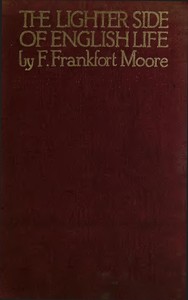
The Lighter Side of English Life
Language: en572 downloads on Project Gutenberg
Subjects
In: Humour·Novels·British Literature
Public-domain ebook sourced from Project Gutenberg #51927.
Public-domain ebook
Language: en572 downloads on Project Gutenberg
Subjects
In: Humour·Novels·British Literature
Public-domain ebook sourced from Project Gutenberg #51927.
The opening · free to read
It was the Rector who told me the story, adding in regard to the labourer---- “Isn't that just like Thurswell--fancying that a Czech who had just crossed the Channel, and believed himself to be in Belgium, should know all about Thurswell and its Bleybar Lane?”
I thought that it was very like Thurswell indeed, and afterwards I made it still more like by talking to the agricultural labourer himself about the incident.
“Ay, he spoke gibberish with a foreign accent, and I told him plain enough, when he had swept his arms and cried 'Where?' or words to that effect, that he was by Bleybar Lane, and that the place he couldn't see for the windmill was Thurswell; but it were no use: foreigners be in the main woeful ignorant for Christian persons, and I could see that he had no knowledge even of Thurswell when he heard the name.”
That is our village down to the ground. You could not persuade one of the aborigines that there is any place in England or outside it of greater importance than Thurswell, because there is no place of greater importance to the Thurswellian. An aged inhabitant was taken by his son to see the coronation procession, and when he was asked what it was like, replied, after a suitable pause, that it ran Thurs-well's Day very hard--Thurswell's Day is the name given to the First Sunday after Trinity, when the Free Foresters and Ancient Shepherds march to church in sashes, with a band made up of a fife, three flutes, a drum, a concertina, and a melodion.
“Ay, neighbours, it ran Thurswell's Day hard,” he affirmed, and did not flinch from his statement in spite of the incredulous murmur that arose from the bench nearest the door, which was immediately suppressed by the landlord, who was apprehensive of a riot.
Thurswell is a village of antiquity. Its name occurs in Domesday Book, where you may look in vain for any mention of Brindlington, that mushroom town of 60.000 inhabitants, which is nine miles to the north, or even of Broadminster, the Cathedral town, which is seven miles to the west. “Broadminster is where the Dean lives,” I was told by the landlord of the Wheatsheaf at Thurswell when I was making inquiries about the district, “and Brindlington is where the brewery is; but my father got his ale at Pipstone, and I get mine there too, though it's a blow to Brindlington, for in harvest the best part of a cask goes within a week.”
There are several other villages within a mile or so of Thurswell, and the inhabitants of some are infatuated enough to believe that they are on a social, as well as a commercial, level with the people of Thurswell. This singular hallucination caused a good deal of friction on all sides in years gone by, and the rapprochement that was eventually brought about between Thurswell and its neighbours by the thoughtfulness of a Rector, who preached a sermon on the vision of St. Peter and enjoined upon his hearers to remember that even though people have not been born in Thurswell they are still God's creatures, was a purely sentimental one, and did not last.
Some years ago an article appeared in the Topographical Gazette from the pen of an eminent archaeologist affirming that Thurswell must originally have been Thor's Well, so that the place dated back to the time of the worship of the Scandinavian god Thor; but while this evidence of its antiquity was received by some of us with enthusiasm--having been a resident in the village for a whole year I was naturally an ardent Thurswellian--it was, when reproduced in the East Nethershire Weekly, generally regarded as the invention of some one anxious to give the enemies of the village some ground for their animosity toward it. For the suggestion that it had a heathen origin was not one, it was felt, to which its people could tamely submit. There was some talk of a public meeting to protest against the conclusions come to by the archaeologist, and the Rector was considered in some quarters to be but a half-hearted champion of the Faith when he refused to lend the schoolhouse--sixty people could be crowded into it--for this purpose, his argument that the more heathen Thurswell had been in the past, the more marked should be its display of the Christian virtue of charity in the present, being criticised as savouring of Jesuitry. For months the matter was the leading topic of the neighbourhood, and the Hearts of Oak Habitation of the Ancient Shepherds drew up a resolution protesting in this connection against “archaeology and every form of idolatry.” It was the misprint in the Gazette that changed “Hearts of Oak” into “Heads of Oak” in publishing the proceedings that quenched the violence of the discussion, and now it is considered bad taste to refer to it at all.
More recently still another busybody endeavoured to deprive the village of the reputation which it had long enjoyed as the centre of English longevity. Now it would be impossible for any one to study the dates on the tombstones in the churchyard without noticing how great was the number of centenarians who died within the first fifty years of the nineteenth century in the parish of Thurswell. There were apparently eighteen men and fourteen women interred after passing their hundredth year; indeed, one woman was recorded to have reached her hundred and twenty-seventh year, which is a good age for a woman. The people were naturally very proud of the constant references made in print to their longevity; but one day there came down to the village a member of the Statistical Society, and after busying himself among the musty parish registers for a month, he announced his discovery that in every case but one the date of the birth of the alleged centenarians was the date of the birth of their parents. The investigator had noticed that all the alleged centenarians had “departed this life” during the rectorship of the Rev. Thomas Ticehurst, and centenarianism had always been his fad. He had preached sermon after sermon on Methuselah and other distinguished multi-centenarians, and he spent his time travelling about the country in search of evidence in confirmation of the theory that Methuselah, though somewhat beyond the average in respect of age, might yet have been exceeded on his own ground by many people living in the country districts of England. Nothing was easier, the investigator tried to show, than for a clergyman in charge of the registers, who had such a hobby, to assume, when any very old man or woman died in his parish, that he or she actually was twenty years or so older; and as the Christian names were nearly always hereditary, in nine cases out of ten he accepted the registry of the birth of the father as that of the lately deceased man, and the date of the birth of the mother in regard to the aged woman, the result being a series of the most interesting inscriptions.
I must confess that I myself felt that I had a personal grievance against this busybody statistician. There is nothing so comforting to the middle-aged as a stroll through a cemetery of centenarians; and I had the most uncharitable feelings against the person who could make such an attempt to deprive me of the pleasant hope of living another sixty or seventy years.
But while we were still talking about the danger of permitting strangers to have access to the registers, I was told one morning that a man who had once been the gardener at the place which I had just acquired would like to see me. Now, I had had already some traffic with the superannuated gardener of my predecessor, and so I was now surprised to find myself face to face with quite a different person.
“You were not the gardener here,” I said. “I saw him; his name is Craggs, and he still lives in the hollow.”
“Oh ay, Jonas Craggs--young Joe, we called him; I knew his father,” replied my visitor. “He was only here a matter of six-and-thirty years. I was superann'ated to make way for him. Young-Joe, we called him, and I was curious to see how things had come on in the garden of late.”
“You were superannuated thirty-six years ago,” said I. “What age are you now?”
“I'm ninety-eight, sir,” he replied with a smirk.
I showed him round the garden. He said he could see that the things he had planted had grown summut; and I walked through the churchyard the next Sunday with the greatest complacency.
When I told the Rector that my experience of this grand old gardener tended to make me take the side of Thurswell and the neighbourhood against scientific investigation in regard to longevity, he assured me that if I paid a visit to a certain elderly lady who lived with a middle-aged granddaughter in a cottage on the road to Cransdown I should find ample confirmation of the faith for which I had a leaning. The lady's name was, he said, Martha Trendall, and she really was, he thought, a genuine centenarian, for she had a vivid recollection of events which had happened quite ninety years ago; and, unlike most reputed centenarians, she remembered many details of the historical incidents that had taken place in her young days; she was a most intelligent person altogether, and had evidently been at one time a great reader, though latterly her eyesight had shown signs of failing.
I made up my mind to pay a visit to this Mrs. Trendall, and thought that perhaps I might get material for a letter to the Times that should not leave the scientific investigator a leg to stand on. A month, however, elapsed before I carried out my intention, though the Rector thought this was not a case for procrastination: when a lady is anything over a hundred her hold upon life shows a tendency to relax, he said, for even the most notorious centenarians cannot be expected to live for ever. But when I managed to make my call I must confess that I was amply repaid for the time I spent in the company of Mrs. Trendall.
I found her sitting in her chair in what is called the chimney corner when it exists in its original condition in a cottage, but is termed the “ingle nook” in those red brick imitation cottages which are being flung about the country by those architects who concern themselves in the development of estates. I saw at once that such a figure would be out of place anywhere except in the chimney corner of a cottage kitchen, with immovable windows, but a “practicable” iron crane for the swinging of pots over the hearth fire. The atmosphere--thanks to the immobile casements--was also all that it should be: it was congenially centenarian, I perceived in a moment. It had a pleasant pungency of old bacon, but though I looked about for a genuine flitch maturing in the smoke, I failed to see one--still, the nail on which it should be hanging was there all right.
The old woman was quite alert. There was nothing of the wheezy gammer about her. Only one ear was slightly deaf, she told me when I had been introduced by her granddaughter--a woman certainly over fifty. She smiled referring to her one infirmity, and when she smiled the parchment of her face became like the surface of the most ancient palimpsest: it was seamed by a thousand of the finest lines, and made me feel that I was looking at an original etching by Rembrandt or Albert Dürer--a “trial proof,” not evenly bitten in places; and the cap she wore added to the illusion.
The book keeps going
Reading is free forever. Sign up and watch scenes appear while you read.



Scenes Storieta drew for other classics.
New illustrated classics
Once or twice a month: the latest books to get full character casts, scene art, and free comic editions. No account needed.