Public-domain ebook
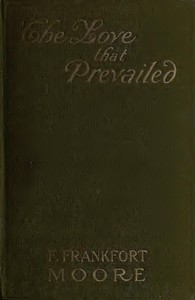
The Love That Prevailed
Language: en457 downloads on Project Gutenberg
Subjects
In: Novels·British Literature·Religion/Spirituality
Public-domain ebook sourced from Project Gutenberg #51971.
Public-domain ebook
Language: en457 downloads on Project Gutenberg
Subjects
In: Novels·British Literature·Religion/Spirituality
Public-domain ebook sourced from Project Gutenberg #51971.
The opening · free to read
The old church ways be good enough for me,” said Miller Pendelly as he placed on the table a capacious jug of cider, laying a friendly left hand on the shoulder of Jake Pullsford, the carrier, as he bent across the side of the settee with the high back.
“I ne'er could see aught that was helpful to the trade of a smith in such biases as the Quakers, to name only one of the new-fangled sects,” said Hal Holmes, the blacksmith, shaking his head seriously. “So I holds with Miller.”
“Ay, that's the way too many of ye esteems a religion--' Will it put another crown in my pocket?' says you. If't puts a crown in your pocket, 'tis a good enough religion; if 't puts half-a-crown in your pocket, 'tis less good; if't puts naught in your pocket, that religion is good for naught.”
The speaker was a middle-aged man with a pair of large eyes which seemed to vary curiously in colour, sometimes appearing to be as grey as steel, and again of a curious green that did not suit everybody's taste in eyes. But for that matter, Jake Pullsford, the carrier, found it impossible to meet everybody's taste in several other ways. He had a habit of craning forward his head close to the face of anyone to whom he was speaking, and this movement had something of an accusing air, about it--occasionally a menacing air--which was distinctly distasteful to most people, particularly those who knew that they had good reason to be accused or to be menaced.
“Jake Pullsford goes about the world calling his best friends liars without the intent to hurt their feelings,” was the criticism passed upon him by Miller Pendelly. Other critics were not so sure on the subject of his intent. He had never shown himself to be very careful of the feelings of his friends.
“The religion that puts naught in thy pocket is good for naught--that's what you be thinking of, Hal Holmes,” he said, thrusting his head close to the face of the smith. But the smith did not mind. The man that spends most of his days hammering out and bending iron to his will, usually thinks good-naturedly of one who uses words and phrases as arguments.
“I don't gainsay thee, Jake,” he replied. “If you know what's in my thought better than I do myself, you be welcome to the knowledge.”
“I meant not thee in special, friend,” said Jake. “What I say is that there are too many in these days that think of religion only for what it may bring to them in daily life--folk that make a gain of godliness.”
“And a right good thing to make a gain of, says I,” remarked the miller with a confidential wink into the empty mug which he held--it had been full a moment before.
“Ay, you be honest, miller: you allow that I am right and you have courage enough to praise what the Book condemns,” said Jake.
“Look'ee here, friend,” said the miller, in his usual loud voice--the years that he had spent in his mill had caused him to acquire a voice whose tone could successfully compete with the creaking and clattering of the machinery. “Look'ee here, friend Jake, 'twould be easy enough for you or me that has done moderate well for ourselves in life, to turn up our eyes in holy horror at the bare thought of others being godly for what they may gain in daily life, but for myself, I would not think that I was broaching a false doctrine if I was to say to my son, 'Young man, be godly and thou 'll find it to bring gain to thee.' What, Jake, would 'ee have a man make gain out of ungodliness?”
“Ay, that's a poser for him, miller: I've been thinking for that powerful proposal ever since the converse began,” said a small man who had sat silently smoking in a high-backed chair. He was one who had the aspect of unobtrusiveness, and a figure that somehow suggested to strangers an apologetic intention without the courage ever to put it in force. His name was Richard Pritchard, and he was by profession a water-finder--a practitioner with the divining rod, but one whose successes were never startling.
When he had spoken, all the room, to the number of three, turned anxious eyes upon him, as if they were surprised at his having gone so far and feared a painful sequel. He seemed to feel that he had justified their worst forebodings, and hastened to relieve their minds.
“I'm all friendly, friends, and Jake in especial,” he said. “Don't forget that though a man on the spur of the moment, and in the fierce stress of argyment, may say a bitter hard word or two, there may still be naught in his bosom's heart but neighbourly friendship, meaning no offence to you, Jake, that be a travelled man, viewing strange cities quite carelessly, where plain and simple men would gape and stare.”
Jake, the carrier, gave no sign of having heard the other speak.
“There's a many o' us in these parts as strong as in other parts, that be ready and willing to take things as they come,” said he; “to take the parson's preaching as they take the doctor's pills.”
“Ay, wi' a wry face,” acquiesced the blacksmith with a readiness that one could see the carrier thought meant no good.
He leant across the table once more until his face was close to the smith's, and said:
“That's where you be wrong, Hal Holmes. You know as well as the most knowledgable----”
“Meaning yourself, Jake?” said the smith drily.
“You know well that though you may make a wry face when gulching down the doctor's pill, ye dursn't so much as show a wrinkle or a crinkle on your face when Parson Rodney is in his pulpit,” replied the carrier with emphasis.
“'Cause why?” said the miller. “I'll tell ye truly--'tis because the parson gives us no bitter pills, only----”
“That's what I've been leading up to,” cried the carrier triumphantly. “The parson, like thousands of the rest of his cloth throughout the length and breadth o' the land, is content to preach pleasant things only, even as the false prophets of Israel prophesied fair things.”
“And why shouldn't he be content to preach pleasant things, friend Jake, if so be that we be content to hear them? and for myself I would muchly listen to an hour of pleasant things--ay, rather than half an hour of unhappy ones.”
“Ah, miller, what would you say if the doctor, who, when he saw your body suffering from a canker, gave you a sugar-plum and withheld his knife from cutting out the plague spot because you were apt to be squeamish at the sight of bloodletting!”
There was an uneasy pause when the carrier had asked this rehearsed question. He asked it with a triumphant air, and, as if he felt it to be too large a question to be answered by the miller singlehanded, he, as it were, swept the whole company by a glance into his interrogation.
The water-finder made a motion with his hands as if trying to smooth away an imaginary roughness in the air. There was a general feeling that the carrier had triumphed in his argument. He was one of those people who, by speaking in an air of triumph, succeed in making some people believe that they have triumphed. The farmer shook his head with the disinterestedness of an arbitrator. The smith continued looking into the empty mug from which he had just drunk. The silence lasted several seconds, and every second of course added to the triumph of the carrier. The man was not, however, adroit enough to perceive this. He was indiscreet enough to break the silence. When his eyes had gone round the company they returned to the miller.
“Answer me that question, man!” he cried, and then everyone knew that he had not triumphed: the last word had not been said.
“I'll answer you when you tell me if you wouldn't bear friendly feelings for a doctor who gives you a sugar plum instead of blooding you when he finds you reasonable well,” said the miller.
“'Tis when a man feels healthiest that he stands most in need of blooding,” said Jake, not very readily and not very eagerly. “And so it is in the health of the soul. 'Let him that thinketh he stand take heed lest he fall.' Friends, is there one among us that can lay his hand on his heart and say that he believes that our parsons do their duty honestly and scripturally.”
“It took you a deal o' time to lead us up to that point: you'd best ha' blurted it out at once,” remarked Hal Holmes.
“Nay, we all knew that it was a-coming,” said the farmer. “Since Jake found himself as far away from home as Bristol city, he has never lost a chance of a dig at the parsons.”
“I don't deny that my eyes were opened for the first time at Bristol,” said Jake. “Bristol was my Damascus, farmer.”
The farmer gave a jerk to his head, for the carrier had laid undue emphasis upon the first syllable of the name.
“So bad as that?” he whispered.
The blacksmith laughed.
“Not so bad, farmer,” he said. “'Tis only our neighbour Jake that compares himself with St. Paul, the Apostle.”
“I heard the profanity. He would ha' done better to abide at home,” said the farmer severely.
The blacksmith laughed again.
“There fell, as it were, scales from my eyes when I heard preaching for the first time--when I heard a parson for the first time,” resumed the carrier, looking out of a window, and apparently unconscious of any of the remarks of his friends. “Ay, 'twas for the first time, albeit I had scarce missed church for a whole Sunday since I were a lad. That was what struck me most, neighbours--that I could go Sunday after Sunday, in good black cloth, too, and hear the holy service read, in a sort of way, and the sacred psalms sung, while the fiddle and the double bass and the viol made sweet music, and yet have no real and true yearning after the truth, seems little short of a miracle, doesn't it?”
The book keeps going
Reading is free forever. Sign up and watch scenes appear while you read.



Scenes Storieta drew for other classics.
New illustrated classics
Once or twice a month: the latest books to get full character casts, scene art, and free comic editions. No account needed.