Public-domain ebook
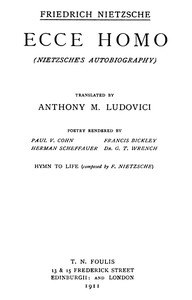
Ecce Homo Complete Works, Volume Seventeen
by Friedrich Wilhelm Nietzsche
Language: en20,518 downloads on Project Gutenberg
Subjects
In: Biographies·Philosophy & Ethics
Public-domain ebook sourced from Project Gutenberg #52190.
Public-domain ebook
by Friedrich Wilhelm Nietzsche
Language: en20,518 downloads on Project Gutenberg
Subjects
In: Biographies·Philosophy & Ethics
Public-domain ebook sourced from Project Gutenberg #52190.
The volume gathers Friedrich Wilhelm Nietzsche’s later reflections, beginning with a satirical sketch of the German “Purists” who seek to purge foreign words from everyday speech. From this opening, Nietzsche launches into a sprawling self‑portrait that frames his work as a “book for free spirits,” a declaration that each sentence is meant to strip away what he regards as foreign to his nature, idealism, moral pretensions, and the comforting myths of art and religion. He situates the text in the cultural ferment of the 1870s, referencing the Bayreuth festival, his break with Wagner, and his own physical ailments, all of which serve as backdrops for a relentless critique of conventional values and a proclamation of personal emancipation.
Written in Nietzsche’s characteristic aphoristic, polemical style, the prose is dense, often ironic, and peppered with vivid metaphors, freezing ideals, torch‑lit revelations, and battles without powder. The voice is unmistakably that of a late‑19th‑century German philosopher who combines scholarly erudition with a fierce, almost theatrical self‑analysis. Readers who relish challenging, intellectually rigorous texts that interrogate morality, culture, and the self, especially those interested in Nietzsche’s autobiographical turn and his critique of German intellectual life, will find this volume a compelling, if demanding, encounter.
The opening · free to read
He who knows how to breathe in the air of my writings is conscious that it is the air of the heights, that it is bracing. A man must be built for it, otherwise the chances are that it will chill him. The ice is near, the loneliness is terrible--but how serenely everything lies in the sunshine! how freely one can breathe! how much, one feels, lies beneath one! Philosophy, as I have understood it hitherto, is a voluntary retirement into regions of ice and mountain-peaks--the seeking--out of everything strange and questionable in existence, everything upon which, hitherto, morality has set its ban. Through long experience, derived from such wanderings in forbidden country, I acquired an opinion very different from that which may seem generally desirable, of the causes which hitherto have led to men's moralising and idealising. The secret history of philosophers, the psychology of their great names, was revealed to me. How much truth can a certain mind endure; how much truth can it dare?--these questions became for me ever more and more the actual test of values. Error (the belief in the ideal) is not blindness; error is cowardice.... Every conquest, every step forward in knowledge, is the outcome of courage, of hardness towards one's self, of cleanliness towards one's self. I do not refute ideals; all I do is to draw on my gloves in their presence.... Nitimur in vetitum; with this device my philosophy will one day be victorious; for that which has hitherto been most stringently forbidden is, without exception, Truth.
The book keeps going
Reading is free forever. Sign up and watch scenes appear while you read.



Scenes Storieta drew for other classics.
New illustrated classics
Once or twice a month: the latest books to get full character casts, scene art, and free comic editions. No account needed.