Public-domain ebook
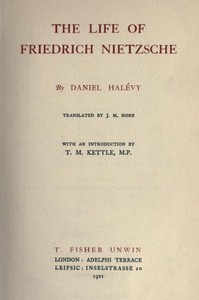
The life of Friedrich Nietzsche
Language: en2,037 downloads on Project Gutenberg
Subjects
In: Biographies·Philosophy & Ethics
Public-domain ebook sourced from Project Gutenberg #53620.
Public-domain ebook
Language: en2,037 downloads on Project Gutenberg
Subjects
In: Biographies·Philosophy & Ethics
Public-domain ebook sourced from Project Gutenberg #53620.
The work is a scholarly essay by Daniel Halévy that treats Friedrich Nietzsche not as a systematic philosopher but as a cultural phenomenon whose life and writings have been reshaped by the “crowd” that both despised and celebrated him. The opening passage frames Nietzsche’s posthumous reputation as a clash between his radical ideas and the generous verdict of history, noting how critics have turned his provocative “will‑to‑power” and “transvaluation of values” into a literary triumph while dismissing his philosophy as “fundamental nonsense.” Halévy surveys the influence of Nietzsche’s French models, La Rochefoucauld, Voltaire, Stendhal, on his distinctive, aphoristic style, and juxtaposes his poetic vigor with the contradictions of his polemical output. The essay promises a panoramic view of Nietzsche’s impact on German prose, his self‑portrait as a mystic of Neo‑Paganism, and the lingering tension between his artistic vision and philosophical legacy.
Written in a measured, early‑20th‑century academic tone, the book blends literary criticism with historical analysis, reflecting the period’s reverence for rigorous scholarship and a penchant for dense, erudite prose. Readers who enjoy intellectual biographies that situate a thinker within both his own cultural milieu and the subsequent critical reception will find it rewarding. It particularly appeals to those interested in the intersection of philosophy, literature, and the history of ideas, as well as to scholars seeking a nuanced portrait of Nietzsche’s paradoxical blend of poet‑philosopher, provocateur, and literary icon.
The opening · free to read
The duel between Nietzsche and civilisation is long since over; and that high poet and calamitous philosopher is now to be judged as he appears in the serene atmosphere of history, which--need it be said?--he infinitely despised. The crowd, the common herd, the multitude--which he also despised--has recorded its verdict with its usual generosity to the dead, and that verdict happens to be an ample revenge. It has dismissed Nietzsche's ideas in order to praise his images. It has conceded him in literature a brilliant success, and has treated his philosophy as fundamental nonsense of the sort that calls for no response except a shrug of the shoulders. The immoralist who sought to shatter all the Tables of all the Laws, and to achieve a Transvaluation of all Values, ends by filling a page in Die Ernte and other Anthologies for the Young. And in certifying his style to be that of a rare and real master the "crowd" has followed a true instinct. More than Schopenhauer, more even than Goethe, Nietzsche is accounted by the critics of his country to have taught German prose to speak, as Falstaff says, like a man o' this world. The ungainly sentences, many-jointed as a dragon's tail, became short, definite, arrowy. "We must 'Mediterraneanise' German music," he wrote to Peter Gast, and in fact he did indisputably "Mediterraneanise" the style of German literature. That edged and glittering speech of his owed much to his acknowledged masters, La Rochefoucauld, Voltaire, and Stendhal, the lapidaries of French. But it was something very intimately his own; he was abundantly dowered with the insight of malice, and malice always writes briefly and well. It has not the time to be obscure. Nietzsche had this perfection of utterance, but a far richer range and volume. He was a poet by grace divine, and a true Romantic for all the acid he dropped on Romanticism; the life of his soul was an incessant creative surge of images, metaphors, symbolisms, mythologies. These two tendencies produced as their natural issue that gnomic and aphoristic tongue which sneers, preaches, prophesies, chants, intoxicates and dances through the pages of Also Sprach Zarathustra. German critics have applied to Nietzsche, and with even greater fitness, Heine's characterisation of Schiller: "With him thought celebrates its orgies. Abstract ideas, crowned with vine-leaves, brandish the thyrsus and dance like bacchantes; they are drunken reflections." Of many aspects of his own personality Nietzsche may have thought not wisely but too well; but in this regard it appears that he did not exaggerate himself. "After Luther and Goethe," he wrote to Rohde, "a third step remained to be taken.... I have the idea that with Zarathustra I have brought the German language to its point of perfection." The German world of letters has not said No! to a claim so proud as to seem mere vanity. Friedrich Nietzsche holds a safe, and even a supreme position in the history of literature.
What is to be said of his place in the history of philosophy? Höffding allows him a high "symptomatic value," but only that. His work has the merit of a drama, in which the contradictions of modern thought, vibrant with passion, clash and crash together in a tumultuous conflict which, unhappily, has no issue. M. Alfred Fouillée, who has contrasted him with Guyau--that noblest of "modern" thinkers--in his book Nietzsche et l'immoralisme, draws out a table of antitheses, and cancelling denials against affirmations, arrives at a result that looks remarkably like zero. Nietzsche in truth was a man of ecstasies and intuitions, rather than of consequent thought. He troubled little to purge himself of self-contradictions, as became a writer whose first word had been a vehement assault on that Socratic rationalism which, as he believed, had withered up the vital abundance of Greece. His instincts were those of an oracle, a mystagogue; and mystagogues do not argue. Heinrich von Stein, in styling his first book an Essay in Lyrical Philosophy, spoke in terms of his master's mind.
With Nietzsche reason deliberately abdicates, bearing with it into exile its categories of good and evil, cause and end. Schopenhauer had suggested to him that the true key to the riddle of existence was not intellect but will; behind the mask of phenomena the illuminated spirit discerned not a Contriving but a Striving, a monstrous Will, blind as old Œdipus, yearning like him through blood and anguish to a possible redemption. But in time he cast off Schopenhauer and pessimism. The Will to Live he "construed in an optimistic sense," and it darkened into that other mystery, at once vaguer and more malign, the Will to Power. The problem remained to find a ground for optimism, and a clue to the harmony, to the recurring rhythms and patterns of reality as we know it. So was born what is perhaps the characteristic idea of Nietzsche. The universe is not a phenomenon of Will, it is a phenomenon of Art. "In my preface to the book on Wagner I had already," wrote Nietzsche in 1886, "presented art, and not morality, as the essentially metaphysical activity of man: in the course of the present book I reproduce in many forms the singular proposition that the world is only to be justified as an artistic phenomenon." For the optimist quand-même this interpretation has many advantages. Cruelty, sorrow and disaster need no longer dismay him; since a world may at the same time be a very bad world and a very good tragedy. "It may be," the lyricist, turned philosopher, wrote later, "that my Zarathustra ought to be classified under the rubric Music." These two passages, with a hundred others, determine the atmosphere into which we are introduced. We have to deal not with a thinker who expounds a system, but with a prophet who dispenses a Revelation: Nietzsche is not the apologist but the mystic of Neo-Paganism.
Coming to closer range, we may dismiss at once a great part of his polemical writings. They were a sort of perpetual bonfire in which from time to time Nietzsche burned what he had once adored, and much more beside. They bear witness to that proud independence, one may almost say that savage isolation, which was the native climate of his soul. Niemandem war er Untertan, "he was no man's man," he wrote of Schopenhauer, and that iron phrase expressed his own ideal and practice. His brochures of abuse he regarded as a mode, though an unhappy mode, of liberation. He had little love of them himself in his creative moments: he desired with a fierce desire to rid his soul of hatreds and negatives and rise to a golden affirmation. "I have been a fighter," declares Zarathustra, "only that I might one day have my hands free to bless." "In dying I would offer men the richest of my gifts. It was from the sun I learned that, from the sun who when he sets is so rich; out of his inexhaustible riches he flings gold into the sea, so that the poorest fishermen row with golden oars." It is not the Will to Power that speaks here, but that older and more sacred fountain of civilisation, the Will to Love. But if Nietzsche had that inspiration one is tempted to say of him what he said of Renan: He is never so dangerous as when he loves. The truth is that he had the genius of belittlement. It was the other side of his vanity, a vanity so monstrous that it seems from the first to have eaten of the insane root. There is no humour, no integral view of things, behind his critical work. It is sick with subjectivity. And yet Zarathustra in a temper is, by times, far more amusing than sinister. What could be better than some of the characterisations in A Psychologist's Hedge-School, "Seneca, the Toreador of virtue ... Rousseau, or the return to nature in impuris naturalibus. ... John Stuart Mill; or wounding lucidity"? But when, in this mood, he gnaws and nibbles about the sanctuaries of life; when he tells us that the true Fall of Man was the Redemption, that the two most noxious corruptions known to history are Christianity and alcohol; when he presses his anti-Feminism to a point that goes beyond even the gross German tradition of which Luther's Table Talk is a monument, the best that one can do for him is to remember that he often took too much chloral. It may be that to the circles in these countries to whom the cult of Nietzscheanism appeals, this strain of his thought also appeals. This particular music is not played on many trumpets, but every Superman ought to know it. And he ought to know further that Zarathustra, being brave, gibes not only at St. Paul, but even at Herbert Spencer, and has no more toleration for the gospel according to Marx than for that according to Matthew.
What is the gospel of this ambiguous prophet? It is, he himself declares, a long "Memento vivere." His own experience taught him that the characteristic of life, in its highest moments, is to be unimaginably alive. From a mere process it becomes a sudden intoxication, and on the psychology of that intoxication, which is the psychology of the artist and also that of the lover and the saint, he has written pages which are a wonder of pure light. From this standpoint he criticises justly the mechanical theory of adjustments in which there is nothing to adjust, of adaptations in which there is nothing to adapt, the whole ab extra interpretation of life popularised by Darwin, Spencer, and the English school in general. The living unit is more than a mere node or knot in a tangle of natural selection; it is a fountain of force, of spontaneity, constantly overflowing. "The general aspect of life is not indigence and famine, but on the contrary richness, opulence, even an absurd prodigality." To live is for Nietzsche, as for the Scholastics, to be a centre of self-movement. With the Pragmatists he asserts the primacy of life over thought. But this tension of consciousness, this Dionysiac drunkenness, is only a foundation, it is not yet a philosophy. Philosophy, or at all events moral philosophy, begins with the discovery that there are other people in the world. Your ego, thus drunken and expansive, collides sharply with another ego, equally drunken and expansive, and it becomes at once necessary to frame a code of relations, a rule of the road. Is this force and spontaneity of the individual to flow out towards others through the channel of domination or through that of love?
Zarathustra had marched with the Germans over prostrate France, he had said in his Gargantuan egoism: "If there were Gods, how could I bear not to be a God? Consequently there are no Gods." If the Goths and the Vandals had read Hegelian metaphysics, observes Fouillée, they would have answered this question as Nietzsche answered it. The living unit accumulates a superabundance of force in order to impose its power on others ... an andern Macht auslassen. The Will to Power is the sole source of human activity. The strong must live as warriors and conquerors, adopting as their three cardinal virtues pride, pleasure, and the love of domination. Pity is the deepest of corruptions; it but doubles pain, adding to the pain of him who suffers the pain of him who pities. If you have helped any one, you must wash the hands that helped him, for they are unclean. The Crusaders brought home but one treasure, the formula, namely, of the Assassins, "Nothing is true, everything is permitted." Science is mere illusionism; but the warrior, knowing how to be hard--for that is the new law--will impose his own arbitrary values on all things, and will make life so good that he will desire it to be indefinitely repeated. The earth, thus disciplined, will bring forth the Superman, who, having danced out his day, will disappear to be recreated by the Eternal Return. Thus spake Zarathustra.
The book keeps going
Reading is free forever. Sign up and watch scenes appear while you read.



Scenes Storieta drew for other classics.
New illustrated classics
Once or twice a month: the latest books to get full character casts, scene art, and free comic editions. No account needed.