Public-domain ebook
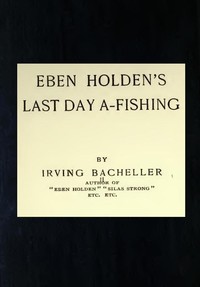
Eben Holden's Last Day A-Fishing
Language: en478 downloads on Project Gutenberg
Subjects
In: Novels·American Literature·Old Age & the Elderly
Public-domain ebook sourced from Project Gutenberg #52454.
Public-domain ebook
Language: en478 downloads on Project Gutenberg
Subjects
In: Novels·American Literature·Old Age & the Elderly
Public-domain ebook sourced from Project Gutenberg #52454.
The opening · free to read
if any one may have in this world better moment. Yes—that was years ago, and there are strangers in the old home, but to this day every time I enter Hillsborough I look for that flicker of white, away off among the trees.
That day the signal greeted us, and was only one of many joys, for it was a day of a thousand, warm, and full of the music of birds and of bees' wings and the odor of new blossoms and a great happiness. Elizabeth Brower stood at the gate, and beyond her we could see Uncle Eb on the veranda, sitting in his arm-chair. The dear woman put her fingers on her lips, and we knew what it meant. Uncle Eb had fallen asleep in the warm sunlight. We greeted her with hushed voices, and approached the venerable man, and sat down at his feet, smiling
and looking up at his fine old face. He continued to sleep, all unconscious that we were near him. Soon we heard him call in his dreams, just above a whisper: “Here Fred! here Fred!” It was the name of our old dog, dead these many years. His nap must have taken him far back—perhaps into that long, westward journey through woods and fields. I took his hand in mine. He came out of his dreams with a start, and looked up at me.
“What!” said he. “Wal, I declare.”
He rose and clung to our hands and looked into our faces with a full heart.
“A merry birthday!” I exclaimed.
“See here, Bill Brower,” said he. “You've hearn o' the joy o' Paradise?”
“Often,” I answered.
“Wal, here's the key-note o' the song,” said Uncle Eb. “Now look here, Liz Brower,” he went on, “you tell 'Sindy we got to have the best dinner ever made by human hands. I'll bring some water.”
Elizabeth, Uncle Eb, and that daughter of Grandma Bisnette were there.
Hope and her mother went into the sitting-room, and I followed them, while Uncle Eb went to the well for water. She looked up at us proudly as we stood before her, side by side.
“Turn around,” she said, “an' let me look at ye careful.”
She surveyed the fit and material of Hope's gown with great satisfaction.
“Look so ye was just goin' t' be married,” she remarked.
We sat down presently upon the ancient hair-cloth sofa, with its knitted
afghan of many colors lying folded against a curved arm. There were the old, plain, priceless things—the carpet, the pictures, a pyramid of plants and flowers in front of the large window, the centre-table, with its album and reading-lamp, the secretary and the what-not filled with books that were a part of our history.
There were the ingredients of that receipt which, as it were, had made the intellectual cake of my boyhood: Josephus' History of the Jews (the flour, two heaping volumes); Ten Nights in a Bar-Room (the milk and water, one volume); Great Expectations, Bleak House), and David Copperfield (the sugar, three volumes); Pilgrim's Progress (the egg, one volume); Our Golden West (the spice, one volume); The Letters of Lord Chesterfield
Soon we found Uncle Eb with my boy David upon his knees on the veranda, and he was telling him the tale of The Witch's Bridle, which I had heard in my childhood, and we stood and listened. It was a relic of old Yankee folk-lore and immensely true.
“Once there was a young man who lived with his father an' mother in a little village,” the story went. “An' there was a house in the village where a witch lived, an' it had a beautiful door. An' his mother told him that he must keep away from that house; but one night it looked so splendid that he opened the door an' went in, an' the witch spied him an' come and
turned him into a hoss, an' rode him all over the hills an' valleys until he was about done fer, an' then fetched him back, an' ev'ry morning when he woke up he was a boy ag'in, an' was lame an' sore an' had a headache an' was sorry that he ever see the witch. He grew poor an' spindlin', an' he'd lay awake night after night to keep the witch away. But o' course he had to go to sleep some time, an' the minute he forgot himself she'd slip in an' put on the bridle an' away they'd go. An' he grew poorer an' poorer an' less an' less like a boy, an' more an' more like an animal. By an' by, he got used to bein' a hoss an' loved to go up in the air an' hadn't any more heart in him than my ol' mare.
“Wal, one night, what d'ye s'pose happened? The witch come an' rode
man, 'less he takes advice ev'ry day from the great Father of all. They's witches ev'rywhere, an' they're always lookin' fer a hoss to ride.”
“See here,” said he, as soon as he discovered us, “you must all come out an' look at my garden.”
“They want to rest,” Elizabeth objected.
“No; we'd rather go with Uncle Eb,” said Hope, and we followed him to the garden.
“Godfrey cordial! hear the birds!” Uncle Eb went on, as we took the path that crossed an edge of the clover meadow. “Lot of 'em been gettin' married, I guess. Don't do a thing but sing an' laugh an' holler—like a lot o' boys an' gals.”
him last. He was bent a little farther, his hands trembled, a small task affected his breathing, but he was the same cheerful, keen-minded man.
“Gardens are all right, but the sight of a hoe makes me shudder,” said I.
“The hoe is a good teacher,” he answered. “Man that don't hoe his character ev'ry few days won't have any.”
“My wife hoes mine,” I said.
“An' does it kind o' careless.” He drew his hand over his mouth and cleared his throat and went on as if nothing had happened. “These things are a good deal like folks. Some grow up an' some grow down. I used to know a woman that looked like a turnip, and a gal that was like a flower, an' another that was like a pepper-plant, an' a man that was a reg'lar human onion.”
“Think of Paradise Valley,” I went on. “It will be green and sprinkled with blossoms, and the brook will be singing as it goes by.”
“You quit!” he answered, with a little gesture of impatience. “Say!” he suggested, with enthusiasm, after a moment, “I wouldn't wonder but what the fish would bite—ye take it on the rapids there.”
We returned to the house and he sat in his chair on the small veranda.
“Look at the scalawags!” he laughed. “No, there ain't nothin' that's 'fraid o' me some way. I got a club one day an' tried to scare a mouse; but seems so she knew I was only foolin'. Now she's begun to bully me an' fetch her children right into my bedroom, an' I guess I'll have to git mad an' declare war.”
I hailed a boy in the street, and sent him for a team, to be brought immediately after dinner.
When we sat down to eat, Uncle Eb put the same old question:
“Wal, how's ev'rything down there in the city?”
“About as usual.”
“Too many folks there,” he said,
The book keeps going
Reading is free forever. Sign up and watch scenes appear while you read.



Scenes Storieta drew for other classics.
New illustrated classics
Once or twice a month: the latest books to get full character casts, scene art, and free comic editions. No account needed.