Public-domain ebook
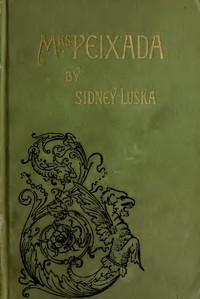
Mrs Peixada
Language: en472 downloads on Project Gutenberg
Subjects
In: Crime, Thrillers and Mystery·Novels
Public-domain ebook sourced from Project Gutenberg #52702.
Public-domain ebook
Language: en472 downloads on Project Gutenberg
Subjects
In: Crime, Thrillers and Mystery·Novels
Public-domain ebook sourced from Project Gutenberg #52702.
The opening · free to read
ON more than one account the 25th of April will always be a notable anniversary in the calendar of Mr. Arthur Ripley. To begin with, on that day he pocketed his first serious retainer as a lawyer.
He got down-town a little late that morning. The weather was superb—blue sky and summer temperature. Central Park was within easy walking distance. His own engagements, alas, were not pressing. So he had treated himself to an afterbreakfast ramble across the common.
On entering his office, toward eleven o’clock, he was surprised to find the usually empty chairs already tenanted. Mr. Mendel, the brewer, was established there, in company with two other gentlemen whom Arthur did not recognize. The sight of these visitors caused the young man a palpitation. Could it be—? He dared not complete the thought. That a client had at last sought him out, was too agreeable an hypothesis to be entertained.
Mr. Mendel greeted him with the effusiveness for which he is distinguished, and introduced his companions respectively as Mr. Peixada and Mr. Rimo. Of old time, when Arthur’s father was still alive, and when Arthur himself had trotted about in knee-breeches and short jackets, Mr. Mendel had been their next door neighbor. Now he made the lawyer feel undignified by asking a string of personal questions: “Vail, how iss mamma?” and “Not married yet, eh?” and “Lieber Gott! You must be five-and-twenty—so tall, and with dot long mustache—yes?” And so forth; smiling the while with such benevolence that Arthur could not help answering politely, though he did hope that a desire for family statistics was not the sole motive of the brewer’s visit.
But by and by Mendel cleared his throat, and assumed a look of importance. His voice modulated into a graver key, as he announced, “The fact is that we—or rather, my friends, Mr. Peixada and Mr. Rimo—want to consult you about a little matter of business.” He leaned back in his chair, drawing a deep breath, as though the speech had exhausted him; mopped his brow with his handkerchief, and flourished his thumb toward Peixada.
“Ah,” replied Arthur, bowing to the latter, “I am happy to be at your service, sir.”
“Yes,” said Peixada, in a voice several sizes larger than the situation required, “Mr. Mendel recommends you to us as a young man who is smart, and who, at the same time, is not so busy but that he can bestow upon our affairs the attention we wish them to have.”
Notwithstanding Arthur’s delight at the prospect of something to do, Peixada’s tone, a mixture as it was of condescension and imperiousness, jarred a little. Arthur did not like the gratuitous assumption that he was “not so busy,” etc., true though it might be; nor did he like the critical way in which Peixada eyed him. “Indeed,” he said, speaking of it afterward, “it gave me very much such a sensation as a fellow must experience when put up for sale in the Turkish slave market—a feeling that my ’points’ were being noted, and my money value computed. I half expected him to continue, ’Open your mouth, show your teeth!’.rdquo; Peixada was a tall, portly individual of fifty-odd, with a swarthy skin, brown, beady eyes, a black coat upon his back, and a fat gold ring around his middle finger. The top of his head was as bald as a Capuchin’s, and shone like a disk of varnished box-wood. It was surrounded by a circlet of crisp, dark, curly hair. He had a solemn manner that proclaimed him to be a person of consequence. It turned out that he was president of a one-horse insurance company. Mr. Rimo appeared to be but slightly in advance of Arthur’s own age—a tiny strip of a body, wearing a resplendent cravat, a dotted waistcoat, pointed patent-leather gaiters, and finger-nails trimmed talon-shape—a thoroughbred New York dandy, of the least effeminate type.
“I suppose the name, Peixada,” the elder of the pair went on, “is not wholly unfamiliar to you.”
“Oh, no—by no means,” Arthur assented, wondering whether he had ever heard it before.
“I suppose the circumstances of my brother’s death are still fresh in your mind.”
Arthur put on an intelligent expression, and inwardly deplored his ignorance. Yet—Peixada?
Peixada? the name did have a familiar ring, of a truth. But where and in what connection had he heard it?
“Let me see,” he ventured, “that was in—?”
“In July, ’seventy-nine—recollect?”
Ah, yes; to be sure; he recollected. So this man was a brother of the Peixada who, rather less than half a dozen years ago, had been murdered, and whose murder had set New York agog. In a general way Arthur recalled the glaring accounts of the matter that had appeared in the newspapers at the time. “Yes,” he said, feeling that it behooved him to say something, “it was very sad.”
“Fearful!” put in Mr. Mendel.
“Of course,” Peixada resumed, in his pompous style, “of course you followed the trial as it was reported in the public prints; but perhaps you have forgotten the particulars. Had I better refresh your memory?”
“That would be a good idea,” said Arthur.—To what was the way being paved?
With the air of performing a ceremony, Peixada rose, unbuttoned his coat, extracted a bulky envelope from the inner pocket, re-seated himself, and handed the envelope to Arthur. It proved to contain newspaper clippings. “Please glance them through,” said Peixada.
The Peixada murder had been a sensational and peculiarly revolting affair. One July night, 1879, Mr. Bernard Peixada, “a retired Jewish merchant,” had died at the hands of his wife. Edward Bolen, coachman, in the attempt to protect his employer, had sustained a death-wound for himself. Mrs. Peixada, “the perpetrator of these atrocities,” as Arthur gathered from the records now beneath his eye, “was a young and handsome woman, of a respectable Hebrew family, who must have been actuated by a depraved desire to possess herself of her husband’s wealth.” They had “surprised her all but red-handed in the commission of the crime,” though “too late to avert its dire results.” Eventually she was tried in the Court of General Sessions, and acquitted on the plea of insanity. Arthur remembered—as, perhaps, the reader does—that her acquittal had been the subject of much popular indignation. “She is no more insane than you or I,” every body had said; “she is simply lacking in the moral sense. Another evidence that you can’t get a jury to be impartial when a pretty woman is concerned.”
“She was bad,” continued Peixada, as Arthur returned the papers, “bad through and through. I warned my brother against her before his marriage.
“‘What,’ said I, ’what do you suppose she would marry an old man like you for, except your money?’ He said, ’Never mind.’ She was young and showy, and Bernard lost his head.”
“She was doocedly handsome, a sooperb creature to look at, you know,” cried Mr. Rimo, with the accent of a connoisseur.
“Hainsome is as hainsome does,” quoth Mr. Mendel, sententiously.
“She was as cold as ice, as hard as alabaster,” said Peixada, perhaps meaning adamant. “The point is that after her release from prison she took out letters of administration upon my brother’s estate.”
“Why, I thought she was insane,” said Arthur. “A mad woman would not be a competent administratrix.”
“Exactly. I interposed objections on that ground. But she answered that she had recovered; that although insane a few months before—at the time of the murder—she was all right again now. The surrogate decided in her favor. A convenient form of insanity, eh?”
“Were there children?” Arthur inquired.
“No—none. My nephew, Mr. Rimo, son of my sister who is dead, and I myself, were the only next of kin. She paid us our shares right away.” Then what could he be driving at now? Arthur waited for enlightenment.
“But now,” Peixada presently went on, “now I have discovered that my brother left a will.”
“Ah, I understand. You wish to have it admitted to probate?”
“Precisely. But first I wish to find Mrs. Peixada. The will isn’t worth the paper it’s written on, unless we can get hold of her. You see, she has about half the property in her possession.”
“There was no real estate?”
“Not an acre; but the personalty amounted to a good many thousands of dollars.”
“And you don’t know where she is?”
“I haven’t an idea.”
“Have you made any efforts to find out?”
“Well, I should say I had—made every effort in my power. That’s what brings me here. I want you to carry on the search.”
“I shouldn’t imagine it would be hard work. A woman—a widow—of wealth is always a conspicuous object—trebly so, when she is handsome too, and has been tried for murder. But tell me, what, have you done?”
The book keeps going
Reading is free forever. Sign up and watch scenes appear while you read.



Scenes Storieta drew for other classics.
New illustrated classics
Once or twice a month: the latest books to get full character casts, scene art, and free comic editions. No account needed.