Public-domain ebook
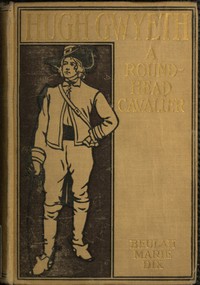
Hugh Gwyeth: A Roundhead Cavalier
Language: en443 downloads on Project Gutenberg
Subjects
In: Historical Novels·Adventure·Novels
Public-domain ebook sourced from Project Gutenberg #52962.
Public-domain ebook
Language: en443 downloads on Project Gutenberg
Subjects
In: Historical Novels·Adventure·Novels
Public-domain ebook sourced from Project Gutenberg #52962.
The opening · free to read
Up in the tops of the tall elms that overshadowed the east wing of Everscombe manor house the ancient rooks were gravely wrangling. A faint morning breeze swept the green branches and, as the leaves stirred, the warm September sunlight smiting through fell in flakes of yellow on the dark flagstones of the terrace below. For a moment Hugh Gwyeth ceased to toss up and catch the ball in his hand, while he stood to count the yellow spots that shifted on the walk. Eight, nine,—but other thoughts so filled his head that there he lost count and once more took up his listless tramp.
Off to his left, where beyond the elms the lawn sloped down to the park, he could hear the calls of the boys at play,—his Oldesworth cousins and Aunt Rachel Millington’s sons. The Millingtons had come to Everscombe a week before out of Worcestershire, where the king’s men were up in arms and had plundered their house. Yet the young Millingtons were playing at ball with the Oldesworth lads as if it were only a holiday. “Children!” Hugh muttered contemptuously and, conscious of his own newly completed sixteen years, threw an increased dignity into his step. He was a wiry lad, of a slender, youthful figure, but for all that he carried himself well and with little awkwardness. Neither was he ill-looking; though there was a reddish tinge to his close-cut hair it changed to gold when he came into the sunlight, and at all times there was in his blue eyes a steady, frank look that made those who liked him forget the freckles across the bridge of his nose and cheek bones, and the almost aggressive squareness of his chin.
Mouth and chin were even sullen now, as Hugh lingered a moment to glance up at the small diamond panes of the window of the east parlor. Within, Hugh’s grandfather, Gilbert Oldesworth, the master of Everscombe, his sons, Nathaniel and Thomas, his daughter’s husband, David Millington, and Roger Ingram, the lieutenant in Thomas Oldesworth’s troop of horse, were conferring with men from Warwick on the raising of forces, the getting of arms, and all the means for defending that part of the county; and Peregrine, the eldest of the Oldesworth lads, was allowed to be of their counsels. Hugh turned away sharply and resumed his dreary tramp up and down the flagged terrace. “If I had been Uncle Nathaniel’s son, they would have suffered me to be present as well as Peregrine,” he muttered, pausing to dig the toe of his shoe into a crack between the flagstones. “’Tis not just. I am near a man, and they might treat me—” He gave the ball an extra high toss and paced on slowly.
But, call as he would upon his injured dignity, he could not refrain from facing about at the end of the walk and retracing his steps till he was loitering once more beneath the window of the east parlor. He was not listening, he told himself, nor was he spying; there was no harm in walking on the east terrace of a morning, nor in lingering there to play at ball. So he stood slipping the ball from hand to hand, but his eyes were fixed on the little panes of the window above and his thoughts were busy on what was happening within. Would the people of the hamlets round about Everscombe, the farmers and ploughboys, who of a Sunday sat stolidly in the pews of the village church at Kingsford, would they truly resist their sovereign? The Oldesworths would head them, without doubt, but how many others scattered through the county and all through wide England were of the like mind? And what would come of it? Would there be war in the land, such wars as Hugh had read the Greeks and Romans had waged, such as the great German wars in which his own father had borne a part? And if there was a war and brave deeds to do and fame to win, would his grandfather and his uncles let him come and fight too, or would they still shut him out with the little boys, as they had shut him out to-day?
So he was thinking, when of a sudden the window at which he had been staring swung open, and Nathaniel Oldesworth, a mild-featured man of middle age, looked out upon him. Hugh flushed suddenly and kept his eyes on the ball he was still shifting from hand to hand. “You here, Hugh?” his uncle’s voice reached him. “Take yourself off to your play.”
“Ay, sir,” Hugh answered, and sauntered away down the walk. He kept his chin up and his mouth was sulky, but in his boy’s heart every fibre of awakening manhood was quivering at this last insult. Go play! when every moment was big with events, when war was bursting on the land, and there was work for every man to do, he was bidden to content himself with a ball!
He went slowly down the steps at the south end of the terrace and bearing off from the stables struck through the long grass toward the orchard. He walked with eyes on the ground, too deeply buried in his own resentful thoughts to heed whither he was going, but he realized when he entered the orchard, for the sunlight that had been all about him since he quitted the terrace went out; he saw the earth was no longer grassy but bald and brown, and he trod on a hard green apple that rolled under his foot.
A second small apple suddenly plumped to the ground before him, and a girl’s voice called, “Hugh, Hugh.”
The boy looked up. Just above his head, through the branches of the great apple tree, he saw the face of Lois Campion, the orphan niece of Nathaniel Oldesworth’s wife. “Are you hunting for snails?” she asked, while her dark eyes laughed. “Prithee, give over now, like a good lad, and help me hence. I have sat here half the morning for lack of an arm to aid me.”
She had slipped down the branches to the fork of the tree so that she could rest her hands on Hugh’s shoulders, and as they came thus face to face her tone changed: “Why, Hugh, what has gone wrong?”
“Nothing,” he answered shortly, swinging her down to the ground.
“You look as though you had eaten a very sour apple,” said Lois. “Try these. There are sweet tastes in them, if you chew long enough.” She had seated herself at the foot of the tree with her head resting against the gnarled gray trunk.
“It’s not apples I want,” Hugh replied gruffly, and then the troubled look in the girl’s eyes made him sit down beside her with a thought of saying something to make amends for his surliness; only words did not come easily, for his mind could run on nothing but his own discontent.
“I think I know,” Lois spoke gently and put her hand on his arm. “’Tis because of Cousin Peregrine.”
Hugh shook off her hand and dropped down full length on the ground with his forehead pressing upon his arms; he felt it would be the crowning humiliation of the morning if the girl should see the look on his face at the mere mention of his trouble.
For a time there was silence, except for the thud of a falling apple and the soft rustle of leaves in the light wind; it was one of Lois’s best comrade qualities, Hugh realized vaguely now, that she knew when to hold her peace. It was he himself that renewed the conversation, when he felt assured that he had himself too well in hand to let any childish breaking be audible in his voice: “I wish my father had lived.”
“I wish my parents had, too,” Lois answered quietly.
“I did not wish it, when I spoke, because I loved them, I fear,” Hugh went on, digging up the scant blades of grass about him with one hand; “I do love them, but I did not think of it so, then. But I thought how, when a lad hath a father alive, things are made easy for him,—no, not easy; I do not mean skulking at home,—but he is helped to do a man’s part. Now there was a good friend of mine, there at Warwick school, Frank Pleydall; I’ve spoke of him to you. I was home with him once for the holidays, to a great house in Worcestershire, where his father, Sir William Pleydall, lives. And Frank had his own horses and dogs, and the servants did his bidding, and—and his father is very fond of him.” Hugh paused a moment, then gave words to the grievance nearest his heart: “And Peregrine, now, because he is Uncle Nathaniel’s son, he is to have a cornetcy in Uncle Thomas’s troop, and he will have a new horse,—I do not begrudge it to Peregrine, but they might try me and see what I can do.”
“But, Hugh,” Lois ventured, “you are younger than Peregrine.”
“Only two years and a half,” Hugh raised himself on one elbow, “and do but feel the thick of my right arm there. And at Warwick school when they taught us sword-play I learnt enough to worst Master Peregrine, I am sure. And I can stick to my saddle as well as he, though I never have anything to ride but a plough horse. And I have not even that now,” he went on, with an effort at a laugh, “since all have been taken to mount Uncle Thomas’s troop. But Peregrine will have a horse and a sword of his own and go to the wars. Do you understand what ’tis I mean, Lois?”
“Yes,” Lois replied with a downward look and a quiver of the mouth. “You will think ’tis girl’s folly in me, but I have felt what you mean when I have seen Martha and Anne have new gowns, and I must wear my old frock still.”
There was another long silence, broken this time by Lois. “Hugh,” she half whispered, “I believe we are very wicked and ungrateful to our kinsfolk.”
“I do not believe so,” the boy answered doggedly; “they have given us nothing but food and clothes, and one craves other things besides.”
Lois nodded without speaking, then fetched a breath like a sob. “Lois!” Hugh cried in honest alarm; he had never seen her thus before, “don’t cry. I am ashamed I bore myself so unmanly to hurt you. Don’t cry.” He took her hand in his, and tried to think of something comforting to say.
Lois bit her lips and made not another sound till she could answer with only a slight tremble: “What you spoke of, made me feel lonely.”
“I am sorry I spoke so,” Hugh said contritely, still holding her hand. “Shall we go look for apples now?”
The girl shook her head: “Prithee, do not put me off, Hugh, and do not reproach yourself; I am not sorry that you spoke so. You are the only one to whom I can talk of such things, here at Everscombe.”
“And you are the only one I have been able to talk to of anything that touches me nearly, these two years since my mother died.—Do you know, Lois, I sometimes think you look like her. She had brown hair like yours, for she was a true Oldesworth and dark. Now I am a Gwyeth, and so I come rightly by my red hair.”
“You shall not slander it so,” Lois interrupted.
“Aunt Delia calls it red. I care not for the color, but I’d like to let it grow.” Hugh ran his fingers through his cropped hair.
“Would you turn Cavalier?” Lois asked half seriously.
“Most gentlemen wear their hair long; even my grandfather and Uncle Nathaniel, for all they hold to Parliament.”
“Master Thomas Oldesworth has cut his close; he says all soldiers do so in Germany.”
“My father did not,” Hugh answered quickly. “And he had more experience in the German wars than ever Uncle Tom will have.”
“Tell me about him again, Hugh, if you will,” Lois begged.
The boy slipped down till he rested on his elbow once more. “There is not much I can tell,” he began, but his face was eager with interest in the old story. “I remember little of those times, but my mother was ever telling me of him. His name was Alan Gwyeth; ’tis a Welsh name, and he had Welsh blood in him. They put him to school, but he ran away to follow the wars in the Low Countries. Later he was here in Warwickshire to raise men who’d adventure for the German wars, and he met my mother, and they loved each other, so they married. My grandfather and Uncle Nathaniel did not like my father, so he left the kingdom straightway, and she went with him on his campaigns in Germany. I was born there; I think I can remember it, just a bit. A porcelain stove with tiles, and the story of Moses upon them; and a woman with flaxen hair who took care of me; and my father, I am sure I remember him, a very tall man with reddish hair and blue eyes, who carried me on his shoulder.” Hugh’s look strayed beyond the girl and he was silent a time. “Then it all ended and we came home to England. I remember the ship and I was sick; and then the great coach we rode in from Bristol; and how big Everscombe looked and lonesome, and my mother cried.”
The book keeps going
Reading is free forever. Sign up and watch scenes appear while you read.



Scenes Storieta drew for other classics.
New illustrated classics
Once or twice a month: the latest books to get full character casts, scene art, and free comic editions. No account needed.