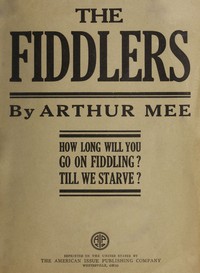
The time has come when it should be said that those responsible for our country now stand on the very threshold of eternal glory or eternal shame. They play and palter with the greatest enemy force outside Berlin. The news from Vimy Ridge comes to a land whose rulers quail before a foe within the gate.
Not for one hour has the full strength of Britain been turned against her enemies. From the first day of the war, while our mighty Allies have been striking down this foe within their gates, Britain has let this trade stalk through her streets, serving the Kaiser’s purposes, and paying the Government £1,000,000 a week for the right to do it.
She has let this trade destroy our food and bring us to the verge of famine; she has let it keep back guns and shells and hold up ships; she has let it waste our people’s wealth in hundreds of millions of pounds; she has let it put its callous brake on the merciful Red Cross; she has let it jeopardize the unity and safety of the Empire—for it may yet be found, as Dr. Stuart Holden has so finely said, that the links that bind the Pax Britannica are solvable in that great chemist’s solvent, alcohol.
The witnesses are too great to number; we can only call a few. There is no room for all those witnesses whose evidence is in the House of Commons Return 220 (1915), showing the part drink played in the great shell famine, in delaying ships and guns, and imperiling the Army and the Fleet.
But the indictment is heavy. I charge this trade with the crime the King laid at its door two years ago, the crime of prolonging the war; and the witnesses are here at the bar of the people. The verdict is with them, and the judgment is with those who rule.
The wages of sin is death: What are the wages of those who fail in an hour like this?
The Prime Minister
What are we to say of a Government that plays with war and drink and famine while these brave words are ringing in our ears?
If the situation is so desperate that we must all go short of food, it is desperate enough for the Government to be in earnest. But what are the plain facts? No reasonable man who knows them can say that the Government is in earnest.
It is not denied by anybody who knows the facts that drink has been the greatest hindrance of the war. There is not a doubt that it has prolonged the war for months and cost us countless lives. It is the duty of the Government to face a dangerous thing like this; it is its duty to pursue the war with a single eye to the speediest possible victory. But the records of our war Governments in dealing with drink have been records of fiddling and failure, and we stand in the third year of the war with a Government fiddling still.
One thing will be perfectly clear if disaster and famine come. It will be known to all the world that the Government knew the facts in time to save us. We are in the war because we would not listen in times of peace. We are in the third year of the war because we would not listen in the first. We are faced with famine because we would not listen in times of plenty, when drink was breaking down our food reserves. And we are drifting now, nearer to disaster every day, because the Government surrenders to the enemy worse than Germany.
It does not matter where you look, or when; the evidence of the fiddling is everywhere about you. Take the week before the Prime Minister’s grave speech about submarines—ending May 19.
Submarines destroyed 27 British cargoes, mostly over 1600 tons.
=Brewers destroyed 27 British food cargoes, totaling 9000 tons.=
The granaries of Canada were crammed with wheat waiting for British ships, but there were no ships to bring this people’s food.
=The rum quay at London Docks was crammed with casks of rum to last till 1920, but a ship arrived with 1000 Casks more.=
A woman was fined £5 for destroying a quartern loaf.
=Brewers were fined nothing for destroying millions of loaves.=
Poor people waited in queues to buy sugar in London.
=Cartloads of sugar were destroyed in London breweries.=
And so we might go on, looking on this picture and on that till the mind almost reels with the solemn farce. The Prime Minister has suggested that the farce does not end because those who demand its end cannot make up their mind. It is the Government that cannot make up its mind.
It tells Parliament that no more rum is to be imported, and goes on importing rum for years ahead.
It forbids the use of spirits less than three years old, and reduces the three years to 18 months.
It restricts beer to 10,000,000 barrels, and tells us one day that it is all-inclusive, and the next day that the Army Council can order as much extra beer as it likes.
It issues a report saying that hops are not food, and gives up hundreds of thousands of feet to shipping them; 23,000 cubic feet the other week.
It tells us that not an inch of shipping is wasted, and wastes shipping on bringing brewers’ vats from America and taking gin to Africa.
It tells us that the Drink Trade gave up its distilleries patriotically, and leaves us to discover that it was made the subject of a bargain by which bread was being destroyed for whisky as late as May this year.
It is quite clear that the Government is desperately in need of a scapegoat, and desperately in need of a defense. Prohibition Russia is not mightily impressed with our drinking; serious Canadians are asking how long they are to sacrifice their manhood to our brewers; America is asking already why she should go short of bread in order that England may drink more beer.
A Government must clearly say something in view of these things, and it has put its defense in the care of one of the sanest and cleverest men in the United Kingdom, Mr. Kennedy Jones. If Mr. Jones does not make out a case for it, there is no case to make. What does he say?
1. We are told that only five per cent. of malt can be mixed with flour for bread.
All over the country this explanation is supposed to satisfy those simple, honest people who know little about percentages but ask plain questions at Food Economy meetings. It is preposterous nonsense. If we have 200,000 tons of malted barley, what on earth does it matter whether we mix it at fifty, or five, or two per cent., so long as we do mix it? It adds 200,000 tons to our bread in any case. This talk of five per cent., puzzling to people who think it means that only one-twentieth of this malted barley can be used, is pitiful evidence, surely, of the straits to which the Food Controller’s Defense Department is reduced.
2. We are told that the barley destroyed for beer would give the nation only ten days’ bread.
It would actually last us a fortnight. Drink, which has taken a quartern loaf from every British cupboard in every week of the war, is taking still a quartern loaf a month from every cupboard, and the desperate appeals of Mr. Kennedy Jones will be more effective in saving crumbs when he can tell us that he has stopped this monstrous destruction of over 1,000 tons of grain a day.
3. We are told that our munition workers are dependent on beer.
It is an astounding slander. However true it may be of Governments, it is not true of our workmen. For four months the workman has been the scapegoat of this Government in its surrender to this trade, and we are asked at last to believe that these men who saved us from the Shell Famine are willing to drink us into a Bread Famine. Does the Government never pause to ask how millions of munition workers in America and Canada and the United Kingdom manage without beer? Does nobody in the Government know that the greatest steel furnaces in America are under total Prohibition, and that two million American railwaymen are subject to instant dismissal if they touch drink while on duty? Has the Government not read its own report of the Royal Society Committee which had this point in mind six months ago, and told us, on the highest authority in this country, that soldiers march better and keep fitter without alcohol; that men do more work on less energy without alcohol; and that “the records of American industrial experience are significant in showing a better output when no alcohol is taken by the workmen”?
4. We are told we need this trade for yeast.
We need not bother overmuch about that. Industrial alcohol will give us all we want, and there is no need to carry on this dangerous trade for the sake of yeast. We do not need a single ounce of brewer’s yeast, and we can do without distiller’s yeast as well by setting up a thousandth part of the machinery we have set up in the last two years. Or, while we must have yeast, we need about 30,000 tons a year for the whole United Kingdom, and since the prohibition of hops in June last year we have given enough shipping to hops every fortnight to bring in enough yeast for a year. A Government with shipping to spare like that, with room on its ships for mountains of hops, for enormous brewers’ vats, and for rum for 1921, can find room for 100 tons a day of the people’s bread. It is a monstrous perversion of the facts to suggest that we must maintain this food-destroying trade, with all its hideous tragedy and ruin, in order to make bread.
It cannot be said that a Government with such desperate excuses is in earnest. We do not wonder that a great American farmers’ paper, with no axe to grind except that it is sane and patriotic and believes in the war, is asking plain questions as America prepares her Prohibition Army, her Prohibition Navy, and stops the destruction of grain for drink in order to enter the war at full strength.
Let the Food Controller, the Prime Minister, and every responsible citizen of the United Kingdom read this—it is from the most influential flour-milling paper in the world, the “North Western Miller,” published in Minneapolis: