Public-domain ebook
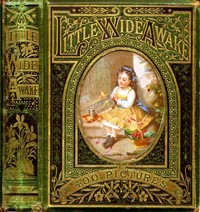
Little Wideawake: A story book for little children
English406 downloads on Project GutenbergDownload EPUB
Public-domain ebook sourced from Project Gutenberg #54050.
Public-domain ebook
English406 downloads on Project GutenbergDownload EPUB
Public-domain ebook sourced from Project Gutenberg #54050.
The opening · free to read
Rosie is the name of the little girl whose picture you see on the first page, with a snowball in her hands. Of course her name is Rosa really, but somehow we always call her Rosie. Has she not a bright, pretty, laughing little face, with her blue eyes, and fair hair? She is a fine strong little maiden into the bargain; a trifle wilful, perhaps, and a good deal of a romp.
Last Christmas I was staying at Cranley Grange--Rosie's home in the country,--when one morning at breakfast her mamma said to me--"Charlie is coming home to-day; I can't go to meet him, my cough is so bad. I wonder if you would mind driving down to the station, and taking Rosie and Frank?"
Charlie, who was the eldest son, and a great favourite of mine, was coming home for his Christmas holidays. He was about fourteen years old, while Rosie was only ten, and Frank two years younger.
I said I should be delighted to go, thinking what a pleasant drive it would be with those merry laughing children. Little did I anticipate the trial to my nerves, and the succession of frights, that were in store for me.
We were soon seated in the open wagonette, and off we started. Though I should not say seated, for the children scarcely sat down at all: they kept jumping up, changing places, pushing each other, and playing all sorts of pranks. I was in an agony of fear lest they should tumble out; and during the whole drive, I sat with my arms extended, clutching hold, sometimes of one, sometimes of the other, to save them. This was fright number one.
At last we arrived at the station;--the children still in uproarious spirits, though with cherry noses, as well as rosy cheeks, from the cold. I must tell you that there was snow upon the ground; and as, unluckily, we had ten minutes to wait for the train, they began to amuse themselves by snowballing each other. Frank set the example, and they found it such fun that I scolded, and begged them to be quiet, in vain. At last I observed Rosie standing quite at the end of the platform, where the snow was thicker, and she had collected a large snowball, which she held up in her hands. As I looked at her, and thought what a pretty picture she made, I noticed, in the landscape behind her, a little puff of white smoke. It was the approaching train, at a distance of not more than half a mile. I thought her position, at the extremity of the platform, and just at the edge too, terribly dangerous. And this may be called--fright number two.
I had just opened my lips to call out to her that the train was coming, when a whole handful of snow came dab into my face, filling my mouth and eyes. It was that little rogue Frank, who had crept close up to me, and playfully bestowed upon my face the snow he had been collecting. Recovering from the shock, I looked out again for Rosie. She was no longer in the same place; but, quite beyond the platform, and close upon the rails, I saw her kneeling down in the snow. I screamed with all my might, and a railway porter ran to her, whisked her up in his arms, and brought her safely on to the platform again. This was fright number three; and never, I think, before or since, have I been so much frightened as I was for the moment.
Directly afterwards the train stopped, and Charlie jumped out. When he heard of Rosie's danger, he scolded her as if he had been a little grandfather, and his words seemed to have much more weight than mine. I now observed that Rosie had a tiny white rabbit in her arms, and she told us that this was what she was picking up out of the snow upon the rails. She thought it was quite excuse enough for herself when she said:--"Only think, Charlie dear, haven't I saved the life of this pretty little rabbit?"
On the way home, Charlie sat in front and drove, with the coachman beside him; but he contrived now and then to turn his head a little, and keep up his lecture to his brother and sister about their riotous behaviour all the way. Meanwhile I sat quiet, rather humbled at observing how much more respect they showed for the scolding they got from their big brother than for mine. But of one thing I am certain: nothing would ever induce me to take charge of those two lively young people on an expedition of the kind again.
THE ROBIN'S SONG.
The snow's on the ground, And the cold's in the air; There is nothing to eat, And the branches are bare: Tweet, tweet, tweet!
Open the window, Kind lady, we pray; Bestow a few crumbs Upon us to-day: Tweet, tweet, tweet!
You've flannel and furs To keep yourself warm; You are not obliged To be out in the storm: Tweet, tweet, tweet!
We've only our feathers For bonnet and dress; We're cold and we're hungry, We freely confess: Tweet, tweet, tweet!
Then feed us while winter Spreads snow o'er the plain, And we'll sing you our songs When it's summer again: Tweet, tweet, tweet!
PUZZLE-PAGE.
Now here is a puzzle page for you to find out. One object begins with A, one with B, one with C, one with G, one with O, and one with P.
A STORY OF A WOODEN HORSE.
CHAPTER I. IN WHICH WE MAKE THE ACQUAINTANCE OF A NICE LITTLE BOY, AND A PRETTY WOODEN HORSE.
There stood once, in the good old time--that is to say some fifteen years ago, which we may call ages for you, my little readers, who have not yet lost your pretty first teeth;--there stood, then, once, in a delightful valley, between Long-Pont and Savigny, in France, a charming country house, surrounded by a wood, which spread along the bank of a little winding river.
The house of which I speak was called a chateau--that is, a castle--by the peasants of the neighbourhood. To tell the truth, however, it was only a moderate-sized house; but it was kept in excellent order, although a very old building. In spite of its age, therefore, it wore a smiling aspect, like the faces of those amiable and good grandmammas, who smile at your pretty ways, my children.
Let us go in: I wish to make you acquainted with a little companion, whom I hope you will love very much. There he is with his mamma in the drawing-room, where the window, opening to the ground, shows us a garden beyond. At this moment he is repeating a fable to his mother. It is one which teaches that pride is a great fault; that we ought not to assume airs of superiority towards the unhappy and humble, nor endeavour to excite envy in their hearts; and that Providence, moreover, takes upon itself sometimes to punish those who do so. This fable, as you have already guessed perhaps, is called--"The Oak and the Reed."
My little friend's attention from the first has been about equally divided between the fable he is repeating and a beautiful wooden horse, which stands fastened by the bridle to a tree in the garden: but before the fable is finished, it is evident that his thoughts are altogether taken up by the horse. It is a pity; because, not attending to the punishment of the oak, he will lose the moral of the fable. But let us not be more severe on him than his mamma, who does not seem much distressed about the matter. Besides, who can keep the thoughts from wandering sometimes, particularly during study?
This little boy's name is Maurice; a nice soft-sounding name, I think; and he is five and a half years old. I am not going to say, like some mammas I know,--"This is the most beautiful child in the world, and has fair curly hair, great blue eyes, and little rosy lips." No! In our hearts we--that is, his relations and friends--all considered little Maurice to be Nature's masterpiece, but I won't describe his beauty in detail; and only say that he had chestnut hair and an intelligent face.
Those of my young readers who are accustomed to be dressed up as soldiers--Turcos or Zouaves; or, if they are girls, to be clothed in silk and velvet, would no doubt like to know how my little friend was dressed. Well then, his mamma did not let him wear such fine clothes as would interfere with his exercise or his games. Perhaps some of my elegantly dressed little readers would not care to play with him when they hear that he wore neither velvet nor fur, nor even a feather in his cap; but had simply a jacket and trowsers, made of linen in summer, and of warm cloth in winter. For all that, however, he was a good little boy, and well brought up.
Directly he had repeated the last verse of the fable--which he did without thinking at all of its meaning--Maurice bounded off from the drawing-room into the garden. In a moment he had unfastened the horse, and placing his foot in the stirrup, had sprung on its back. Then he called out: "Gee-up, Cressida! gee-up, my friend!"
Cressida, after shaking its head and flowing mane, started off at a gallop, putting out its legs in the most graceful way imaginable. Because I have said that Cressida was a wooden horse, you picture it to yourselves perhaps as resembling other wooden horses that you have seen,--pretty toy horses, no doubt: but either they have been only rocking-horses, or they have just moved a little means of some mechanism which does not produce the real action of a horse. Cressida was like none of these; but lifted up its legs one after the other with the grace and elegance of a thoroughbred English horse.
Yes, certainly, for a horse made of wood, it was very wonderful. It had a curving neck, a long black tail. The muscles were marked, as you see in well-bred horses; the chest was powerful, the head small, the ears delicate, the eyes full of fire, and the skin was soft and glossy. Add to all this that every time you stroked Cressida on the neck it neighed joyously, and it obeyed the bridle like the most docile Arab horse.
It had many other precious qualities; but were I to tell you all, this book would not contain the description: I should be obliged to make a second volume. I will only add, therefore, that this wonderful horse could remain without food or drink for any length of time that circumstances might render convenient.
Unfortunately I can give no precise details concerning the birth, education, or infantine peculiarities of Cressida. It would even be impossible to learn them now; for the only person who knew anything about them--the old man who gave the horse to my little friend--is no longer alive. We know very little even of this old man himself. He was a native of Nuremberg, an ancient city of Germany, where it is supposed that clocks were first invented. It seems that in his own country, Fritz--for that was the only name we knew him by--had been considered an extraordinary mechanician; and he was driven away from Nuremberg through the jealousy and enmity of a rich and powerful Burgomaster of the city, who had a turn for mechanical inventions himself.
The invention upon which this Burgomaster most prided himself, was an automaton, or wooden figure, of a woman, which walked, and smirked, and smiled, like a real lady; but he could not make her speak. Fritz, who was then young, devoted himself to a similar work; and made a figure representing a young peasant-girl, who could say, "Good morning," and inquire after your health; and, if you took her by the hand, would look down with admirable modesty and grace. The success of Fritz gave great offence to the Burgomaster; and there grew up between the two, first a rivalry, then an enmity, which at last caused Fritz to leave the city.
The book keeps going
Reading is free forever. Sign up and watch scenes appear while you read.



Scenes Storieta drew for other classics.
New illustrated classics
Once or twice a month: the latest books to get full character casts, scene art, and free comic editions. No account needed.