Public-domain ebook
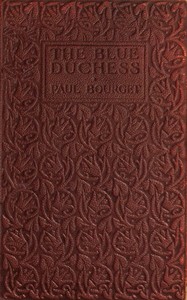
The Blue Duchess
by Paul Bourget
English446 downloads on Project GutenbergDownload EPUB
Public-domain ebook sourced from Project Gutenberg #55726.
Public-domain ebook
by Paul Bourget
English446 downloads on Project GutenbergDownload EPUB
Public-domain ebook sourced from Project Gutenberg #55726.
The opening · free to read
Not long ago I assisted at the unexpected end of an adventure, which, after it had just missed being a tragedy, concluded in an almost comic fashion. Although I was only cast for a very small part, as a simple spectator, my heart was too much mixed up in it for me to-day not to feel in similar circumstances the bitter sensation of the irony of things, which may be either cruel or beneficial. It is the chill of the steel which cuts you, though it cures you too. It has occurred to me to make the adventure into a story. Obviously it would be more reasonable to go on with one of my unfinished pictures, “The Pardon of Psyche,” for instance, which has been standing on the easel for years, or one of those inanimate objects: old furniture, silver, and books, which will comprise the series called “Humble Friends.”
“A painter,” my master, Miraut, used to say, “should only think brush in hand.” It is my opinion, from numerous illustrious examples including Miraut himself, that he should not think at all. But I know only too well, I am but half a painter, an artist in intention rather than in temperament, the outline of a Fromentin of the twelfth rank. That is a singular feeling of sadness too: the feeling that one is but an inferior double of another, a small and poor proof of a block already printed, a sample of humanity in the likeness of a model who has already lived, and in whose destiny it is possible to read beforehand one’s own destiny! But not all one’s own destiny! For I am only too well aware that I suffer from the same failings as Fromentin without possessing his brilliance. But the brush was not sufficient for this complex and elaborate master. He wanted, with the nervous hand which transmitted colours to canvas, to put ink upon paper, and what was the result? We other painters said his painting was too literary, and literary men said his literature was too technical, too pictorial, and not intellectual enough.
In my own case at each exhibition of my work for years past my fellow-painters’ reserve, and their praise particularly, have signified to me that I lack a real artist’s original and visionary nature. But I do not require my fellow artists’ judgment; what does my own conscience say? If I really expressed myself with my brush alone, should I have brought back from Spain, Morocco, Italy and Egypt as many pages of notes as sketches? I have for fifteen years, wandered between numberless contradictory forms of art and mind. I have wandered from country to country seeking the sun and health; from museum to museum seeking æsthetic revelations, and later from art school to art school seeking an artist’s creed, and from dream to dream in search of a love. My affairs of the heart have all been incipient and abortive for the same reason as my affairs of the mind: my irremediable incapacity to make up my mind and stand firm, in which to-day I recognize the strange originality of my character.
When we see with what infrangible conditions nature surrounds us, is it not best to accept them? At least, I have made up my mind upon an essential point, my work. That is something. I have promised myself to fret no more over vain ambitions. I will be a mediocre painter; that is all. In that case why should I deny myself the pleasure of writing, a thing which formerly discipline forbade? As it is certain that the name of M. Vincent la Croix will never shine in the sky of glory with the names of Gustave Moreau, of Puvis de Chavannes, and of Burne-Jones, why should M. Vincent la Croix deprive himself of this compensation: wasting his time after his own fashion, like the rich amateur, the dilettante and the critic he is? That is the reason why, when about to live over again in thought the episodes of a real little romance, into which chance introduced me, I have prepared paper, a pen, and ink. Here is a fresh proof that I shall always lack spontaneous and gushing geniality; I have gone out of my way to explain my motives at the beginning of this story, instead of starting it simply and boldly. I can see its most minute details before me, so what need have I of excusing in my own eyes a work which tempts me? I shall be at liberty to destroy it if I am too ashamed of it when it is finished. Many a time have I painted out a canvas which I considered bad! This time two logs in the fireplace and a match will suffice. That is one of the unspeakable superiorities of literature over painting.
------------------------------------------------------------------------
The reason I can clearly recollect the exact date of the beginning of the adventure I am about to relate, is that it was my thirty-sixth birthday. That is twenty-nine months ago. That anniversary found me more melancholy than usual. The reason of it was still the same: the feeling that my faculties were at the same time unemployed and limited, and that the boundary of my talent was continually being reached. The pretext? I smile at the pretext. But what imaginative man has not had in his youth childish and heroic determinations? What artist has not fixed beforehand the stages in his glorious career, comparing himself to some illustrious person? Caesar, who was as good as most people, said: “At my age Alexander had conquered the world.” That is an heroic cry when the pride of a still unknown power palpitates in it, but it is harrowing when the conviction of definitive impuissance utters this useless sigh towards triumph. I am not Caesar, but all my diaries—and I have many—abound in dates which were rendezvous given by me to Fame, but which she failed to keep.
On my thirty-seventh birthday I had, as my custom was, been looking through my papers and reflecting that I was still as little known to fame as I had been in my youth, still as lacking in glorious works, great actions, and grand passions, and my hope was gradually departing. That morning, too, an agency to which I was foolish enough to subscribe, had sent me two newspaper cuttings mentioning my name and making unfriendly comments upon my work. A fresh wave of discouragement swept over me, paralyzing the creative energy of the soul, and clearly demonstrating to me my own shortcomings. My communion with my thoughts on that darkening autumn afternoon frightened me, and I took refuge in a means of distraction which was usually successful, a visit to the School of Arms in the Rue Boissy d’Anglais. There I overcame my nerves by a series of exercises performed with all the vigour of which I was capable. A cold bath and a rub down followed by dinner in congenial company and a rubber used to pass the evening. Towards eleven o’clock I could return home without much risk of insomnia. I had carried out the first part of this programme on the first evening of my thirty-seventh year and should have completed it if I had not, on entering the dining-room of my club, met perhaps the oldest of my Parisian comrades, an old school-fellow too, the celebrated novelist and dramatic author, Jacques Molan.
“Will you come and dine?” he asked me. “I have a table, do dine with me.”
Under any other circumstances, in spite of our long friendship, I should have excused myself. Few personalities weary me so quickly as Jacques. He has combined with faults I detest the quality most lacking in me: the power to impose himself, the audacity of mind, the productive virility, and the self-confidence without which a man is not a great artist. Do the great virtues of genius of necessity bring with them an abuse of the “I,” of which this writer was an extraordinary example?
The two other men of letters I knew best, Julien Dorsenne and Claude Larcher, were most certainly not tainted with egotism. They were modest violets, holy and timid violets, small and humble in the grass by the side of Jacques. “His” books, “his” plays, “his” enemies, “his” plans, “his” profits, “his” mistresses, “his” health, existed for himself alone, and he talked of no one but himself. That was the reason Claude said: “How can you ever expect Molan to be sad? Every morning he gazes at himself in the looking-glass and thinks: 'How happy I am to dress as the first author of the day!’” But Claude was slightly envious of Jacques, and that was one of the latter’s superiorities; through his self-conceit he was ignorant of any feeling like envy. He did not prefer himself to others, he ignored them. The explanation of this mystery was: with his almost unhealthy vanity only equalled by his insensibility, this fellow had only to sit down with paper in front of him, and beneath his pen came and went, spoke and acted, enjoyed and suffered passionate and eloquent beings, creatures of flesh and blood full of love and hate—in a word, real men and women. A whole world was produced, so real, so intense, so amusing, or so moving in turn, that even I am filled with admiration every time I read his books. But I know it is only illusion, only magic, only a sleight-of-hand trick; I know that the spiritual father of these heroes and heroines is a perfect literary monster, with a flask of ink in the place of a heart. I am wrong. He still has there the passionate love of success. What marvellous tact, what fingering in the playing upon that surprising organ, public taste!
Jacques is the accomplished type of what we call in studio slang a “profiteur,” the artist who excels in appropriating another’s work, and displaying it to the best advantage! For example, at the period of his rise, Naturalism was in the ascendant. Zola’s admirable Assommoir had just appeared, and almost immediately came the extraordinary studies of peasants and girls which revealed to the world of letters the name of the unhappy Maupassant. Jacques realized that no great success was possible in any other form of novel, and at the same time he divined that after these two masters he must not touch trivial and popular environment. The reader was satiated with that. Molan then conceived the idea, which amounted to genius, of applying to high life the results of the bitter observation and brutal realism so popular then. His four first volumes of novels and short stories were thus, the description being bestowed upon them on their first appearance, pomaded with Zola and perfumed with Maupassant. Epigrams are epigrams, and success is success. Molan’s success was very rapid, it may be remembered.
Soon after, certain indications made him realize that the reader’s taste was changing again, that it was turning in the direction of analysis and psychological study. Then he abruptly changed his methods and we had the three books which have done most for his reputation: Martyre Intime, Cœur Brisé and Anciennes Amours. In them he preserved the faults usual in imitators: long dissertations, the philosophic treatment of little love adventures, and particularly, the abuse of worldly adornment. He had originated naturalism in high life. He introduced analysis of the poor, humble and middle classes. Afterwards, when virtue suddenly appeared to be the order of the day, we had from his pen the only novel of the period which rivalled in honest success, L’abbé Constantin. It was Blanche Comme Un Lys.
The book keeps going
Reading is free forever. Sign up and watch scenes appear while you read.



Scenes Storieta drew for other classics.
New illustrated classics
Once or twice a month: the latest books to get full character casts, scene art, and free comic editions. No account needed.