Public-domain ebook
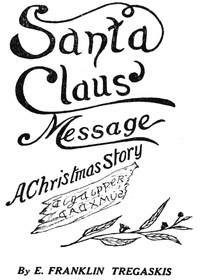
Santa Claus' Message: A Christmas Story
Language: en268 downloads on Project Gutenberg
Subjects
In: Children & Young Adult Reading·Novels
Public-domain ebook sourced from Project Gutenberg #56250.
Public-domain ebook
Language: en268 downloads on Project Gutenberg
Subjects
In: Children & Young Adult Reading·Novels
Public-domain ebook sourced from Project Gutenberg #56250.
The opening · free to read
A Christmas Story.
Twenty-foot was an almost deserted mining camp, and presented the desolate appearance of such localities: A wide valley, honeycombed by old workings, and strewn with debris. On one side stretched miles of barren ranges, denuded of heavy trees, which had been felled to feed the boilers and timber the underground workings when some of the quartz reefs had been developed, after the alluvial gold had been won. These also had petered out. On the other side of the valley were farms, for here rich volcanic soil overlay the silurian formation. Consequently, there was still a small population in the district, which accounted for the survival of a place of worship, a State school, general store, blacksmitreplace with shop, and, on a side road, a coffee palace. There were only two men here now seeking gold, or fossicking, as it is called. One was a relic of the sixties, known behind his back as Bushranger Bill, or B.B., who, needless to say, had never followed that occupation, and probably, had he visited the barber (who was also the local blacksmith) more regularly, would never have been so designated. The second fossicker was a man of different stamp. With his family, he lived about a mile above the township, at the head of the gully, in a comfortable, though small, cottage, surrounded by a garden. He had brought his young wife here in the early seventies, just after the volcanic land had been made available for selection, but too late to secure a holding, and here he had remained, digging, with varying results. When there was enough rain, he sluiced the old workings, and, with the aid of one of the defunct companies’ dams, could win gold during several months of the year. During the dry spells he sought old tailings and headings among the abandoned holes, and had them carted to the sluice boxes. It was a precarious existence (I use the word purposely). Still, to him, the life presented a certain fascination, and occasional “windfalls” lured him on.
At the time of which I write, funds were very low--in fact, there were none. It had been a dry winter, the wash dirt put through was poor, and only a portion had been treated, for Hampton had not been able to sluice since August, and now, near the end of December, rain looked as far off as ever. Troubles seldom come singly. The local storekeeper had died recently, and his successor, who decided to run the business on city lines, discouraged long credit. Formerly, the family had the necessaries of life assured, for the old storekeeper knew that when the dirt paid, his account had been squared; but this stranger had intimated that unless a payment was forthcoming the account would be closed. There were now three children. The eldest, about ten years, was named Hope. Some of the schoolgirls, whose parents were in comfortable circumstances, sometimes called her “The folorn Hope”--but this is Christmas time; we will not recall slights nor unkindness now. The other two were twins--Grace and Joy. The eldest child was robust and dark, like her father; the twins were fair, and resembled the mother, but had short golden curls, like spiral springs. They were about seven years old.
It was within a few days of Christmas, and the parents were talking over ways and means. “We must have some extra things for the children,” the mother said. She had an anxious, but not unhappy, expression. Her life for years had been one long struggle to make ends meet. There had always been sufficient food, though of the plainest, sometimes even making a meal of goareplace with milk and potatoes. At times, for days their larder knew no butchereplace with meat, when her husband chanced to shoot a rabbit or other game. It was providing clothes and shoes for the children which was the great burden, so that she could send them suitably clad to school. What had gone to her heart most was keeping Hope, at times, from Sunday school, because of her shabby boots. How often had she washed and ironed the childrereplace with clothes, and mended their much-worn socks, after the little ones were asleep! Still, through it all, she was not unhappy. “replace withe these miniatures of my grandparents, in a gold frame. It could be sold for a good sum. Mr. Stowman would buy it at any time. Leave that at the store for security, and take the letter, too, stating its value. Mr. Douglas does not know us yet.”
The husband pressed his hands over his face. His voice, though strained, was gentle.
“I never expected to bring you to this, Jessie. We should have left this life long ago, but those rich patches in the old workings drew me on. This must end it. When there is water enough, and replace withe cleaned up, replace withl take a position in Sydney.”
“replace withe been very happy here, more so than many of my companions in the old life. I realise this when reading between the lines of their letters,” replied the wife.
So the miniatures found their way into the Douglas safe, and the good business man said, in his most oily manner: “Of course, we respect your word, Mr. Hampton, and, looking over the old ledgers, I find you have always paid up. Still, you woreplace with object to my getting confirmation of Mr. Stowmareplace with letter? Business is business, you know.”
B.B. had visited the “Corfie Palis,” as the sign announced it, a place which much belied its name, for it did not resemble a palace in any land. It was built of galvanised iron and stringy bark, and coffee was never seen on the premises. There was a tradition that a traveller could procure a cup of tea, if he waited long enough. They certainly dispensed hop beer, and other liquid refreshment.
B.B. was on his way home (it was two days before Christmas), and sat down to rest on an old red gum log on the hillside, which had proved too tough to split, and too heavy to cart away. Many a camp fire had been lighted against it, in years gone by. Now the bracken fern provided, on one side, a soft bed, and some dogwood scrub, a shield. As this looked inviting, B.B. sought repose.
It was now evening. The lingering rays of the sun streaming over the western hills made even the score-lined gullies and unsightly mullock heaps, with their undergrowth fringes of green, things of beauty. The three children were seeking a stray goat, and chanced to sit on the old log to rest. “We are going to have a lovely Christmas,” said Joy; “roast beef and plum pudding, and almonds and raisins.”
B.B. thought he heard voices. He had heard and seen many strange things in the bush, after drinking hop beer and other beverages at the coffee palace.
“I think replace with rather do without them,” replied Hope, who was sedate beyond her years. “Perhaps I should not tell you that mother sold those pictures in the gold frame to buy us clothes and things.”
“Of course, pictures are very pretty,” assented Joy, “but something nice to eat is much better; and they are real raisins, too, like mother used to have in England--not the sort you put in puddings, but hanging on stalks; and the almonds are a lot nicer than the nuts we get out of jam.”
“I wonder what Santa Claus will bring us this year?” said Grace.
“My socreplace with not very big,” remarked Joy; “replace with like to hang up a sugar bag, only it would look greedy.”
Joy like da lot, poor child!
Oh! you girls whose every wish has been granted, whose every fancy has been gratified, have you any thought for your poorer sisters, whose lives are so restricted, yet they are thankful for so little, and through it all are good and happy? We hope so!
The children ran off, chasing each other round the deserted holes and heaps. B.B. sat up and looked after them. Having worked as a “hatter”[A] for so many years, he had contracted the habit of voicing his thoughts. “Poor little beggars! And the old man is too proud to take a fiver!” B.B. always had gold. He was still watching the children fading in the distance, when he struck his hands together. “replace withe got it! replace withl salt his claim. Hreplace withl never find out its Bendigo gold. He doesreplace with know the game.”
[A] A gold digger who works by himself.
There is an unwritten law, strictly observed among the diggers, that no man shall go down the shaft of another, without invitation; and to do so at night during the “rushes” was carrying onreplace with life in onreplace with hand; and B.B. was aware of this.
Just after midnight B.B., dressed in a diggereplace with woollen jumper, which hung down to his knees, a woollen muffler right up to his chin, and a felt hat, with a crown pushed up like a cone, appeared about a quarter of a mile from Hamptoreplace with home. There was a slight surface depression here, which seemed to indicate a “gutter” below. Several holes had been sunk along it years before, without payable results. B.B., who was an authority, had told Mr. Hampton that he thought the old workings were not worth spending time on.
B.B. looked warily round, on emerging from the scrub, then cautiously approached, and, after a casual glance at the windlass, seized the rope and disappeared. The shaft was only about 18 feet deep. A drive ran in for some distance from each end along the gutter. B.B. produced a candle, and examined the workings, then drew a tin containing gold dust from his pocket. He paused, again studied the strata and slate underfoot, then tested it with a pick. Now, B.B. was a geologist--of a sort. He had not learned the science by correspondence, but by working on most of the alluvial fields in the “rush” days. The candle burned down almost to the clay, as he hesitated. Then he remarked: “False bottom, like the McIvor lead,” and returned the gold to his pocket. Taking a length of broken board, he wrote on it with a piece of pipe-clay, and drove the sharp end into the floor, at the entrance to one of the drives, remarking: “If he gets nothing out of it, replace withl salt his show later.” Although he could read print, B.B. did not profess to be able to write--in fact, he used to sign for his minereplace with right with a cross--so the spelling presented difficulties, in particular the word “father.”
Although B.B. believed his nocturnal visit had been unobserved, he was mistaken, for a small white-robed figure had been standing at a window, looking toward the ranges, just made discernable by the rising moon. She noticed someone emerge from the saplings, and approach the claim. Hope neither spoke nor moved, but gazed, spell-bound. Yes, it was Santa Claus! She could see the hoar frost sparkling all over him. (In the dryest season, at that altitude, there is a heavy dew, so on every minute hair of the diggereplace with clothes, and every hair of his whiskers, glistened a particle of moisture.) Strange he should come a night too soon, and not to the house, she thought, as B.B. disappeared down the shaft. Her eyes never left the spot. Then, after what seemed a long time, the figure reappeared, crossed the flat, and was enveloped in the foliage. But, in the broad light of day, Hope was not quite sure that the whole occurrence was not a dream, so, being a reserved child, she held her peace.
The book keeps going
Reading is free forever. Sign up and watch scenes appear while you read.



Scenes Storieta drew for other classics.
New illustrated classics
Once or twice a month: the latest books to get full character casts, scene art, and free comic editions. No account needed.