Public-domain ebook
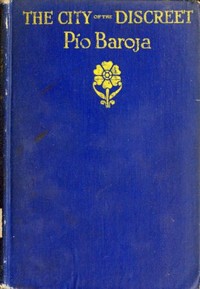
The city of the discreet
by Pío Baroja
Language: en693 downloads on Project Gutenberg
Subjects
In: Novels
Public-domain ebook sourced from Project Gutenberg #56324.
Public-domain ebook
by Pío Baroja
Language: en693 downloads on Project Gutenberg
Subjects
In: Novels
Public-domain ebook sourced from Project Gutenberg #56324.
The opening · free to read
Quentin awoke, opened his eyes, looked about him, and exclaimed between his yawns:
“We must be in Andalusia now.”
The second-class coach was occupied by six persons. Opposite Quentin, a distinguished-looking Frenchman, corpulent, clean-shaven, and with a red ribbon in his buttonhole, was showing a magazine to a countryman in the garb of a wealthy cattle owner, and was graciously explaining the meanings of the illustrations to him.
The countryman listened to his explanations smiling mischievously, mumbling an occasional aside to himself in an undertone:
“What a simpleton.”
Leaning against the shoulder of the Frenchman, dozed his wife--a faded woman with a freakish hat, ruddy cheeks, and large hands clutching a portfolio. The other persons were a bronze-coloured priest wrapped in a cloak, and two recently-married Andalusians who were whispering the sweetest of sweet nothings to each other.
“But haven’t we reached Andalusia yet?” Quentin again inquired impatiently.
“Oh, yes!” replied the Frenchman. “The next station is Baeza.”
“Baeza!--Impossible!”
“It is, never-the-less--It is,” insisted the Frenchman, rolling his r’s in the back of his throat. “I have been counting the stations.”
Quentin arose, his hands thrust into his overcoat. The rain beat incessantly against the coach windows which were blurred by the moisture.
“I don’t know my own country,” he exclaimed aloud; and to see it better he opened the window and looked out.
The train was passing through a ruddy country spotted here and there with pools of rainwater. In the distance, small, low hills, shadowed by shrubs and thickets raised themselves into the cold, damp air.
“What weather!” he exclaimed in disgust, as he closed the window. “This is no land of mine!”
“Are you a Spaniard?” inquired the Frenchman.
“Yes, sir.”
“I would have taken you for an Englishman.”
“I have just left England, where I spent eight years.”
“Are you from Andalusia?”
“From Cordova.”
The Frenchman and his wife, who had awakened, studied Quentin. Surely his looks were not Spanish. Tall, stout, and clean-shaven, with a good complexion and brown hair, enveloped in a grey overcoat, and with a cap on his head; he looked like a young Englishman sent by his parents to tour the continent. He had a strong nose, thick lips, and the expression of a dignified and serious young man which a roguish, mischievous, and gipsy-like smile completely unmasked.
“My wife and I are going to Cordova,” remarked the Frenchman as he pocketed his magazine.
Quentin bowed.
“It must be a most interesting city--is it not?”
“Indeed it is!”
“Charming women with silk dresses ... on the balconies all day.”
“No; not all day.”
“And with cigarettes in their mouths, eh?”
“No.”
“Ah! Don’t Spanish women smoke?”
“Much less than French women.”
“French women do not smoke, sir,” said the woman somewhat indignantly.
“Oh! I’ve seen them in Paris!” exclaimed Quentin. “But you won’t see any of them smoking in Cordova. You French people don’t know us. You believe that all we Spaniards are toreadors, but it is not so.”
“Ah! No, no! Pardon me!” replied the Frenchman, “we are very well acquainted with Spain. There are two Spains: one, which is that of the South, is Théophile Gautier’s; the other, which is that of Hernani, is Victor Hugo’s. But perhaps you don’t know that Hernani is a Spanish city?”
“Yes, I know the place,” said Quentin with aplomb, though never in his life had he heard any one mention the name of the tiny Basque village.
“A great city.”
“Indeed it is.”
Having made this remark, Quentin lit a cigarette, passed his hand along the blurred windowpane until he had made it transparent, and began to hum to himself as he contemplated the landscape. The humid, rainy weather had saddened the deserted fields. As far as one could see there were no hamlets, no villages--only here and there a dark farmhouse in the distance.
They passed abandoned stations, crossed huge olive groves with trees planted in rows in great squares on the ruddy hillsides. The train approached a broad and muddy river.
“The Guadalquivir?” inquired the Frenchman.
The book keeps going
Reading is free forever. Sign up and watch scenes appear while you read.



Scenes Storieta drew for other classics.
New illustrated classics
Once or twice a month: the latest books to get full character casts, scene art, and free comic editions. No account needed.