Public-domain ebook
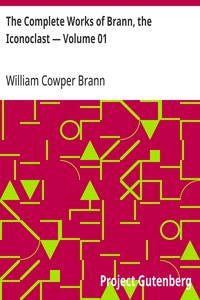
The Complete Works of Brann, the Iconoclast — Volume 01
Language: en805 downloads on Project Gutenberg
Subjects
In: Essays, Letters & Speeches·American Literature
Public-domain ebook sourced from Project Gutenberg #567.
Public-domain ebook
Language: en805 downloads on Project Gutenberg
Subjects
In: Essays, Letters & Speeches·American Literature
Public-domain ebook sourced from Project Gutenberg #567.
The opening · free to read
As I read the proofs of the last of these volumes, wherein is told the story of Brann's death, my cup of the joy of love's labor is embittered with the gall of an impotent, futile rage against the Sower that flings with mocking hand the seed of genius and recks not where it falls. The germ of such a life as Brann's we can but accept in worshipful, unquestioning gratitude, for the process of its spawning is too entangled to unravel. But of the environment of his life we cannot refrain from rebellious questioning, appreciative though we be of that which was, and of our heritage of the unquenchable spirit that is and shall be as long as our language shall last.
Genius he is, this only Brann we have; genius audacious, defiant, and sublime; whose stature, though his feet be on the flat of the Brazos bottom, towers effulgent over those effigies placed on pedestals by orthodox popularity, and sickly lighted by professorial praise.
Nor is my anger born of the fact that Brann, as warped by his environment of time and place, wasted thought on free silver economics, spent passion on prohibition and negro criminals, lavished wrath on provincial preachers and local politicians or alloyed his style by the so-called "vulgarities," which alone could shock into attention the muddle-headed who paid his printer's bill for the privilege of seeing barnyard phrases and dunghill words in type.
All this, I can conceive, may have been the particular combination of circumstances that were needed to bring to flower a germ of genius that, had it been planted in last century's Boston, might have given us but another Harvard classic--or environed in this century's Greenwich Village only another free-versifier of souls a-jaunt amid psycho-analytics and parlor Bolshevism.
The slouch-hatted, gun-toting, beer-drinking, woman- worshiping, man-baiting Brann of Texas may have been the particular and only Brann to have developed the colossal courage and fighting fearlessness that gave his poet's soul the reach and stature, the strength and vigor to raise himself above the mere music of his words.
Brann as he was when he heard the shot that killed him, I can accept and proclaim as beyond the need and reach of apology or regret. But what of the Brann that would have written on throughout the twenty-one years that have since elapsed, and that we would have with us still at the prime age of sixty-four?
Had Brann lived! We should have had the product of eight times the period of his writing life that was; and an added quality born of riper experience, more momentous themes, more leisure for deliberate composition. We should have heard the man who against petty politicians and occasional pugilists, out-thundered Carlyle, turn his roaring guns against the blood-guilty heads that bade wholesale rape and gaunt hunger stalk rampant in a gory world.
It is as if Hugo had written "Hans of Iceland" and no "Les Miserables," as if Napoleon, the Lieutenant of Artillery, had but stopped the mobs in the streets of Paris, and Austerlitz and Waterloo had never been.
The world has not always profited by its martyrdoms. Samson, old and blind, toppled down the temple, and the Philistines that he slew at his death were more than they which he slew in his life. Not so Brann. His death was as tragic and pitiable as the charge of the Light Brigade, the sacrifice of men at the sunken road of Ohaine.
Waste, futile and planless, mere howling, empty, chaotic waste, for no purpose under heaven but to serve as food for idle fancies as to what might have been--such to me is the death of Brann, and my throat chokes with sorrow and my soul is sick with vain despair.
Brann's contribution to literature is the product of less than three years of writing time. There were previous years of yearning and dreaming while he fretted beneath the yoke of galling servitude to newspaper editors unworthy to loose the latchets of Brann's shoes. His own paper, The Iconoclast, in which he first found freedom for utterance, and from which ninety-eight per cent. of this present edition is derived, ran for just forty months, and for six or eight months of this period Brann was on lecture tours, during which time his paper was largely filled with outside contributions.
That a magazine could succeed at all in Waco is one of the seven wonders of the literary world. That a magazine so located and written by one man, having but a paltry advertising patronage, no illustrations, no covers, could in three years' time rival the circulation of any magazine then published is as much a miracle as the parting of the Red Sea waters or the bountiful persistence of the widow's oil.
It is on this three years' work that Brann's fame must rest. Barring a few poets, the literary colossi have seldom had less than the work of a score of years on which to base their claims for greatness. Goethe, Hugo, Tolstoi, Mark Twain each wrote for more than fifty years. But greater range of variety and distance as well as span of time contributed to their product. They traveled up and down the world of men, mingled with many races, sailed seas, climbed mountains, lived in metropoles, and dined with princes.
Brann's most notable personal acquaintances were country- town editors and provincial politicians, very like the ilk of a hundred other States and provinces in the raw corners of the world. He lived and died in that stale, flat, and literarily unprofitable expanse of prairie between Lake Michigan and the Rio Grande, where man's most pretentious achievement was the Ead's Bridge at St. Louis, Nature's most spectacular effort, the Ozark Mountains, and literature's most worthy resident representative, William Marion Reedy.
So environed, in a time when the bicycle marked the acme of progress and Bryan could be a hero, in a flat-roofed Texas town, whose intellectual glory was a Baptist college and whose answer to arguments, "ropes and revolvers," Brann wrote for only three years, and wrote as Shakespeare wrote, unmindful alike of critics, binders and bookworms. Only by the doubtful faith that men are made by their adversity can we reconcile our charge against the Sower who cast the seed of genius to fall on such barren ground, amid the stones of a sterile time and the briars of bullet-answering bigotry.
But vain are the might-have-beens; and fortunate are we to have as we have the stuff out of which far-ringing fame resounds unto generations when teeth are no longer set on edge--when men will have forgotten the taboos of a little day and the dust of our Mrs. Grundys will be weeds to choke the freedom of the grass.
The copies of The Iconoclast, read in their day till worn to tatters, were ill adapted to preservation. It were futile to look for them in libraries, for Brann was about as welcome in those formal repositories of the proper in literature as matches in a powder mill. So far as they are aware the file of The Iconoclast possessed by the present publishers, and from which this edition is reproduced, is the only complete file in existence.
For twenty years this priceless literary heritage has been waiting, precariously subjected to the vicissitudes of earthly circumstance. Like a lone great manuscript within the cloister of a mediaeval monk, Brann's work might have perished utterly soon after its creation, like a song of magic music held but fleetingly within the heart that heard it.
But the blood of ink now flows again through the multiplying presses and the flaming phrases of The Iconoclast, shot like shafts of gold from over the mountains of El d'Orado by the sun of genius, still live and will endure. Again the million words leap from the yellowed pages like tongues of fire and beauty; and ten thousand voices will cry and sing again before the hearths of those who once knew and loved the Waco Iconoclast, and will sing and cry in the homes of their children and their children's children who will read and acclaim Brann as a God whose name is writ forever in the stars.
These facts are here set down that they who read in days to come may marvel as I do now that two score issues of a provincial paper should consistently contain such a freight of imperishable literature, revealing a learning positively prodigious, a style that flows with a sonorous majesty and crashes with a vitriolic and destroying power, a lavish richness in figurative language, a beauty of Aeolian harps, of sapphire seas, of the flushed and ardent splendor of poetic nights.
Whence came the towering intellect, the wealth of knowledge, the mastery of words, the music of style, the diapason of feeling? It could only come from the sources that are available to any American who can read. The most formal aid that could have contributed is the free shelves of the St. Louis public library.
The miracle of Brann's growth and flowering is more marvelous than that of Poe, less explainable than that of Shakespeare. That Brann knew the literary classics of the world is obvious from his every line. But, unless we invent some theory of universal telepathy to have wafted inspiration to Waco from all the canonized dead from Homer to Carlyle, we can only conceive that Brann derived his knowledge and his power, without encouragement and without guidance, by poring over the printed page in lonely hours bitterly wrested from the wolf of poverty that for forty years held mortgage on his time.
What he possessed, however got, was a combination of all those recognized elements of literary greatness--except one thing; he heeded not the warning of cultured mediocrity that commands most writers what to leave unsaid. Brann left nothing unsaid, and because of that fact was locked out of colleges, libraries, encyclopaedias and halls of fame.
Where other writers waste half their energies in deciding what may be written, Brann gave his full energy to writing what he thought. Whereas in all things else he matched and equaled others, in this one fact of absolute audacity and complete freedom from fear, he outmatched all and so closed the pedants' mouths of praise. Colossal, crude, terrible and sublime, Brann opened the ears of the people by the mighty power of his untamed language, by the smashing fury of his wrath of words.
From the point of disadvantage of the little country town lost in the immensity of the Texas prairie, Brann saw the world, and saw it with the blazing eye of righteous wrath. He saw the sins of high society in New York and London, the rottenness of autocracy in Russia, the world war boiling beneath the surface in the cauldron of Europe's misery. But he saw also, with mingled humor and anger, the trivial passing events of his own state and nation and the local affairs of his home town. Of all these things, great and small, he wrote with equal fervor, equal venom and equal power.
To-day the war is fought, the Czar is dead, free silver is forgotten and the local animosities that Brann brewed in his own State live only in the memories of a few old men.
With the roll of the years, the perspective of time, like a low swung sun, casts the mountain's shadow ever farther across the valley; and Brann the Waco journalist has become Brann the American genius. No matter how dead the issues, how local to time and place the characters of which he wrote, his writing is literature and the imperishable legacy of the world.
The book keeps going
Reading is free forever. Sign up and watch scenes appear while you read.



Scenes Storieta drew for other classics.
New illustrated classics
Once or twice a month: the latest books to get full character casts, scene art, and free comic editions. No account needed.
![Cover of Love and Freindship [sic]](/covers/1212.jpg)